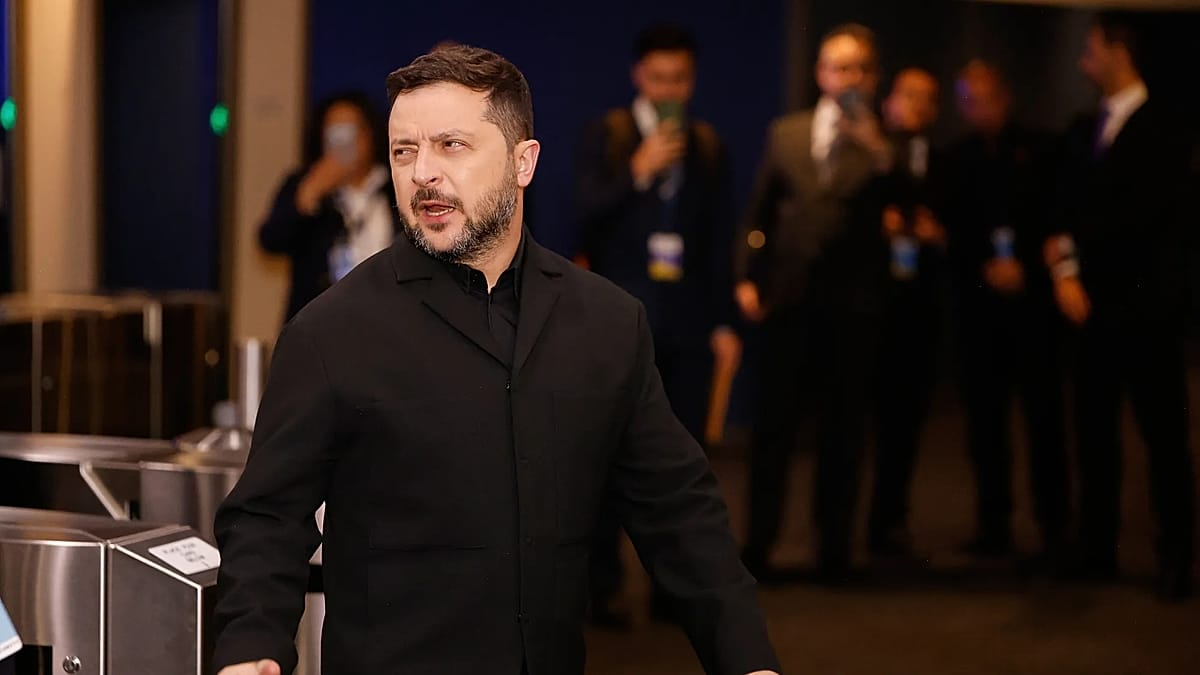
Ukrainian President Volodymyr Zelenskyy said Kyiv and Washington share a goal of ending Russia's war in Ukraine before the coldest months arrive, following a meeting with US President Donald Trump on the margins of the United Nations General Assembly in New York.
In a social media post, Zelenskyy described the encounter as "positive and productive" and said the two sides discussed "de-escalatory steps that can open up the way to diplomacy." He added that both countries "want to see this senseless Russian war ended before winter."
The Ukrainian leader also said the talks covered a winter air defence package for Ukraine, along with other bilateral and multilateral matters. The meeting came as European capitals watch Washington's posture on the conflict with a mixture of hope and unease, wary that any push for a rapid settlement could come at Ukraine's expense.
Winter strikes and the energy war
Moscow has pounded Ukrainian cities and regions since its full-scale invasion in February 2022, and has repeatedly concentrated fire on the country's power grid as temperatures fall. Those campaigns have left millions of Ukrainians facing blackouts, heating failures and disrupted water supplies during the winter.
Kyiv has responded with a deep-strike campaign aimed at Russia's oil sector, targeting refineries, terminals and depots in an effort to erode a central pillar of the Russian economy and the Kremlin's ability to sustain its war effort. Zelenskyy said that in the previous 24 hours, Ukrainian forces had hit one refinery in Bashkortostan and another in the Samara region.
Trump acknowledged the impact of those attacks, telling reporters alongside Zelenskyy that they had dealt "a very serious hit" to Russia but also "a serious hit on the price of diesel." In a post on his Truth Social platform, he said Russia had "unfortunately lost control of its diesel oil industry due to its war with Ukraine" and called for an end to what he termed a "ridiculous and never ending" conflict.
"A large number of their diesel refineries have been blown up and are, at least temporarily, out of commission," Trump wrote. "The whole world suffers as 25,000 people, mostly soldiers, are being killed each month. What a shame!"
Zelenskyy responded by saying Ukraine would be prepared to halt strikes on Russia's energy industry if Moscow agreed to reciprocal restraint — a conditional offer that leaves the ball in the Kremlin's court.
A diplomatic opening, with caveats
The New York meeting fits into a wider diplomatic push by Kyiv to keep its case before Western partners. Zelenskyy has been bringing a de-escalation plan to the UN while Russian and Ukrainian forces continue to trade deadly blows on the battlefield.
European governments have their own stakes in the outcome. The EU is weighing the renewal of sanctions on Russian oligarchs, and Zelenskyy has urged the EU to keep Usmanov and Fridman sanctioned as a key deadline approaches. Any signal from Washington that it favours a swift deal will be read closely in Paris, Berlin, Warsaw and the Baltic states, where leaders worry that pressure on Kyiv could weaken Europe's security architecture.
Trump's comments on diesel prices also touch a sensitive nerve in Europe, where fuel costs have fed inflation and political discontent. A sustained campaign against Russian refining capacity may hurt Moscow's revenues, but it also tightens global distillate markets — a trade-off that European finance ministries and central banks will be watching as winter demand rises.
For now, the immediate question is whether the talk of ending the war "before winter" translates into concrete movement. Zelenskyy's offer on energy strikes is conditional; Trump's language is impatient; and Moscow has given no indication it is ready to scale back. The coming weeks will show whether the New York meeting was a genuine opening or another round of positioning before the cold sets in.