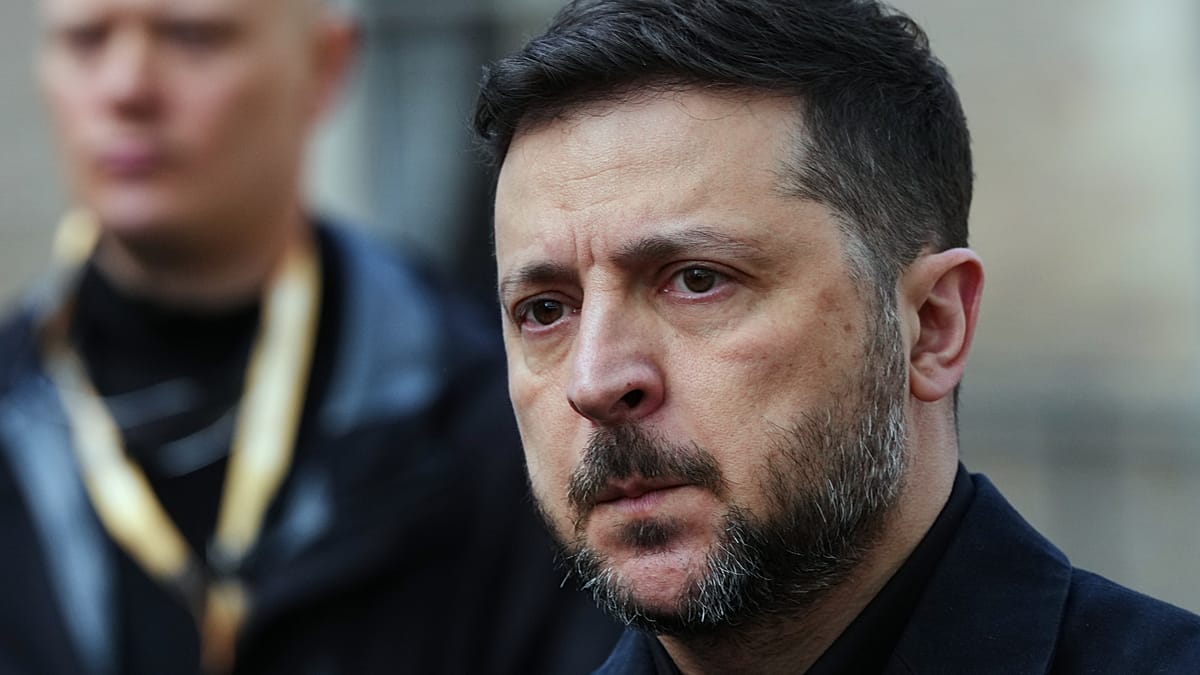
Ukrainian President Volodymyr Zelenskyy has accused Russia of rejecting diplomatic overtures by launching a barrage of attacks across the country, hours after Kyiv proposed a ceasefire. In an evening address on Wednesday, Zelenskyy declared that Ukraine would “respond in kind” to Russian aggression, signaling a potential escalation as Moscow prepares for its annual Victory Day parade.
“As of today, we see that Russia has responded to our proposal for a ceasefire only with new strikes and new attacks,” Zelenskyy said. “Depending on the situation tonight and tomorrow, we will also determine our entirely justified responses.”
The Ukrainian leader emphasized that the Kremlin had received a clear proposal for a ceasefire and diplomatic engagement, but that Moscow’s actions suggested a preference for conflict. “However, if that one person in Moscow, who cannot live without war, is interested in nothing but a parade and nothing else, that is a different matter,” he added, in a pointed reference to President Vladimir Putin.
Competing Ceasefire Proposals and Escalating Violence
Earlier this week, Russia announced a two-day “Victory Day truce” scheduled for 8-9 May, coinciding with the parade on Red Square. In response, Ukraine proposed its own ceasefire starting at midnight on 6 May, arguing that the earlier timeframe would test whether a genuine pause in hostilities was possible. However, within the first 10 hours of the Kyiv-proposed truce, Ukrainian authorities recorded 1,820 violations by Russian forces, including attacks on civilian infrastructure and drone strikes.
On Wednesday morning, a Russian strike hit a kindergarten in the northern Sumy region, killing two people. No children were present at the time, but the attack underscored the indiscriminate nature of the assault. The incident has drawn condemnation from European capitals, with leaders in Berlin, Paris, and Warsaw calling for renewed pressure on Moscow.
The competing ceasefire proposals highlight the deep mistrust between the two sides. While Russia’s truce was seen as a symbolic gesture tied to Victory Day, Ukraine’s offer aimed to create a window for humanitarian corridors and diplomatic talks. The failure of the Kyiv-proposed ceasefire now shifts attention to the Kremlin’s Victory Day parade, a key event in the Russian calendar that celebrates the end of World War II. Since 2022, the parade has been used to link the Soviet victory over Nazi Germany with the invasion of Ukraine, a narrative that has drawn criticism across Europe.
This year, the Kremlin has ordered a scaled-back version of the event, with no military hardware on display due to fears of Ukrainian strikes. Russian-installed occupation authorities in annexed Crimea have cancelled Victory Day celebrations altogether, citing “safety concerns.”
The situation has broader implications for European security. As Ukraine accuses Russia of breaking the ceasefire with drone and missile barrages, the EU and NATO are reassessing their support for Kyiv. The attack on the kindergarten in Sumy has particularly angered European officials, who see it as a violation of international humanitarian law.
Zelenskyy’s warning of retaliation raises the prospect of Ukrainian strikes on Russian targets, including those linked to the Victory Day parade. Ukraine has previously demonstrated its ability to hit deep inside Russian territory, and any such action could further escalate the conflict. Meanwhile, European diplomats are urging restraint, fearing a spiral of violence that could destabilize the region further.
The competing ceasefire proposals and the subsequent violations underscore the challenges of achieving peace in Ukraine. As the war enters its third year, the divide between Kyiv and Moscow remains vast, with each side accusing the other of bad faith. For European leaders, the priority is to maintain pressure on Russia while supporting Ukraine’s defense, a balancing act that grows more difficult with each new attack.