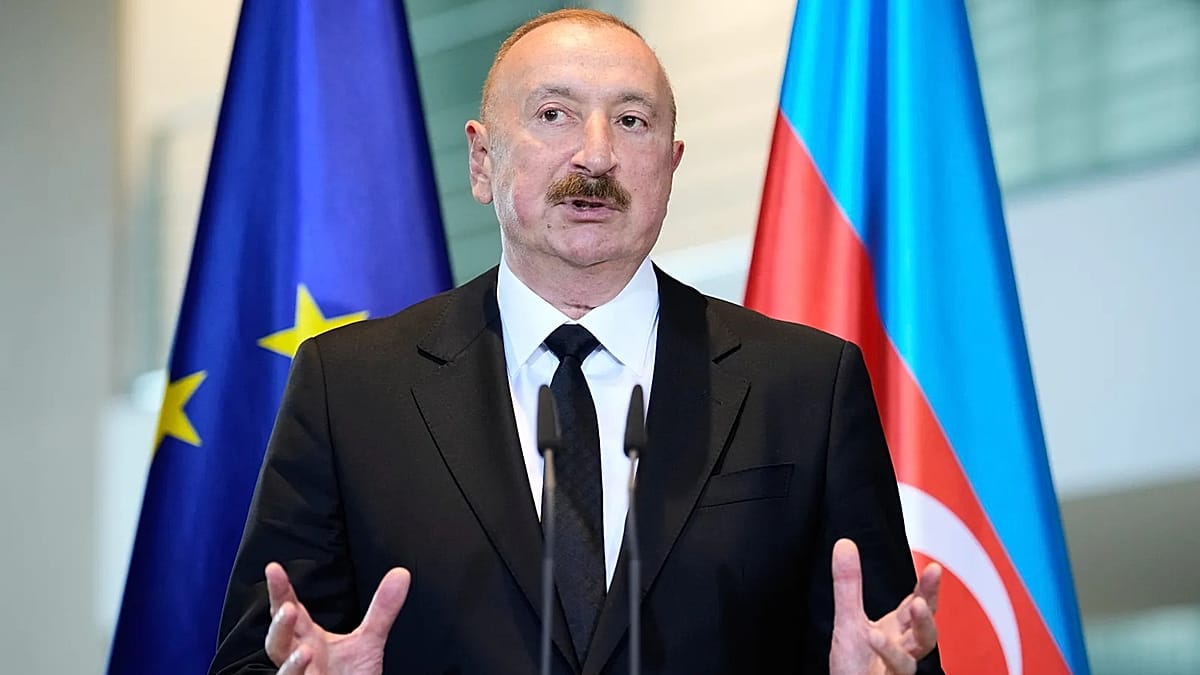
During a joint press conference with German Chancellor Friedrich Merz in Berlin on Tuesday, Azerbaijani President Ilham Aliyev revealed that former Russian and German officials had gathered in Baku in mid-July, likely to discuss Moscow's ongoing full-scale invasion of Ukraine. Aliyev stated that Baku was unaware of the meeting until after it occurred.
“The flights statistics provide grounds to suggest that such a secret meeting was held in Baku,” Aliyev said, adding that Azerbaijan “received no notification regarding this from either Germany or Russia.” He described the situation as “our territory was simply utilised without our knowledge.”
Despite the lack of transparency, Aliyev expressed conditional support: “If this meeting serves to end the Ukrainian–Russian war, we, of course, welcome it.”
Details of the Alleged Meeting
Aliyev said he ordered an investigation by the State Border Service following media reports. “I can inform you that this information was confirmed,” he explained, naming the participants. On 12 July, two German figures arrived in Baku on a Berlin–Baku flight and departed on 14 July: Ronald Pofalla and Matthias Platzeck.
Ronald Pofalla served as chief of staff to Chancellor Angela Merkel and Minister for Special Affairs from 2009 to 2013, later becoming CEO of Deutsche Bahn's infrastructure division. He co-chaired the Petersburg Dialogue, a semi-official German-Russian forum suspended by Germany after Russia's initial invasion of Ukraine in 2021. He has maintained informal contacts with Russian political figures and has been cited as a possible unofficial mediator.
Matthias Platzeck, a former Social Democrat Minister-President of Brandenburg, previously headed the Forum on Russo-German Cooperation and is known for advocating rapprochement between Germany and Russia.
On the same day, two Russian officials arrived from Moscow: former Prime Minister Viktor Zubkov and Valery Fadeyev, head of the Presidential Council for Civil Society and Human Rights. Zubkov, now chairman of Gazprom's board, has a long-standing relationship with President Vladimir Putin dating back to their time in St Petersburg. Fadeyev has led the advisory body since 2019, which has been used in diplomatic and back-channel contexts. Both are considered part of Putin's trusted inner circle.
German Chancellor's Response
Chancellor Merz said he had no information about the alleged meeting but noted that “for months, we have been trying to persuade President Putin to initiate negotiations.” He added that Putin has refused. “Ending this war rests solely with the Russian government and the Russian president. Entering into talks and, if necessary, starting peace negotiations depends solely on him,” Merz stated. “He continues to refuse to do so.”
Merz expressed gratitude to Aliyev for sharing a similar stance on the war, its causes, and its possible conclusion. Aliyev reiterated that “the war must be stopped immediately.”
The revelation comes amid broader diplomatic efforts, including recent developments such as Zelenskyy replacing Syrskyi with Drapatyi as Ukraine's commander-in-chief and ongoing tensions like Ukraine launching 400 drones at Moscow. The meeting in Baku also highlights the complex role of Azerbaijan, which recently signed a strategic energy and trade pact with Germany, as covered in Aliyev in Berlin: Germany and Azerbaijan Sign Strategic Energy and Trade Pact.