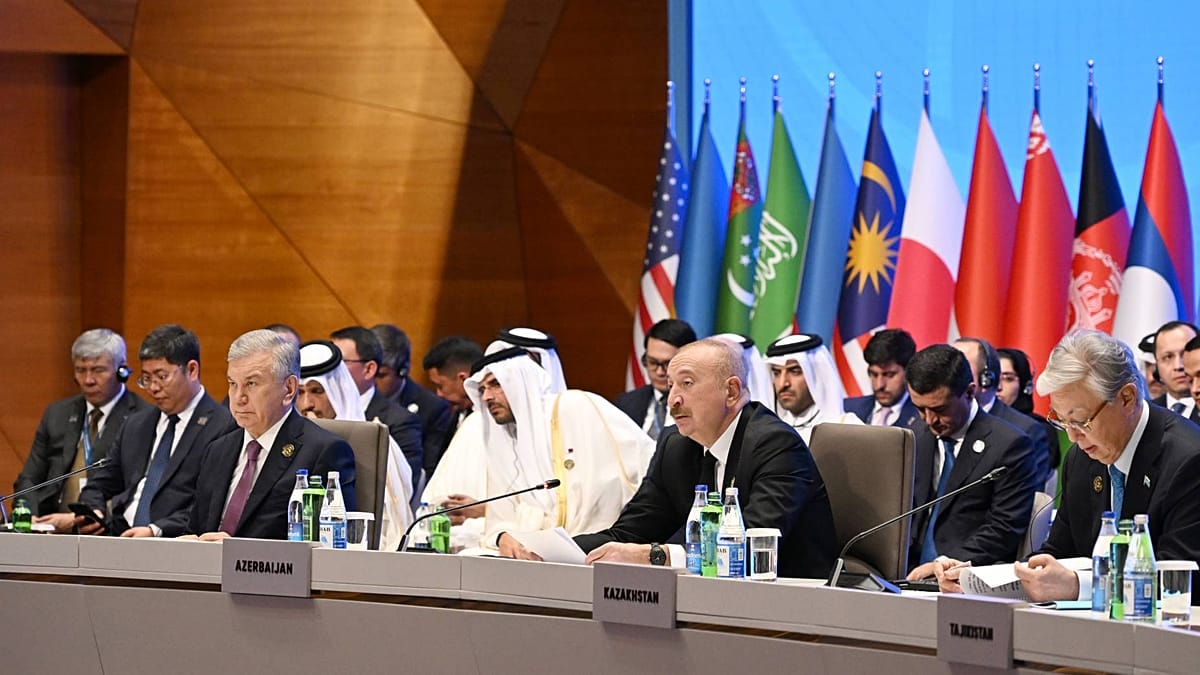
Azerbaijan convened an unusual gathering in Baku on Thursday, bringing together heads of state and government from across Asia and the Middle East whose countries are, in several cases, actively hostile to one another. The seventh summit of the Conference on Interaction and Confidence-Building Measures in Asia (CICA) was designed around the theme of trust, but the tensions were never far from the surface.
President Ilham Aliyev of Azerbaijan, whose country sits at the junction of the South Caucasus, the Caspian basin and the wider Eurasian landmass, used the occasion to cast Baku as a diplomatic and logistical hub. "Azerbaijan plays an increasingly important role as a connecting hub in the Eurasian space," he told delegates, according to the official account of the proceedings.
The guest list was striking for its breadth. Israel's President Isaac Herzog attended alongside Iran's Deputy Foreign Minister Kazem Gharibabadi. Turkey's Foreign Minister Hakan Fidan and Russia's Foreign Minister Sergey Lavrov were present, as were Qatar's Emir Sheikh Tamim bin Hamad Al-Thani and the UAE's Minister of State for Foreign Affairs, Khalifa bin Shaheen Al Marar. A Palestinian delegation was led by foreign minister Varsen Aghabekian Shahin. China's Foreign Minister Wang Yi joined the presidents of Uzbekistan, Kazakhstan, Kyrgyzstan and Tajikistan, along with representatives from Laos, Cambodia, Vietnam, India and Sri Lanka.
Walkouts and a Gulf presence
The most visible rupture came when Herzog rose to speak. Delegations from Turkey, Iran, Kuwait and Pakistan, among others, left the hall. The emir of Qatar and delegations from the United Arab Emirates and Bahrain remained in their seats — a detail that Herzog himself acknowledged, describing the presence of Bahraini and other Arab representatives as "at the center of our attention and commendable."
Herzog used his address to stress what he called "practical cooperation" on technology and water management, arguing that "thanks to cooperation, there is no place for boycotts." He met Aliyev and Kazakhstan's President Kassym-Jomart Tokayev on the margins, and held talks with Bahrain's Foreign Minister, Dr Abdul Latif bin Rashid Al Zayani, a rare encounter given the long-frozen state of relations between Manama and Tehran.
Al Zayani, speaking as a non-permanent member of the UN Security Council, called for the full implementation of Resolution 2317, co-sponsored by 136 states, and warned about the cumulative cost of disruption at sea. "Some 1,600 vessels have been held up, and more than 23,000 seafarers have been deprived of their freedom," he said, referring to the Strait of Hormuz and Bab el-Mandeb.
Corridors, cables and the Asian century
Beyond the Middle East file, the summit's economic agenda focused on the infrastructure that would bind Central Asia, the Caspian and Europe more tightly together. Tokayev proposed a CICA transport connectivity strategy and pointed to a strategic partnership document signed last year between Kazakhstan, Azerbaijan and Uzbekistan, which he said lays the groundwork for a Caspian green energy corridor feeding goods and services towards European markets via the Black Sea. He also noted that the arrangement would complement the existing Baku-Tbilisi-Ceyhan pipeline.
"The 21st century has already been called the Asian century," Tokayev said. "Whether it is called an era of peace or an era of separation and division, our responsibilities are still upon us."
Aliyev and Tokayev formally inaugurated a Trans-Caspian fibre-optic cable on the seabed of the Caspian, a project intended to speed digital traffic from China and Central Asia towards Europe. It forms part of the broader Middle Corridor trade route that Brussels and several member states have been watching closely as an alternative to routes through Russia.
Uzbekistan's President Shavkat Mirziyoyev called for what he described as "an infrastructure of trust in Asia," built on transport and energy projects that would make future conflict less likely. "When dialogue weakens, the risk of wrong decisions being made increases," he said. "We must strive to ensure that political disagreements do not turn into armed confrontations."
Kyrgyzstan's President Sadyr Japarov cited UN figures suggesting that 59% of global economic development this year will fall to Asia's share, while warning that international conflicts, technological change and climate risk are all accelerating. Vietnam's Vice President Võ Thị Ánh Xuân urged closer coordination between CICA, ASEAN and other regional bodies, arguing for stronger links between Southeast Asia, Central Asia and the wider Eurasian space.
For European capitals, the significance of the Baku meeting lies less in any binding outcome than in the direction of travel. The gathering of rival delegations under one roof signals that Azerbaijan, Kazakhstan and Uzbekistan are positioning themselves as brokers and transit states at a moment when the EU is rethinking its own energy, trade and connectivity map. Whether that translates into durable arrangements — or remains a diplomatic showcase — is the question officials in Brussels, Berlin and Paris will be asking in the months ahead.