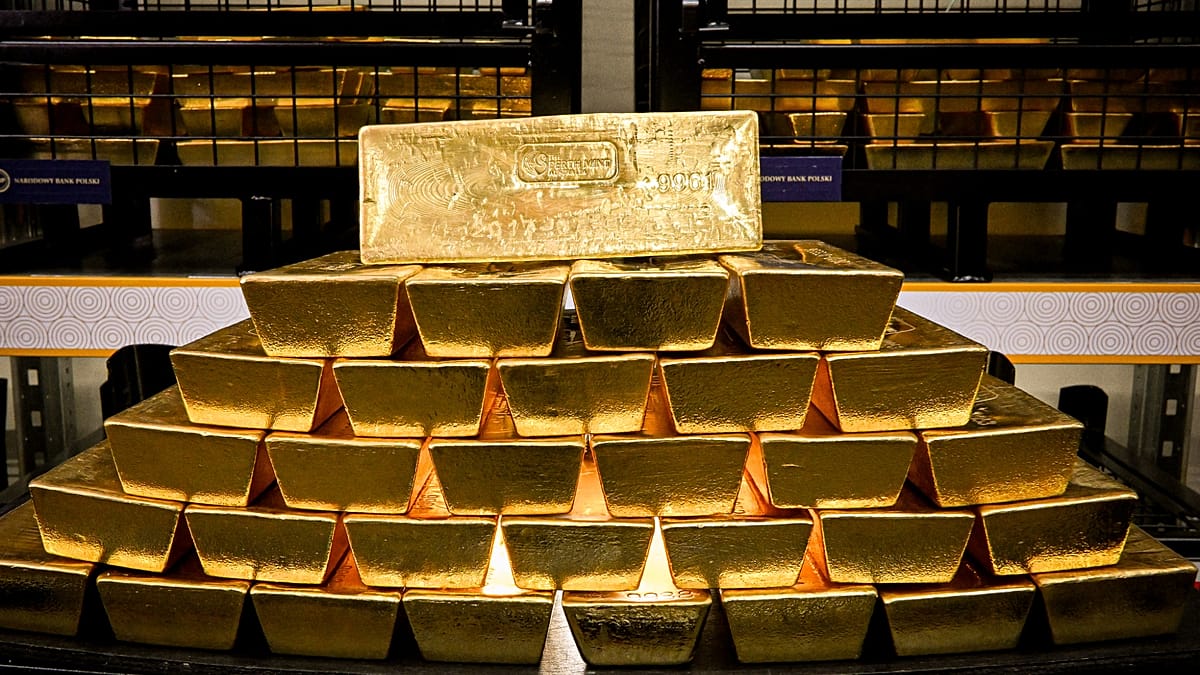
Central banks are moving in opposite directions on gold. Russia and Kazakhstan have been reducing their holdings, while Poland and China are adding to theirs. The reshuffle raises questions about what it means for the metal's price and for individual investors.
Russia's steady sell-off
Russia has been offloading gold throughout 2026. In September alone, its reserves fell by roughly 6.2 tonnes, bringing the total reduction since January to about 62 tonnes. The only comparable episode in modern Russian history came in 1998, when Moscow sold 118 tonnes in just three months.
According to Adam Stroniawski, managing director of Polish precious metals dealer Mennica Skarbowa, the motivation is clear: "Russia has a serious budget shortfall because of its war in Ukraine and wants to inject more funds into the defence sector." He notes that the sales are happening outside the London bullion market, with Hong Kong as the main destination. "The sell-off of reserves will take place in Hong Kong, and the main buyer is China's central bank," he told European Pulse.
Hong Kong trade data support this: from January to July, around 100 tonnes of Russian gold arrived in the city, nearly three times the volume in the same period last year. Stroniawski believes these transactions will have a negligible impact on the global gold price, given their scale and the fact that they are largely bilateral.
He does not rule out Russia returning to the buying side later, as it did after the 1998 sell-off.
Kazakhstan takes profits
Days before the Russian central bank published its data, Kazakhstan announced plans to reduce its gold holdings. The country, which spans Europe and Asia, was among the world's biggest buyers of bullion in the first eight months of 2026. Now it intends to lower the share of gold in its total reserves to 75% by the end of the year, from roughly 78%.
"The liquidation of part of Kazakhstan's gold-denominated foreign reserves may seem surprising, because for years the country was one of the biggest buyers of bullion," said Stroniawski. He attributes the move to a need to plug a budget deficit or simply to take profits after years of accumulation. "Kazakhstan has been buying gold for a long time, so it will now be selling at a significant profit," he added.
The scale of the reduction is modest, and sales will be spread over time, so Stroniawski expects little impact on global markets.
Will Poland follow?
The shifts in Moscow and Astana raise the question of whether other central banks, particularly Poland, might start selling. Poland has significantly increased its gold reserves in recent years and could theoretically cash in while prices are high. But Stroniawski considers that unlikely.
"This stems from internal factors, with government policy and central bank policy moving in different directions. In this parliamentary term it is unlikely that reserves will be liquidated," he said.
The National Bank of Poland has been a consistent buyer, and its reserves are close to the target of 700 tonnes. Stroniawski argues that reaching that level would not mark the end of purchases. "At present, with its level of gold reserves, Poland ranks 10th in the world. In my opinion, reaching 700 tonnes will only be one stage. It does not mean the end of purchases or the start of a sell-off," he said.
Large gold holdings, he notes, improve a country's credit standing and help stabilise its currency.
Gold price outlook
For individual investors, the recent price weakness may prompt profit-taking. Gold rose 25.5% in 2024 and 67.4% in 2025 in US dollar terms, according to the World Gold Council, but fell 4.4% in the first nine months of 2026.
Stroniawski sees these corrections as temporary. "At the moment, many investors who bought gold a few years ago may be thinking about taking profits," he said, but he believes the long-term trend remains upward. Central bank buying and demand for gold as a safe haven and reserve asset should continue to support prices.
He added: "I wouldn't assume it will ever be cheaper."
For context, the broader geopolitical backdrop remains tense, with renewed Russian strikes on Ukraine and espionage arrests in Germany adding to uncertainty. Meanwhile, lab-made gold is emerging as a potential long-term challenge to traditional bullion markets.