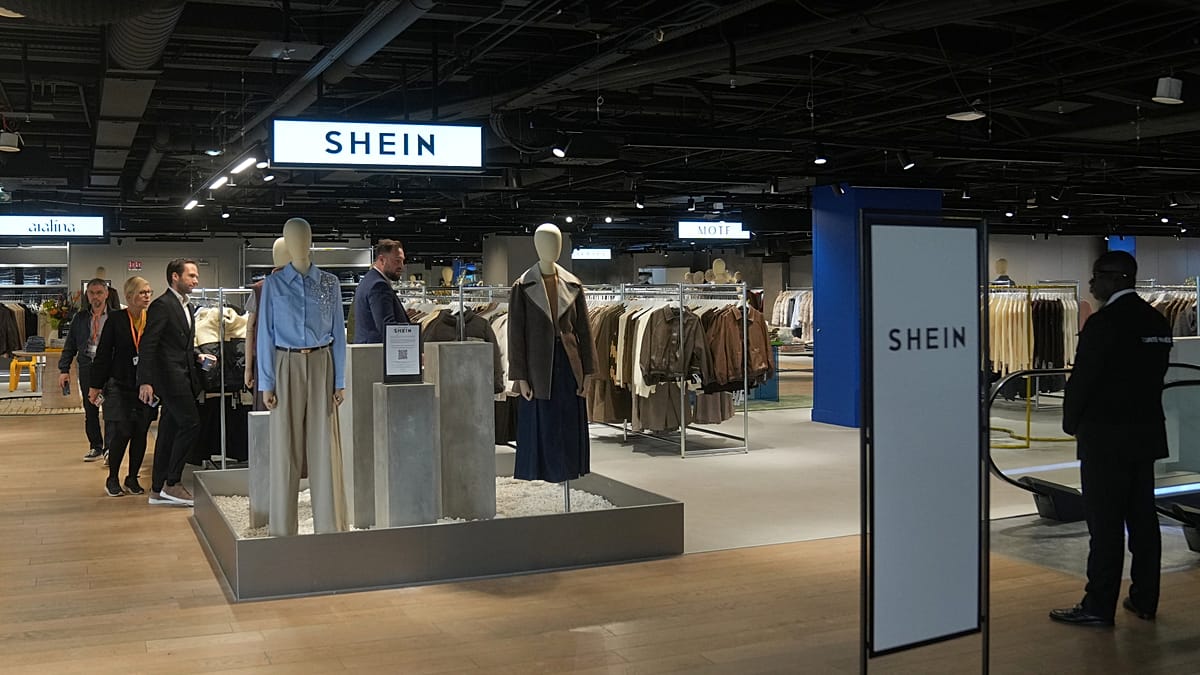
Beijing has formally called on Paris to withdraw a newly enacted environmental levy on ultra-fast fashion, warning that failure to do so could trigger unspecified retaliatory measures against French interests. The demand, voiced by China's commerce ministry on Thursday, escalates a trade dispute that pits France's push for greener textiles against the commercial ambitions of Chinese-owned e-commerce platforms.
The French law, which took effect on Tuesday, imposes a sliding fee on producers of clothing, footwear, and household linen sold through business models defined as ultra-fast fashion. Charges start at €0.25 per item in 2026 and can rise to €12, with a maximum of €20 per item from 2030. The measure is designed to curb the environmental toll of rapidly produced, low-cost garments and to shield France's domestic apparel industry from an influx of cheap imports.
Commerce ministry spokeswoman Huang Ling told a press conference in Beijing that China was "strongly dissatisfied" with the French decision. She argued that the law applies environmental and sustainability standards in a way that creates double standards and may violate World Trade Organization rules on non-discrimination. "China urges France to immediately halt the implementation of the anti-ultra-fast-fashion law," Huang said.
She added that if France insists on proceeding, "China will take necessary measures to safeguard the legitimate rights and interests of Chinese enterprises," and warned that "France will bear all consequences arising from this." The threat of retaliation, though unspecified, signals that Beijing views the levy as a direct challenge to its e-commerce champions.
How the French law works
The legislation defines ultra-fast fashion using two criteria: the number of new product introductions a company makes and whether its business model encourages repair over replacement. Products are scored on both, and the per-item fee is set accordingly. The charge is levied on producers, not consumers, though companies may pass some or all of the cost on through higher prices.
The law targets major online retailers such as Shein, Temu, and AliExpress, all of which rely on vast catalogs and rapid turnover. French lawmakers have argued that these platforms generate disproportionate waste and undercut local brands that follow stricter environmental standards. The measure is part of a broader European effort to make fashion more circular, though critics note that global apparel emissions continue to rise despite such initiatives.
China's response fits a pattern of friction over trade and environmental rules. The EU has been pushing for tougher scrutiny of Chinese goods, and Brussels has set an October deadline for Beijing to deliver concrete results on market access and trade imbalances. France's levy is a unilateral move, but it aligns with the EU's broader strategy to hold foreign producers accountable for their environmental footprint.
Shein, one of the primary targets, made a subdued debut on the Hong Kong Stock Exchange on Tuesday, after earlier plans to list in New York and London stalled amid scrutiny of its Chinese supply chains. The retailer moved its headquarters from China to Singapore in 2022, a step widely seen as an attempt to distance itself from growing international criticism of Chinese business practices. The new French levy adds another layer of pressure on its European operations.
Diplomatic observers note that China's threat of retaliation could take various forms, from tariffs on French luxury goods to restrictions on French agricultural exports. France, for its part, has shown little inclination to back down, with officials framing the law as a necessary environmental measure rather than a trade barrier. The dispute is likely to feature in upcoming EU-China trade talks, where critical minerals and supply chain security are already contentious topics.
For European consumers, the immediate impact may be higher prices on ultra-fast fashion items as companies adjust to the new fees. But the broader stakes are about who sets the rules for global e-commerce and environmental standards. As the EU and China jostle for influence, France's levy could become a test case for how far member states can go in regulating foreign digital platforms.