As tensions in the Middle East continue to disrupt global energy markets—with over 10 million barrels of oil per day held up in the Strait of Hormuz—the urgency of reducing Europe's dependence on imported fossil fuels has never been more apparent. Against this backdrop, a new international conference convening in Santa Marta, Colombia, from 24 to 29 April, is being hailed as a potential turning point.
Co-sponsored by Colombia and the Netherlands, the First International Conference on the Just Transition Away from Fossil Fuels brings together government representatives from nearly 50 countries, including a strong European contingent: Germany, Austria, Belgium, Denmark, Slovenia, Spain, Finland, France, Ireland, Italy, Luxembourg, the Netherlands, Portugal, Sweden, Switzerland, Norway, and Türkiye. Notably absent are the United States and Saudi Arabia, two of the world's largest oil producers, underscoring the deep divisions over the pace of decarbonisation.
Beyond COP: A New Model for Climate Diplomacy
The conference is designed to overcome the paralysis that has long plagued annual UN climate summits. At COP30 in 2025, more than 85 countries—including Germany, France, Spain, and the United Kingdom—called for a roadmap to phase out fossil fuels, but the final text did not even mention the words “fossil fuels.” The Santa Marta meeting aims to start drawing up that roadmap, using majority voting rather than the UN's consensus rule, which has allowed a handful of petrostates to block progress.
“We are opening a space for discussion that does not exist,” said Colombia’s environment minister Irene Vélez Torres ahead of the talks. Organisers stress that the conference is not a formal negotiating body and does not replace the UN Framework Convention on Climate Change (UNFCCC), but it offers a more agile forum for actionable solutions.
Just Transition: Protecting Workers and Communities
A central theme of the summit is ensuring that the shift away from fossil fuels is socially and economically just. Organisers define a just transition as one that does not cause “adverse impacts in terms of employment, macroeconomic stability, or energy security.” This is particularly relevant for European nations that still rely on coal regions—such as Poland’s Silesia or Germany’s Ruhr—and for countries like Angola, Brazil, and Vietnam whose economies are heavily dependent on oil, coal, or gas exports.
“Oil prices don’t just stay in energy markets—they move straight into people’s lives,” warned Mary Robinson, former president of Ireland and a leading climate justice advocate. She noted that the impacts of volatile fossil fuel prices hit the most vulnerable hardest, a lesson Europe has learned painfully during recent energy crises.
One key area of discussion will be how to phase out the $7 trillion (€5.9 trillion) in annual global fossil fuel subsidies without punishing communities and workers. Indigenous leaders are also pushing for the creation of fossil-free zones—designated areas off-limits to extraction, particularly in ecologically sensitive regions.
European Implications and the Road Ahead
For Europe, the stakes are high. The continent has already seen renewables slash electricity prices by 25%, but the transition remains uneven. The Santa Marta conference could accelerate efforts to diversify energy sources and reduce reliance on unstable regions. The Netherlands’ Deputy Prime Minister and Minister for Climate Policy and Green Growth, Sophie Hermans, said: “There is a clear momentum to phase out fossil fuels, and now is the time to capitalise on it.”
The summit also comes amid a broader push to move climate diplomacy beyond emissions targets and toward directly confronting fossil fuel production—a politically sensitive issue that has long divided countries. The European Commission has signalled support for such an approach, and several EU member states are already exploring bilateral agreements to accelerate the phase-out.
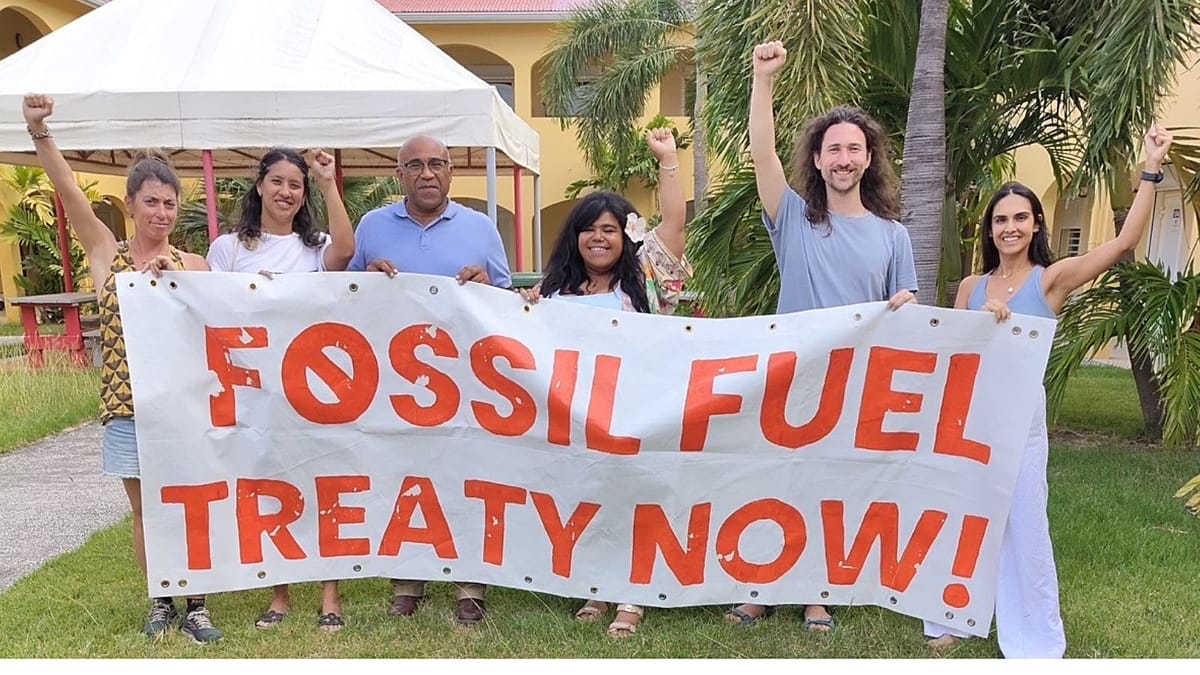
Meanwhile, the Climate Justice Flotilla, organised by groups including Extinction Rebellion and the Fossil Fuel Treaty, is sailing to Santa Marta with stops in Bonaire, Aruba, and Curaçao. The flotilla’s journey highlights a landmark ruling in January 2026 by the District Court of The Hague, which found that the Netherlands is violating the human rights of Bonaire residents by failing to protect them from the climate crisis.
As the conference gets underway, the question remains whether this new forum can deliver where COPs have failed. With majority voting and a focus on concrete, actionable steps, the Santa Marta meeting may offer a ray of hope for a continent—and a world—still heavily dependent on fossil fuels.