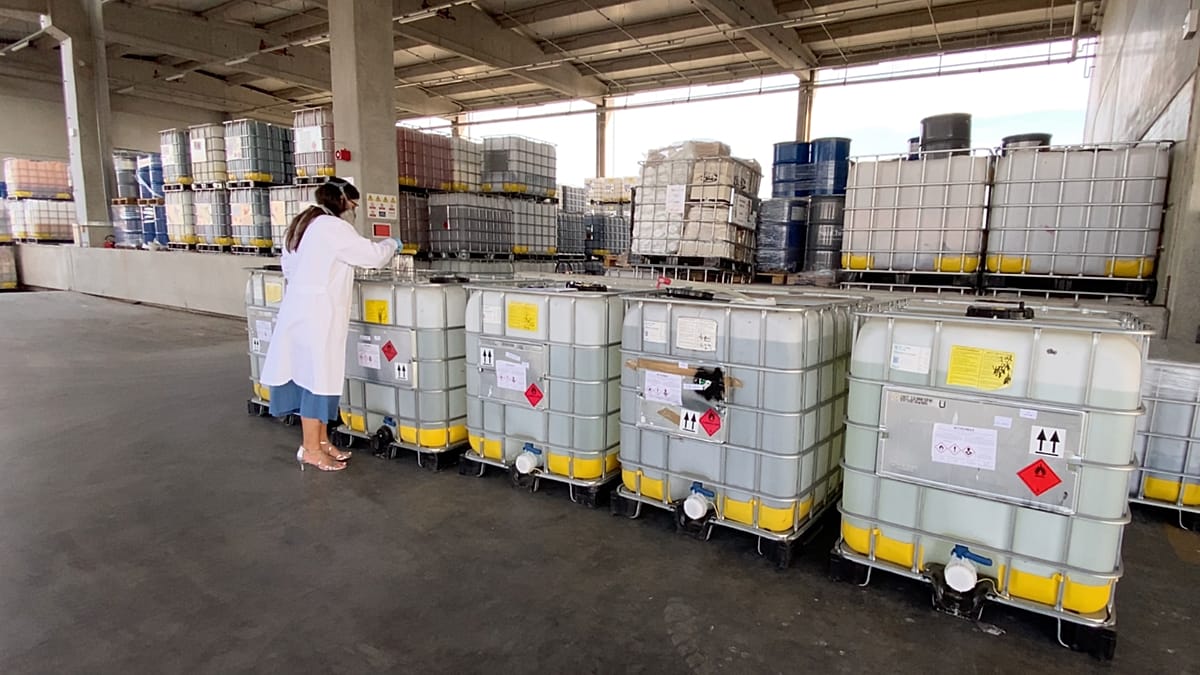
In the small Croatian town of Ivanić-Grad, about 30 kilometres southeast of Zagreb, a clean-tech company is quietly demonstrating what a truly circular economy can look like. Premifab Ltd, a family-owned firm, has developed a process that recycles around three million kilograms of contaminated industrial solvents every year — and claims to do so without generating any waste.
The solvents — ethanol, benzene, acetone, and paint thinners — arrive from across Europe, sent by clients in the food packaging, pharmaceutical, and automotive industries. They are heavily polluted with hazardous substances, making them unfit for further use. But inside the plant, a complex distillation process strips away impurities, returning the solvents to a purity that allows them to be reused in the same production lines.
“This is the contaminated solvent that we are taking from the machine and into the distillator. We are distilling it, and for the result we are getting the clean solvent that is used to further production. Clean as a whistle,” says Mario Želježnjak, Production Supervisor at Premifab, as he guides visitors through the recently inaugurated facility.
A closed loop with no waste
The distillation process leaves behind a sludge containing water and other residues. Rather than disposing of it, Premifab burns this material in a rotary kiln. The heat generated powers the recycling equipment, and the resulting ash is sold as a construction material. “Everything is burned inside a rotary kiln and turned into harmless ash,” explains Želježnjak.
This approach aligns with the broader push for circular economy models across Europe, where waste is increasingly seen as a resource rather than a problem. The company’s claim of a 90% recycling rate for the contaminated raw material it receives is impressive, especially given the stiff competition from larger players in Germany, France, Spain, and Italy.
Igor Podravac, Business Development Director, stresses that efficiency and versatility are key to staying competitive. “We have a lot of high demanding customers from pharmaceutical, automotive, paint industry, food packaging industry also. After they pollute a material and it is no longer usable for a second treatment, they send this material to us,” he says. “We are accepting the material, analysing the material, purifying the material and after all the parameters are checked, we return that material into the same production line to get a closed loop circular economy in real life.”
The process begins in the company’s laboratory, where samples of used solvents are analysed to determine if recycling is technically and economically feasible. Silvija Petković, Quality Control Director & Laboratory Manager, explains the challenges: “Maybe the distillation yield is too low, so it's not really feasible, both material-wise and financial-wise. And on the other hand, if we have lots of distillation residue remaining, that we cannot do anything about it, we opt not to use that material at all.”
Safety is paramount, given the flammable nature of the chemicals. “The specificity within the solvents is their flammability. So they're all flammable liquids, and we need to take all the precautionary measures in order not to burn anything, not to light anything up,” Petković adds.
After distillation, quality control checks are repeated before the clean solvents are shipped back to clients. Petković demonstrates the process with two samples: one with precipitation, which fails inspection and requires further filtration, and another that is clear and ready for dispatch. “This one is okay, no precipitation, whatsoever. It can be closed and sealed and put into the truck,” she says.
Transporting these recovered solvents is a specialised task. Nikola Gojavić, a driver at Premifab, explains the risks: “This cargo is unique because it’s in a liquid state and is highly explosive. Great care is required during loading and transport, so specialised drivers are needed—it’s quite a challenging job.” He adds that in the event of an accident, the driver must remain composed and follow strict procedures.
One of Premifab’s clients is Rotoplast, a family business in Croatia that produces around 5,000 tonnes of packaging and labelling annually for the food, energy, and pet product industries. The company uses solvents to dissolve inks in its printing processes. Production Director Antun Čengić highlights the environmental and economic benefits: “It is important to us that our products, along with being highly effective from a production point of view, are also environmentally sustainable. In cooperation with Premifab, we collect all our waste in a safe way, we transport it to their location, so that they can process it and return it to us as a new resource. With this, we reduce the costs of production.”
Rotoplast, founded in 1975, employs 260 staff and is one of many European manufacturers embracing waste-reduction strategies. The EU has been pushing for greater resource efficiency, and initiatives like Premifab’s are part of a broader trend. The company received partial EU funding, underscoring the bloc’s support for innovative recycling technologies.
While the concept of a zero-waste chemical recycling plant may sound futuristic, Premifab is proving it can work at scale. As Europe seeks to reduce its reliance on virgin materials and cut industrial emissions, such closed-loop systems could become more common. The challenge lies in scaling up and ensuring economic viability, but Premifab’s success suggests that green industry can be competitive.
For now, the plant in Ivanić-Grad stands as a model of how hazardous waste can be transformed into valuable resources, offering a second life to chemicals that would otherwise pose a threat to the environment.