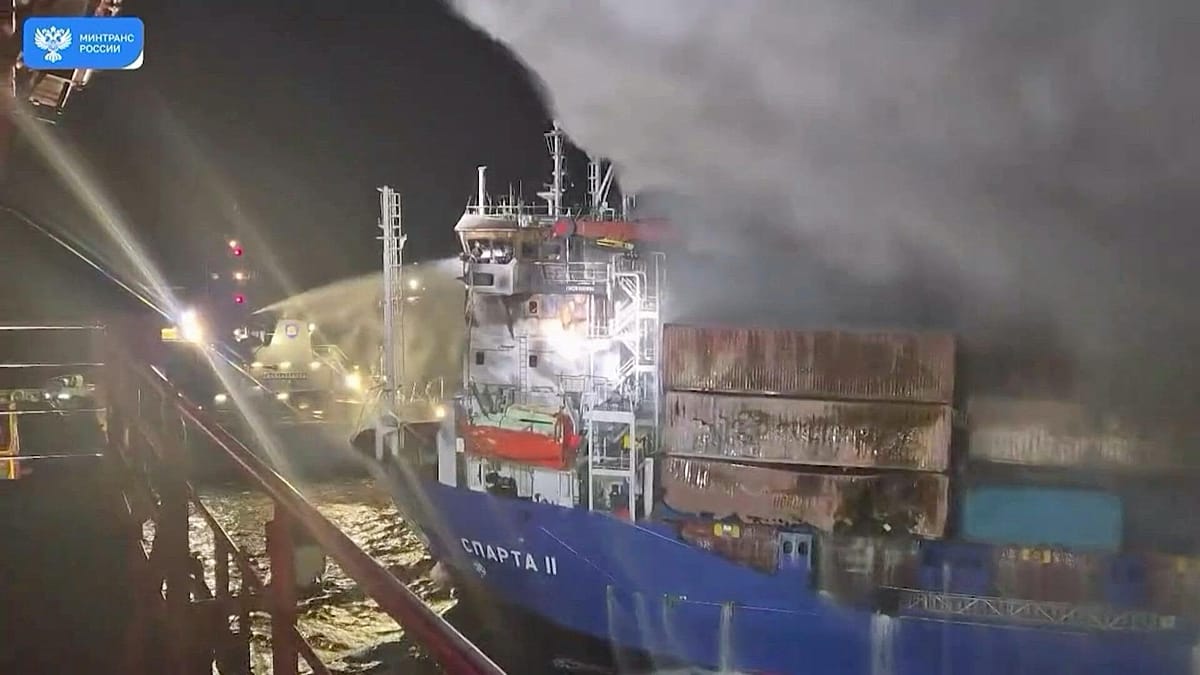
A Russian cargo vessel damaged in a drone attack in the Gulf of Finland has been towed back to Russian waters, according to images released by Russia's Transport Ministry on Monday. The ship, identified as the Sparta II, was struck on Saturday, 21 November, while en route to the Russian exclave of Kaliningrad.
The attack ignited a fire on board and forced the evacuation of all 16 crew members. Finnish military officials have indicated that Ukraine was likely responsible, although Kyiv has not publicly claimed the operation. The vessel drifted into Finnish waters after the strike, prompting a coordinated response involving Finnish, Estonian, and Russian rescue teams.
Fire contained, vessel returned
Rescue crews managed to bring the blaze under control before the ship was towed away. Russia's Transport Ministry said water was sprayed over the damaged vessel to prevent the fire from reigniting. The ship subsequently returned to the Saint Petersburg area.
The Sparta II has been linked to Russia's military logistics network and is under both US and Ukrainian sanctions. Its cargo at the time of the attack has not been publicly confirmed, but the incident underscores the ongoing vulnerability of Russian maritime assets in the Baltic region.
The attack comes amid a broader pattern of Ukrainian drone strikes targeting Russian infrastructure and shipping. In a related development, Russian drones killed seven people across Ukraine as Kyiv struck three refineries, highlighting the continued intensity of the conflict.
The Gulf of Finland incident also raises concerns about the safety of commercial shipping in the Baltic, a vital waterway for trade and energy supplies. The European Union has repeatedly condemned Russian military actions and has been working to bolster maritime security. The EU energy chief has stated that Russian gas is gone for good, regardless of US-Russia talks, underscoring the bloc's shift away from Russian energy dependence.
Finland, which joined NATO in 2023, has been increasingly vigilant about Russian activities in the region. The Finnish military's assessment that Ukraine was behind the attack reflects the complex geopolitical dynamics at play. While Kyiv has not claimed responsibility, the incident fits a pattern of Ukrainian strikes aimed at disrupting Russian logistics and supply lines.
The Sparta II is not the only vessel to have faced trouble in European waters recently. A separate incident saw a grounded cargo ship refloated off France's Atlantic coast, though that was unrelated to military action.
As the war in Ukraine continues, attacks on Russian shipping and infrastructure are likely to persist, with potential consequences for regional stability and maritime safety. The European Union has been exploring ways to counter Russian influence, with some politicians arguing that faster EU enlargement is key to countering Russian influence.
The incident also highlights the broader security challenges facing the Baltic Sea region, which has seen increased military activity and sabotage attempts. The UK recently issued a fresh warning to defence firms over Russian sabotage, reflecting growing concerns about hybrid threats.
For now, the Sparta II is back in Russian waters, but the questions surrounding the attack and its implications for maritime security remain unresolved.



