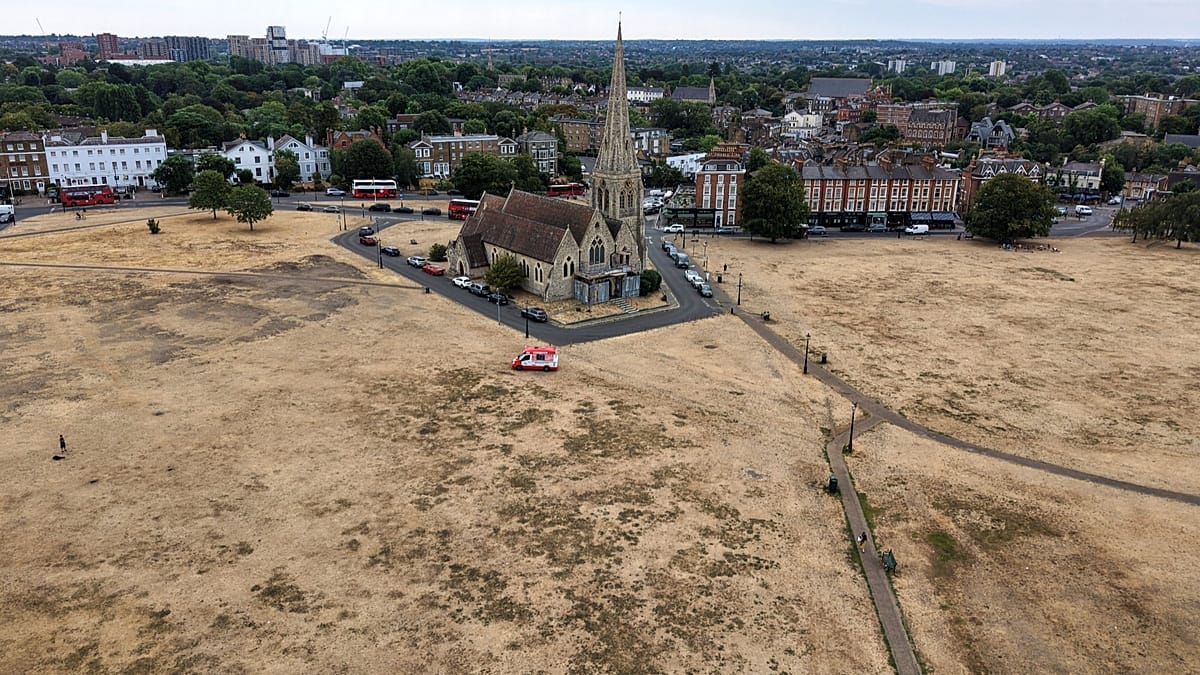
London — England is now officially in drought across 71.3% of its territory, the UK government confirmed on Monday, as the country endures its driest July on record and braces for a fifth heatwave of the summer. The announcement from the Department for Environment, Food and Rural Affairs (DEFRA) follows weeks of scorching temperatures and scant rainfall that have left once-green landscapes parched and yellow.
According to AFP photographs, parks and fields that would normally be lush at this time of year are now dry and brittle. River levels have dropped dramatically, and farmers are warning of potential food shortages as crop yields suffer. The dry spell has hit the central Midlands and northeast England particularly hard, joining other regions already classified as drought-affected.
“Almost three-quarters of England is now in drought as conditions worsen following a dry start to August,” DEFRA said in a statement. The department added that “all regions of the country are experiencing pressure on their water resources,” with no area of the UK currently enjoying a “normal” status.
DEFRA described the situation as a “flash drought” — a rapid-onset phenomenon driven by extremely low rainfall and high temperatures, rather than a slow-building water deficit. This is the third drought England has experienced in five years, a stark reminder of how climate change is altering the country’s traditionally wet and unpredictable weather patterns.
A record-breaking dry spell
The UK’s Met Office confirmed that England and Wales both recorded their driest July since records began in 1836, with England receiving just 10% of its long-term average rainfall for the month. The lack of precipitation has been compounded by successive heatwaves, with temperatures expected to reach the mid-30s Celsius in some areas in the coming days.
“There are warnings of more dry weather and another heatwave on the way, with temperatures tipped to reach the mid-30s in some places,” DEFRA warned. The government has responded by imposing irrigation restrictions on farmers and introducing hosepipe bans in several regions, affecting more than 27 million people. Official figures show that 45 million people — roughly two-thirds of the UK’s 69.3 million population — now live in drought-affected areas.
The crisis is not confined to England. Across Europe, similar conditions are unfolding. England and Wales’s record dry July is part of a broader pattern of extreme weather that scientists link to climate change, which is making heatwaves and droughts more frequent and intense.
In other parts of the continent, the drought is exposing long-submerged relics and disrupting energy production. Europe’s drought has revealed hunger stones, Nazi warships, and mammoth bones in rivers and lakes, while hydropower generation has hit record lows, forcing countries to rely more heavily on fossil fuels. In Poland, the Vistula River’s falling levels have exposed the fragility of coal-fired power plants that depend on river water for cooling.
As the UK grapples with its own water crisis, the government faces mounting pressure to address long-term resilience. Critics argue that decades of underinvestment in water infrastructure and leakage-prone pipes have left the country ill-prepared for a changing climate. Meanwhile, farmers in regions like Alsace are already adapting by shifting to drought-resistant crops, a model that British agriculture may need to consider.
The immediate outlook offers little relief. Forecasters predict the heatwave will persist, with no significant rainfall expected in the coming week. For millions of residents, the hosepipe bans and irrigation limits are a stark reminder that water, once taken for granted, is becoming an increasingly precious resource.