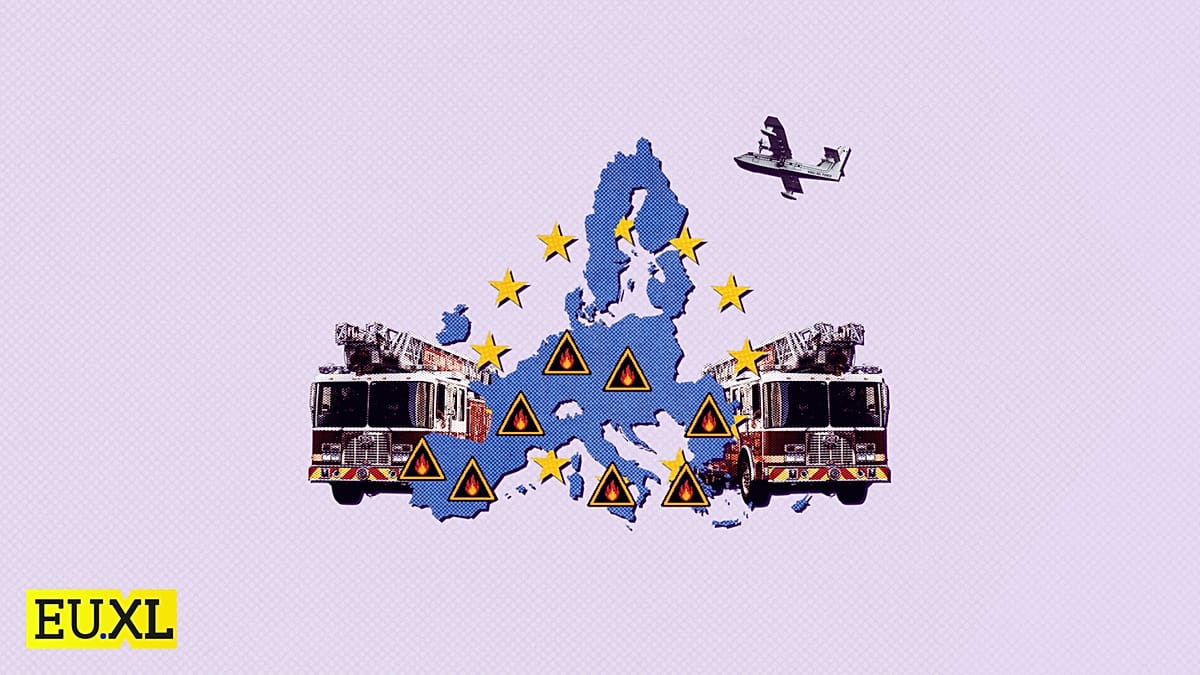
As flames consume forests from the Algarve to the Peloponnese, the European Union has rolled out its most extensive joint firefighting operation to date. But the scale of the emergency response is also drawing attention to a persistent weakness: the bloc's ability to prevent wildfires before they start.
This summer, Portugal and France triggered the EU Civil Protection Mechanism, which coordinates cross-border assistance. France received four rescEU firefighting planes from Sweden and Cyprus, while Portugal was reinforced with 118 firefighters and 45 vehicles from Spain, plus three rescEU aircraft from Italy and Spain. The deployments mark the highest participation since the programme was established in 2022, with 777 firefighters from 14 countries, 22 planes, and 5 helicopters pre-positioned before the fires broke out.
“We have regular wake-up calls, but this one is the biggest since a couple of years,” said Hadja Lahbib, the European Commissioner for Equality, Preparedness and Crisis Management. “Europe stands together.” Her words underscore the solidarity that defines the EU's emergency response, yet they also hint at a recurring pattern: the bloc reacts with impressive force but struggles to invest in long-term resilience.
Record numbers, but a worrying trend
According to the European Forest Fire Information System (EFFIS), the EU had recorded 1,407 wildfires by 30 July 2026, burning nearly 435,000 hectares and releasing an estimated 17.98 million tonnes of CO₂. While this is below last year's record season, it remains above the 20-year average. Forecasters warn that the danger is far from over, with “very extreme conditions” flagged across Portugal, Spain, France, Italy and Greece.
The numbers highlight a paradox: the EU's firefighting capacity has grown significantly, but the underlying drivers of wildfires—climate change, land abandonment, and the accumulation of flammable vegetation—are intensifying. As EU wildfire tools come under strain, the gap between emergency response and prevention becomes harder to ignore.
Prevention involves measures such as controlled burns, grazing, and creating firebreaks, but these require sustained funding and political will. In many southern European regions, rural depopulation has left vast areas of forest unmanaged, turning them into tinderboxes. The EU's Common Agricultural Policy and rural development funds could support such efforts, but critics argue they are not being used effectively.
Some innovative approaches are emerging. In Spain, European bison are being reintroduced to help manage forest undergrowth and reduce fire risk. Similarly, regenerative farming practices are being tested as a way to make landscapes more resilient. These projects remain small-scale, however, and are not yet integrated into a comprehensive EU strategy.
The European Commission acknowledges the challenge. “We need to move from a culture of reaction to a culture of prevention,” said a spokesperson for the Directorate-General for European Civil Protection and Humanitarian Aid Operations. But translating that rhetoric into action has proven difficult, as member states retain primary responsibility for land management and firefighting.
The recent fires in Greece, where crews gained the upper hand on an Athens wildfire as winds eased, show that even with better coordination, the margin for error is thin. The EU's rescEU fleet, which includes planes and helicopters, is a valuable asset, but it is not a substitute for reducing the fuel that feeds these fires.
As the climate continues to warm, the frequency and intensity of wildfires are expected to rise. The EU's response this summer is a testament to what can be achieved through solidarity, but it also raises a fundamental question: is the bloc investing enough in the prevention that could make such massive deployments unnecessary?
For now, the focus remains on extinguishing the flames. But as the smoke clears, the debate over Europe's wildfire strategy is only beginning.