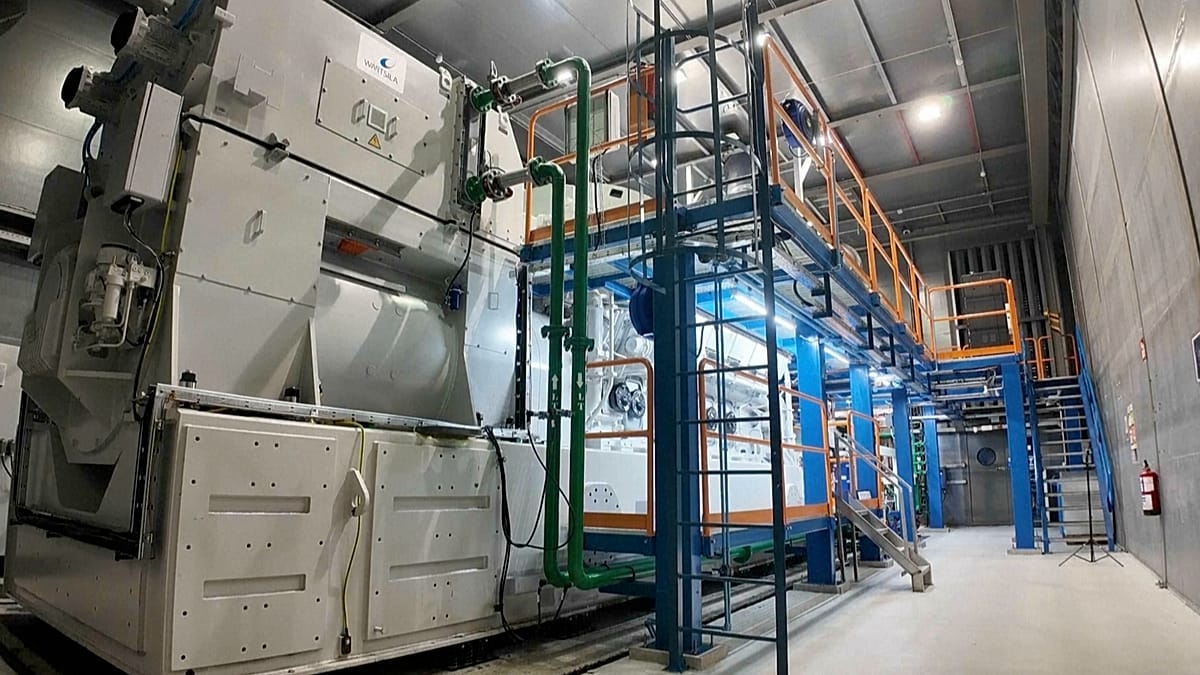
Finnish energy technology group Wärtsilä has achieved what it calls a world first: a large-scale hydrogen-powered engine that has successfully fed electricity into Spain's national grid. The test, conducted at the company's facility in northern Spain, marks a significant step in the search for carbon-free backup power for renewable energy systems.
The engine runs entirely on hydrogen and is designed to address one of the most persistent challenges of wind and solar power: intermittency. When the sun does not shine or the wind does not blow, grid operators need a reliable, zero-emission source of electricity to keep the lights on. Wärtsilä's solution is a modified combustion engine that burns pure hydrogen, rather than relying on hydrogen fuel cells, which are more complex and expensive.
How the hydrogen engine works
Unlike fuel cells, which convert hydrogen into electricity through an electrochemical reaction, Wärtsilä's engine uses a conventional internal combustion cycle adapted to handle hydrogen's unique properties. The company says multiple units could be combined into utility-scale power plants capable of generating hundreds of megawatts, making them suitable for grid-scale applications.
"This is a breakthrough for balancing renewable energy systems without carbon emissions," a company spokesperson said. "The technology can provide on-demand power when renewables are not generating enough, and it does so without releasing CO₂."
The test in Spain is part of a broader push by European companies to develop hydrogen infrastructure. The European Union has set ambitious targets for green hydrogen production under its Fit for 55 climate package, and projects like this could help bridge the gap between intermittent renewables and a stable grid. However, as the Brussels to propose electricity tax cuts and grid overhaul to lower bills story highlights, the EU is also exploring other ways to reduce electricity costs and modernise the grid.
Challenges ahead
Despite the technical success, experts caution that large-scale deployment of hydrogen power faces significant hurdles. Producing green hydrogen — made by splitting water using renewable electricity — remains expensive and energy-intensive. Storage and transport infrastructure is also underdeveloped, and policy support across the 27 member states is uneven.
"The engine itself is a promising piece of engineering, but the real challenge is the ecosystem around it," said an energy analyst based in Berlin. "You need cheap green hydrogen, pipelines, storage caverns, and a regulatory framework that encourages investment. That is still a work in progress."
Wärtsilä acknowledges these challenges but argues that the technology is ready now. "We have proven that the engine works at scale," the spokesperson added. "The next step is for governments and industry to build the hydrogen supply chain."
The test comes as Europe grapples with energy security and decarbonisation. The war in Ukraine has accelerated the push for alternatives to Russian gas, and hydrogen is seen as a key part of the mix. Countries like Germany, Spain, and the Netherlands are investing heavily in hydrogen hubs, while the EU's Hydrogen Strategy aims to install 40 gigawatts of electrolyser capacity by 2030.
For now, Wärtsilä's achievement is a proof of concept. Whether it becomes a cornerstone of Europe's future energy system depends on the willingness of policymakers and investors to build the infrastructure that hydrogen needs to thrive. As the EU-Western Balkans Summit showed, the continent's energy transition is also a geopolitical project, linking stability, investment, and cooperation across borders.