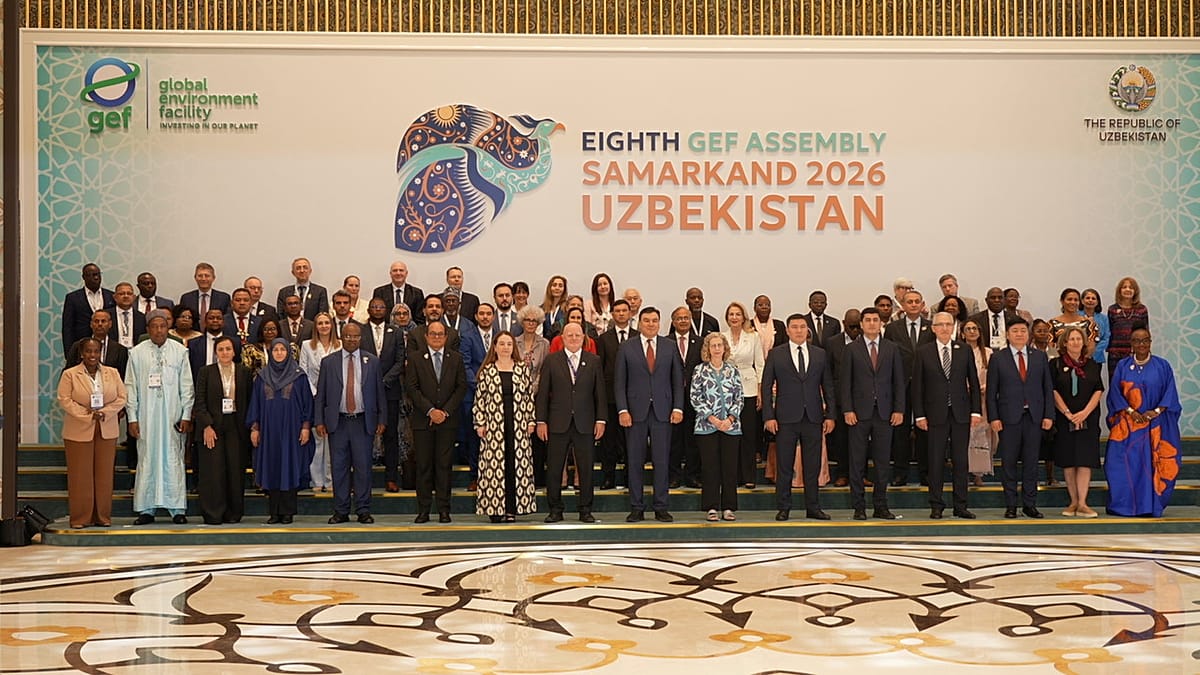
Delegates from 186 nations meeting in Samarkand, Uzbekistan, have approved a $3.9 billion (€3.4 billion) initial funding package for the Global Environment Facility (GEF), the multilateral fund that channels resources into environmental projects worldwide. The decision, taken at the GEF Assembly, sets priorities for the fund's ninth replenishment cycle (GEF-9), which runs from 2026 to 2030.
The funding arrives as governments across Europe and beyond confront mounting pressure from droughts, floods, biodiversity loss, and other climate-linked challenges. European countries remain among the largest contributors to the GEF, and many of the issues the fund targets—such as water scarcity and ecosystem degradation—are increasingly relevant on the continent. For instance, Copernicus Warns Record May Heatwave Signals New Climate Normal for Europe, underscoring the urgency of adaptation measures.
How the GEF Works and What the New Cycle Delivers
Established in 1991, the GEF serves as the financial mechanism for several international environmental agreements, including the Paris Agreement on climate change and the Kunming-Montreal Global Biodiversity Framework. It currently supports over 2,300 active projects and programmes, with $12.6 billion (€11 billion) in financing under implementation. The organisation expects to mobilise an additional $80.5 billion (€70 billion) through co-financing. Since its inception, the GEF has provided more than $27 billion (€23.5 billion) in grants and helped attract roughly $155 billion (€135 billion) in co-investment globally.
The GEF-9 package will support projects across 144 recipient countries. At least 35 per cent of the GEF Trust Fund will be directed to least developed countries and small island developing states, which are often the most exposed to environmental risks. A further 20 per cent will back initiatives led by Indigenous peoples and local communities.
Fred Boltz, Head of Programming at the GEF Secretariat, explained the scope: “This is $3.9bn that European donors and other donors globally have committed to supporting GEF's 144 recipient countries to pursue environmental goals of global significance – conserving biodiversity, managing the climate, restoring degraded areas, and managing shared freshwater and ocean systems.”
Reforms to Speed Up Access and Integrated Programmes
The new funding cycle introduces reforms aimed at reducing bureaucracy and accelerating access to financing. “GEF-9 focuses on streamlining, enabling agencies and countries to hit the ground with resources more quickly, massively decreasing the bureaucratic complexity of receiving GEF funding,” Boltz said. The changes are intended to shorten approval timelines and allow projects to move faster from planning to implementation.
The cycle also places greater emphasis on integrated programmes that link climate change, biodiversity, land degradation, food systems, and water management. This reflects a growing recognition that environmental challenges cannot be tackled in isolation. The first projects are expected to begin receiving support in the coming months, with the full cycle starting in July 2026 and running until 2030—a key deadline year for global climate, biodiversity, and land restoration commitments.
One example of the GEF's work is its Sustainable Cities programme, which, according to the World Bank, has already collaborated with more than 100 cities across 40 countries. Ming Zhang, the World Bank's Global Director for Urban, Subnational Finance, Tourism and Disaster Management, noted that grant funding can help attract larger investments from development banks and the private sector. “The performance approach could be useful, providing the right incentive to achieve the results you want,” he said.
Central Asia as a Case Study and Uzbekistan's Shift
The Assembly was held in Central Asia for the first time, highlighting the region's acute environmental vulnerabilities. Rachel Kyte, the UK's Special Representative for Climate, remarked: “Central Asia is ground zero for the impacts that we see from climate change. What we can do here then becomes lessons for other parts of the world.”
According to World Bank data presented at the gathering, around 37 million people in the region currently live in areas experiencing severe water scarcity. That figure could rise to 75 million by 2050 as glaciers retreat and river flows decline. These pressures are already visible across Europe, where EU Environment Chief: Climate Policy Is Now Defence Policy highlights the growing security dimension of environmental degradation.
Uzbekistan, which joined the GEF in 1995 as a recipient country, announced during the Assembly that it plans to become a contributor to future funding cycles. In a message to delegates, President Shavkat Mirziyoyev described ecological transformation as “a new model of development.” Marcos Athias Neto, UN Assistant Secretary-General and UNDP Assistant Administrator, commented: “What you see in this assembly is Uzbekistan taking a leadership role, becoming a donor to the GEF, as well as taking leadership at the Central Asian regional level.”
Alongside the Assembly, the Eco Expo Central Asia brought together around 10,000 participants from more than 100 countries, featuring 68 pavilions showcasing environmental solutions. The event underscored the growing momentum for international cooperation on climate adaptation and biodiversity protection—issues that are no longer distant threats but pressing realities for Europe and the world.