When tensions in the Strait of Hormuz sent energy prices spiraling across Europe in recent months, households from Lisbon to Warsaw felt the pinch. But in Feldheim, a village of roughly 130 people in the Brandenburg region east of Berlin, the crisis barely registered. Residents there pay just 12 euro cents per kilowatt-hour for electricity—roughly half the German average and a fraction of what many Europeans now face.
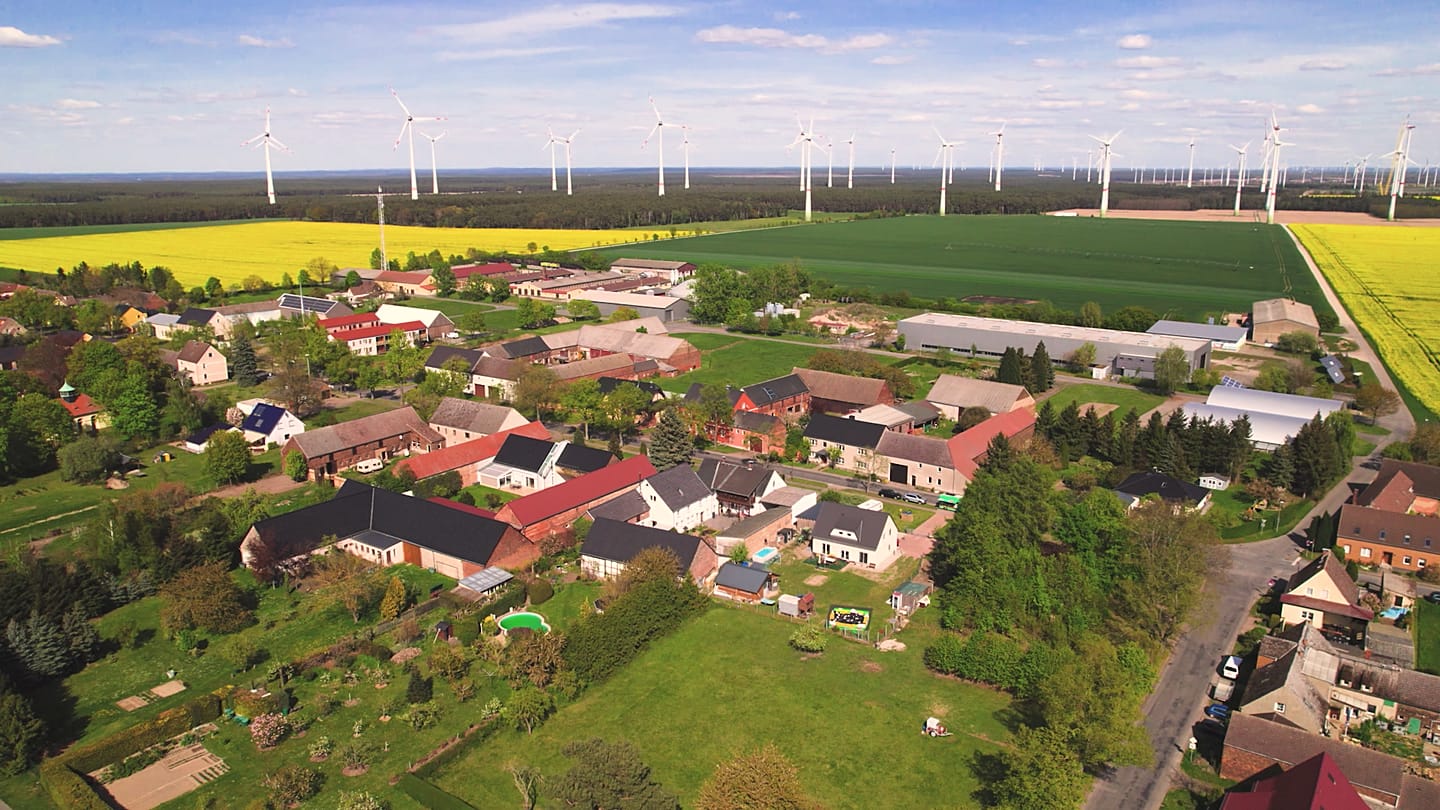
Feldheim’s secret is not austerity or luck, but a deliberate, decades-long shift toward energy autonomy. The village generates its own electricity and heat from a combination of wind turbines, solar panels, and a biogas plant fed by local agricultural waste. A local heating grid distributes warmth to every home, and a battery storage system smooths out fluctuations. The result: a community that is almost entirely disconnected from the fossil-fuel markets that roil the rest of the continent.
A Model Born from Necessity
The story begins in the 1990s, when Feldheim was a struggling agricultural hamlet in the former East Germany. After reunification, many residents left for jobs in western cities. Those who remained faced high energy costs and unreliable supply. In 1995, a local farmer named Michael Raschemann proposed building a wind turbine. Skepticism was high, but the project went ahead. Today, Feldheim hosts seven wind turbines, a solar farm, and a biogas plant that converts manure and corn silage into methane for a combined heat and power unit.
The village’s energy cooperative, founded in 2010, owns most of the infrastructure. Residents buy shares and receive dividends, but the main benefit is stable, low-cost power. “We don’t worry about what happens in the Middle East or on global commodity exchanges,” says Raschemann, now the cooperative’s chairman. “Our energy comes from our fields and our wind. That’s it.”
Feldheim’s approach has attracted attention from across Europe. Delegations from France, Poland, and the Netherlands have visited to study the model. The European Commission has cited it as an example of how local energy communities can contribute to the EU’s climate goals and energy security. As EU Cohesion Funds Could Be Redirected to Ease Energy Crisis, Feldheim shows what targeted investment can achieve.
Lessons for a Continent Under Pressure
The Hormuz crisis—sparked by US-Iran Clashes Erupt Near Hormuz—exposed the fragility of Europe’s energy system, which still relies heavily on imported oil and gas. While the EU has accelerated its renewable energy targets, progress is uneven. Germany, for instance, generated 52 percent of its electricity from renewables in 2023, but many households still pay over 30 cents per kilowatt-hour due to grid fees, taxes, and legacy contracts.
Feldheim’s success hinges on local ownership and long-term planning. The village secured grants from the state of Brandenburg and the German federal government, but the key was community buy-in. Every household agreed to connect to the local heating grid, ensuring economies of scale. The cooperative also negotiated fixed-price contracts for biogas feedstock, insulating itself from agricultural price swings.
Critics argue that Feldheim’s model is hard to replicate in dense urban areas or regions with less wind and sun. Yet similar projects are emerging elsewhere: in the Danish island of Samsø, the Austrian town of Güssing, and the Spanish village of Crevillent. The challenge is scaling up. As May Heatwave Across Europe Prompts UN Call to Accelerate Clean Energy Transition, the urgency is clear.
For now, Feldheim remains a proof of concept. Its residents enjoy not only cheap energy but also a sense of resilience. “When I hear about crises in the news, I know we’re safe,” says local teacher Anna Weber. “Our lights stay on, and our bills don’t change.” In a continent where energy anxiety is rising, that quiet confidence is worth studying.