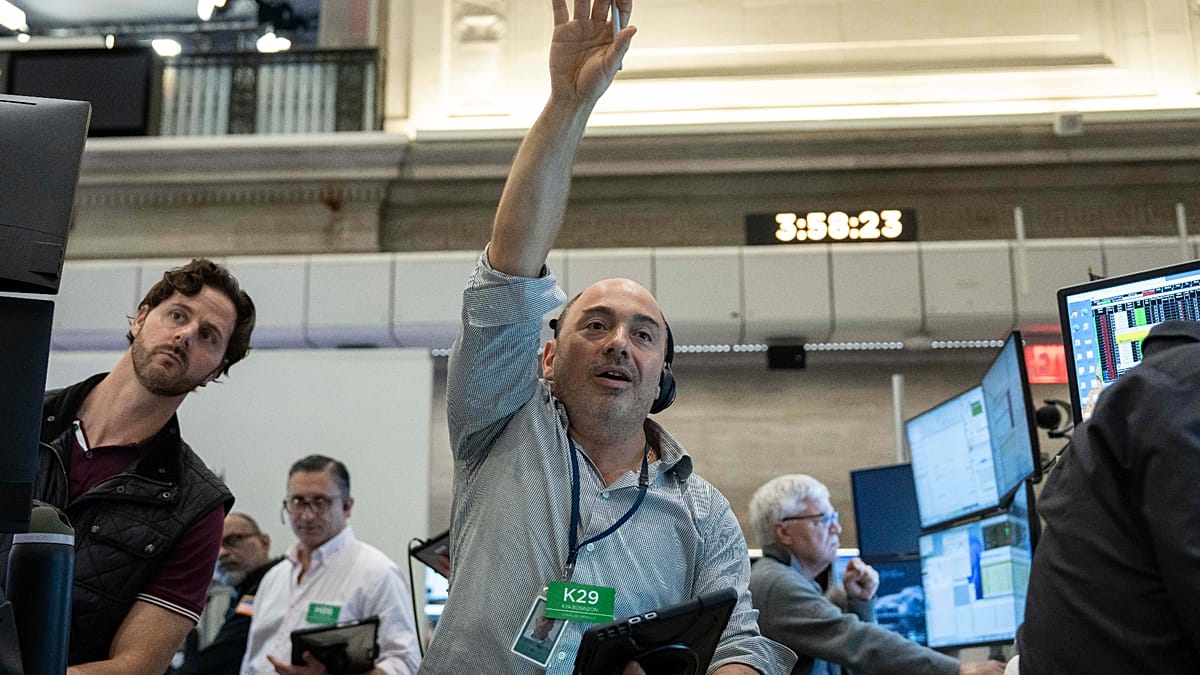
When American voters went to the polls last week, European investors were watching one question above all: how much room would Donald Trump have left to govern?
By Wednesday morning, they had their answer. The Democratic Party took control of both the House of Representatives and the Senate, a clear defeat for the US president halfway through his term. On trading floors, the result quickly earned a name: the "blue tsunami."
At first glance, Europe's stock market barely reacted. The Stoxx 600 jumped 1.8% on Wednesday, then gave most of it back. By Friday's close it stood just 0.4% above Tuesday's level. The Euro Stoxx 50, which tracks the euro area's 50 largest companies, followed the same path: it rose 2% on Wednesday and ended the week just 0.4% higher.
Look beneath the surface, though, and it was one of the most violent reshuffles of the year.
Banks up, tech down
The rotation was clearest at sector level. European banks rose 3.2% between Tuesday and Friday, with most of the gain on Wednesday alone. Jordi Visser, head of AI macro research at 22V Research, said it was the sector's best week since June. Travel and leisure stocks did even better, climbing 3.9% as oil prices fell. Brent crude dropped more than 9% on Wednesday, as traders bet that a weakened president would be less likely to escalate the war with Iran.
Utilities gained 2.5% and healthcare 2%. On the other side, energy stocks fell 4.2% on cheaper oil, and technology lost 3.6%.
Europe held up better than Wall Street for a simple reason: its market owns far fewer AI stocks and far more banks. "The equity market is a distorted mirror of the economy," Sharon Bell, senior European equity strategist at Goldman Sachs, said in a report. According to Bell, financial companies make up more than 30% of Stoxx 600 earnings, but only 10% of euro area economic activity. After the midterm tech sell-off, European stocks have now pulled ahead of US equities this year in local-currency terms, according to Goldman Sachs.
"European indices are less exposed to the semiconductor correction," Intesa Sanpaolo's equity strategy team said in a report on Friday. The team added that banks were recovering thanks to solid quarterly results.
Thursday's tech blow-up
Most of the damage in tech came in a single session. The trigger for Thursday's sell-off was not Congress. It was what happened in the states. Democrats won governors' races in Texas, Ohio and Georgia. In all three states, Republican governors had courted the data-centre boom with tax breaks and fast-track permits. The upset in Texas, home to some of the largest AI data-centre projects in the US, hit hardest. At the same time, voters in parts of Ohio, Illinois, Maine and Florida approved local measures to ban or restrict new data centres.
"The fear of Democrat-inspired opposition to data centres has gained greater political weight, and the risk concerns not only new regulations but above all permits, energy consumption and local resistance," Gian Marco Salcioli, head of global markets strategy at Intesa Sanpaolo, said in the report. If new governors slow approvals, fewer data centres get built. That means fewer chips, fewer machines to make those chips and less equipment to power them. European technology stocks fell 3.2% on Thursday alone. The sell-off was part of a broader global AI sell-off that has hit chip stocks hardest.
Why bond yields fell
Bonds rallied across the board. Germany's 10-year Bund yield fell from 3.33% on Tuesday to 3.25% on Friday, after touching its lowest level since late August. France's 10-year yield fell further, from 4.95% to 4.77%. The US 10-year Treasury yield dropped from 4.97% to 4.86%.
According to Peter Williams, economist at 22V Research, bond markets see "greater-than-expected constraints on the war, tariffs, and the artificial intelligence (AI) boom as modestly disinflationary shifts over the medium term." The AI part matters for borrowing too. To pay for their data centres, the big US cloud companies, known as hyperscalers, have become some of the world's largest borrowers, and they compete with governments for the same investors. Last week alone, Meta sold $10 billion (€9 billion) of bonds in its first euro-denominated deal. The sale drew more than $59 billion (€53 billion) of orders, a record for a corporate issuer in Europe.
"The market continues to finance the investment programmes of the big hyperscalers, but demands increasingly higher compensation," Intesa Sanpaolo credit strategist Pasquale Lodato said. A pause in data centres would flip that. Less AI spending would mean less Big Tech debt, and less competition for governments funding their deficits. The midterm backlash against AI firms has already raised questions about the sector's growth prospects.
Europe's five biggest winners after the midterms
- 5. Saint-Gobain: +5.4% — The French building materials group rode the rotation. Construction stocks benefit from lower borrowing costs, and they were among Europe's best-performing sectors on Wednesday.
- 4. BBVA: +5.7% — The Spanish lender led the rally in European banks, which rose more than 4% on Wednesday alone. The sector has now largely recovered from its weakness in September and October. Markets are refocusing on earnings that mostly beat expectations.
- 3. Prosus: +6.5% — The biggest asset of this Dutch tech investor is a large stake in Chinese tech giant Tencent. Prosus gained as investors swapped US AI exposure for Chinese technology. Tencent and Alibaba both jumped more than 6% in Hong Kong on Thursday.
- 2. Bayer: +7.2% — The German drugs and crop science group rose 4.6% on Wednesday. Bank of America analysts said that, with most of its legal battles behind it, Bayer had a path to stronger cash generation and lower debt. Healthcare was also one of the week's favoured defensive sectors.
- 1. Adyen: +8.9% — The Dutch payments group was among the biggest beneficiaries of money leaving AI. Its shares had fallen sharply after results in late October, when it cut its profit margin target to fund more investment, and were down about 35% this year. On Friday, the stock surged as investors rotated back into beaten-down tech names.
The midterm outcome has also reshaped the political landscape in Washington, with Trump tapping Stephen Miller as chief of staff in a bid to consolidate his base. But for European investors, the immediate focus is on how the new balance of power will affect trade, energy and tech policy — and which sectors will benefit or suffer as a result.