As Iran's new academic year gets underway, families across the country are confronting a stark reality: tuition fees at private schools have in some cases nearly tripled over the summer, while the cost of basic stationery has doubled. The economic strain, compounded by international sanctions, a collapsing rial, and persistent fears of renewed conflict, is pushing enrollment numbers down, particularly in Tehran.
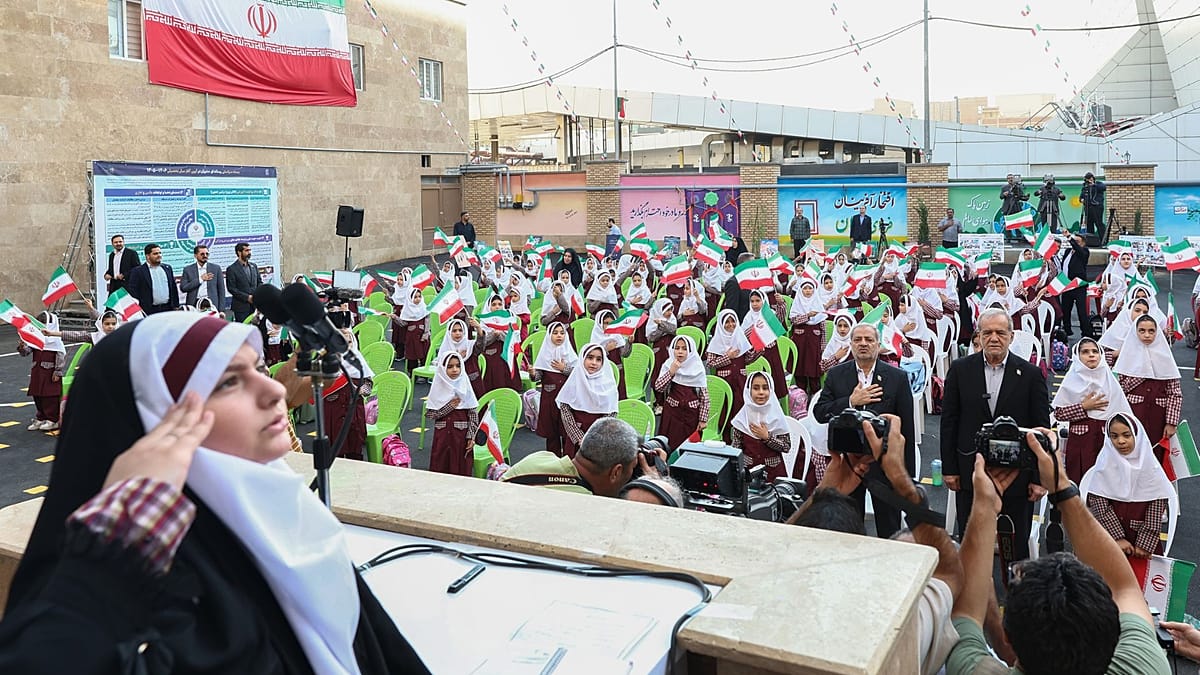
President Masoud Pezeshkian marked the start of the school year on Monday by ringing the bell at a girls' primary school in the capital. The Ministry of Education has urged schools to prioritise in-person teaching after several terms of online learning during earlier phases of the war, but the financial hurdles for parents remain formidable.
Official figures show that total enrollment in Iran's fee-charging schools and universities now stands at roughly 3.3 million students, nearly 70% of whom pay tuition. That number has fallen from 4.4 million a decade ago, a decline the ministry attributes largely to reduced purchasing power.
Tuition caps ignored
The ministry issued a directive capping tuition increases at private schools at 35% for the new academic year, setting fees between 14 million and 145 million tomans (€53–€549). In practice, however, the cap is widely disregarded.
Bita, a final-year high school student in eastern Tehran, told Euronews Persian that her tuition jumped from 80 million tomans (€303) last year to 220 million tomans (€833) this year — an increase of 175%. “I'm in my final year of high school. Students in lower grades pay somewhat less. We also have to pay a separate fee for pamphlets and school-printed textbooks, which comes to around 20 million tomans (€76),” she said.
“Right now, for a senior at a private high school, their family has to pay roughly 250 million tomans (€947) for their education. Of course, in the affluent neighborhoods in the northern part of the city, this cost goes even higher,” she added.
Maryam, a 57-year-old accountant at several private primary schools in southern Tehran, has witnessed the trend firsthand. At one school she works with, tuition rose from 36 million tomans (€136) two years ago to 85 million tomans (€322) this year. She also sees enrollment declining not only because of cost but also security concerns.
“At one of these schools many pupils have not enrolled because it is opposite a police station and their parents worry that if the war starts again their children will not be safe there,” Maryam said. “Their other concern is that classes may move online and they are not willing to pay heavy fees for virtual lessons at non-profit schools.” One school in Tehran's Shahrak-e Valiasr district closed entirely after failing to reach the minimum enrollment required to operate, she added.
Stationery costs soar
The financial burden extends beyond tuition. A basic school supplies bundle now ranges from 3 million tomans (€11.30) to 17 million tomans (€64.30). A 500-sheet ream of CopyMax A4 paper — commonly used by university students for lecture notes — starts at 975,000 tomans (€3.69). Recycled newsprint A4 paper is cheaper at 390,000 tomans (€1.48) but is considered unsuitable for school work. Prices also vary significantly depending on where in Tehran you buy supplies.
Arya and his wife Roksana, who run a stationery shop in the small town of Vahidieh near Shahriar, on the outskirts of Karaj, told Euronews Persian that although they source their stock from the same wholesale markets as sellers across Tehran and Karaj, they cannot match big-city prices. Arya said the price of a quality notebook rose from 85,000 tomans (€0.32) last year to 180,000 tomans (€0.68) this year, an increase of around 100%.
Roksana noted that customer numbers had dropped, but added that some families are simply using supplies left over from the previous year when many classes were held online and materials went largely unused. “Our customer numbers have dropped, but that doesn't mean students aren't getting school supplies this year. For instance, my own son is using leftover notebooks from last year,” she said. “Plus, with classes held online for much of the previous school year, students barely used their backpacks, shoes, and uniforms. As a result, families don't see the need to buy new ones this year.”
The situation in Iran echoes broader concerns about education access under economic duress, a theme that resonates in other parts of the world. In Europe, debates over school funding and migrant education continue, as seen in Italy's recent moves to restrict foreign pupils. Meanwhile, the impact of climate-related disruptions on schooling, such as flooding in Tunis, highlights how external shocks can upend academic calendars.
For now, Iranian families are left to navigate a new school year marked by soaring costs and dwindling options, with little relief in sight.