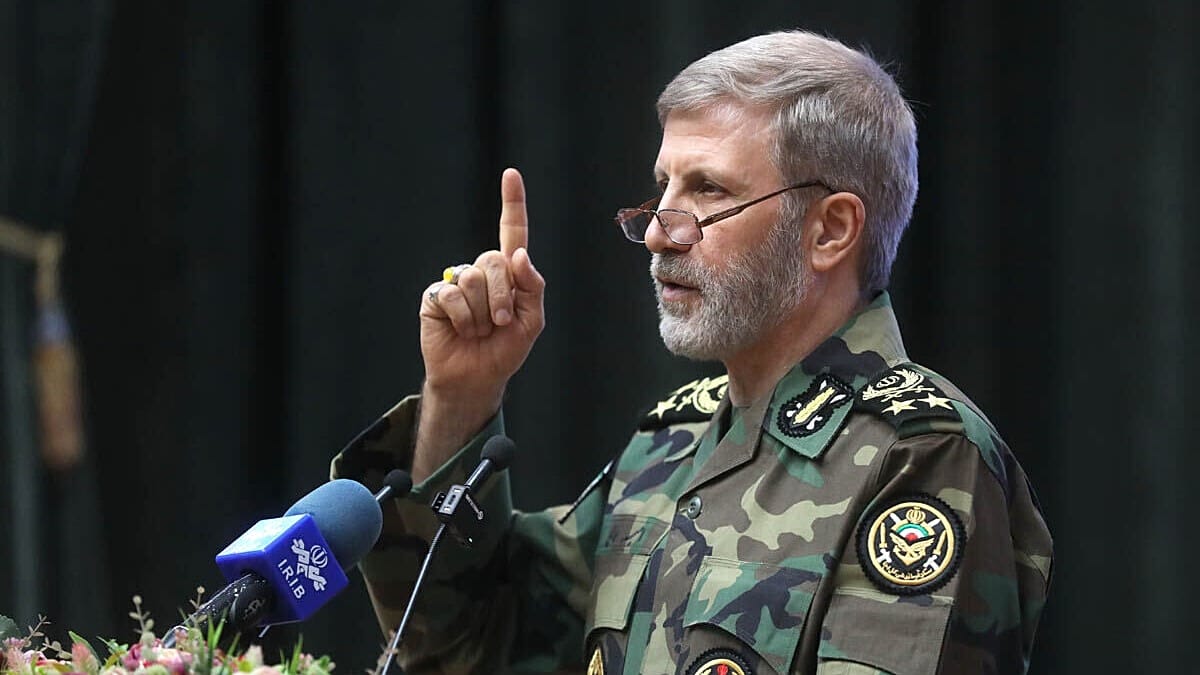
Iran's army commander-in-chief, Amir Hatami, has issued a stark warning that any further US attack would be met with a response that is 'more crushing, harsher and without geographical limitation.' Speaking on Wednesday, Hatami said Iranian forces would strike the United States 'along with its supporters' wherever they are based, underscoring Tehran's readiness to escalate the confrontation beyond its borders.
Hatami's remarks come amid heightened tensions in the Persian Gulf, where the US has now positioned three aircraft carriers, including the USS Theodore Roosevelt, which Central Command (CENTCOM) confirmed has joined the USS Nimitz and USS Eisenhower in the region. The buildup signals Washington's determination to project force, but Tehran insists it is undeterred.
'If the enemy once again takes action, it will without doubt be dealt with more crushingly, more harshly and without geographical limitation, along with its supporters,' Hatami said. He expressed hope that the other side would not 'miscalculate,' warning that if it did, 'it will receive a lesson that will be a warning to everyone.'
The Iranian army's public relations department claimed its forces had destroyed a US MQ-9 drone east of the Strait of Hormuz using domestically produced air defence systems, operated through an integrated network. The claim has not been independently verified, and Washington has not commented. If confirmed, it would mark a significant demonstration of Iran's evolving military capabilities.
Regional flashpoints and European concerns
The Strait of Hormuz, a vital chokepoint for global oil shipments, has become a focal point of the standoff. Recent days have seen attacks on commercial vessels in the strait, with mines reportedly used. On Tuesday, the US carried out air strikes on Iranian positions on Qeshm Island, following Iranian reports of attacks on US military installations. The exchange of fire has raised fears of a broader conflict that could disrupt energy supplies and destabilise the region.
For Europe, the implications are direct. The European Union relies heavily on Gulf oil and gas, and any disruption to shipping through Hormuz would send shockwaves through European economies already grappling with energy price volatility. The bloc has been walking a diplomatic tightrope, urging restraint while maintaining channels with Tehran. The escalating tanker attacks have prompted EU ministers to discuss joint action, as they did in response to Russian aggression beyond Ukraine.
Iran's military leadership has made clear that its response would not be confined to targets within Iranian borders. Yadollah Javani, political deputy of the Islamic Revolutionary Guard Corps (IRGC), claimed Tehran's forces could now strike or intercept advanced drones in areas including the Strait of Hormuz and Qeshm Island, citing advances in missile and electronic warfare capabilities. This suggests a strategy of asymmetric deterrence aimed at countering US technological superiority.
The situation has also drawn attention to Iranian activities further afield. In a separate development, North Macedonia recently foiled an Iranian-linked plot to assassinate a target in Greece, highlighting Tehran's reach into Europe. Such incidents underscore the security challenges facing the continent, even as it focuses on the war in Ukraine.
Hatami said Iranian ground, naval, air and air defence forces were monitoring military movements and continuously raising their readiness. He added that necessary preparations to counter possible attacks had been put in place under orders issued to senior commanders. The message is clear: Iran is bracing for a potential conflict, but also signalling that the cost of any US action would be high.
As the standoff intensifies, European diplomats are urging both sides to de-escalate. The EU has called for a return to diplomacy, but with each passing day, the risk of miscalculation grows. The EU ministers' push for joint action reflects a broader concern about the spread of conflict beyond Ukraine, and the Gulf is now a worrying new front.
For now, the world watches as the US and Iran edge closer to the brink. The coming days will test whether Hatami's warnings are rhetoric or a prelude to a wider war that could have profound consequences for global security and Europe's energy future.