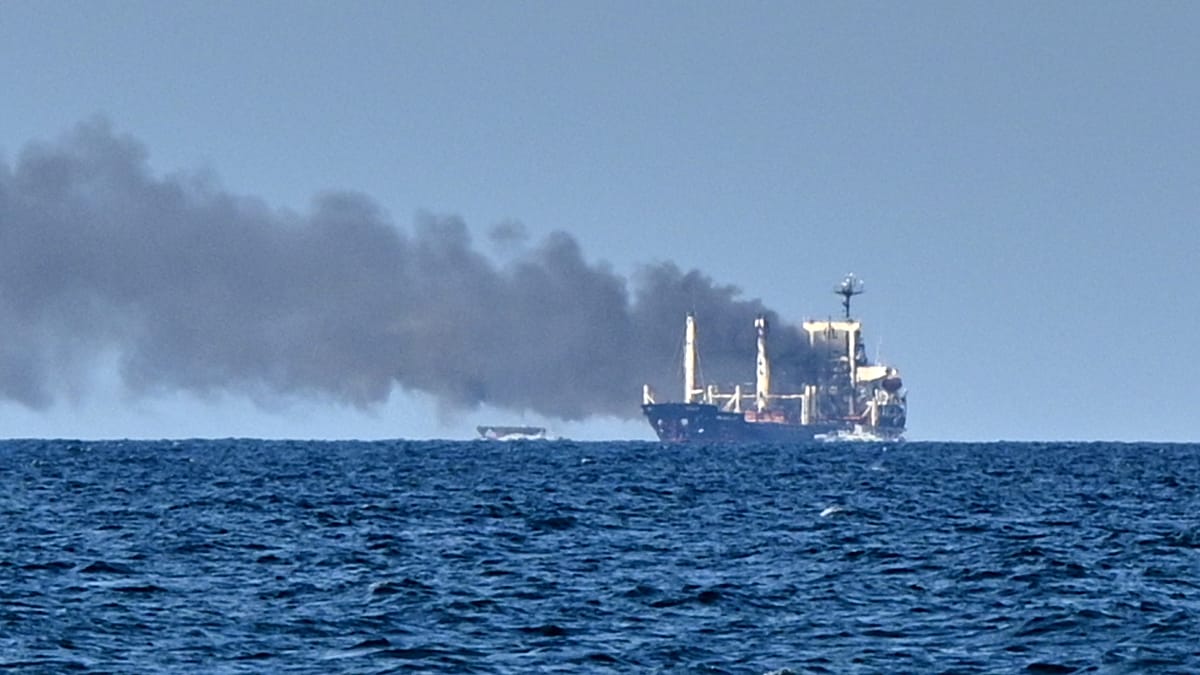
Over four consecutive days, four tankers scheduled to load Kazakh crude oil at the Caspian Pipeline Consortium (CPC) marine terminal near Novorossiysk, Russia, were struck by drones. The attacks, widely attributed to Ukraine, have drawn sharp condemnation from Kazakhstan’s foreign and energy ministries, who described them as an unacceptable infringement on the country’s economic interests and a deliberate destabilisation of international trade.
“We regard such attacks as an unacceptable infringement upon the economic interests of the Republic of Kazakhstan, as well as deliberate acts aimed at destabilising lawful international trade and global energy markets and undermining the security of global transport and logistics supply chains,” the Kazakh foreign ministry said in a statement.
The targeted vessels were civilian tankers engaged in legitimate commercial oil transportation, according to Astana. The attacks come amid Ukraine’s broader campaign of drone strikes on Russian oil infrastructure, intended to cut one of Moscow’s primary revenue sources for its war effort. CPC has not formally attributed responsibility, and Ukraine has not publicly claimed the strikes.
Timeline of the Strikes
The first incident occurred on Friday, when the tanker Nordic Zenith, empty and en route to the terminal, was hit by a drone. The resulting fire was extinguished by the crew, and no casualties were reported.
On Sunday, two tankers—the Liberia-flagged ASIA and the Marshall Islands-flagged NISSOS IOS—were struck while loading at the terminal. Fires broke out on both vessels but were brought under control by their crews. According to Kazakhstan’s energy ministry, the Single Point Mooring (SPM) facilities were undamaged, and no oil was spilled.
On Monday, CPC reported a fourth attack on the Cameroon-flagged tanker NELSA, which was loading at SPM-1. The strike ignited a fire, prompting the evacuation of 22 crew members. The vessel remained afloat, and authorities confirmed that no oil spill occurred.
“At present, crude oil loading operations at the terminal have been suspended pending a full assessment of the consequences of the incident,” the Kazakh energy ministry said.
Strategic Importance of the CPC Route
The CPC pipeline is Kazakhstan’s primary export artery, transporting crude from the Tengiz, Kashagan, and Karachaganak fields over 1,510 kilometres to Novorossiysk for shipment to global markets. The route handles approximately 80% of Kazakhstan’s oil exports and more than 1% of the world’s oil supply, making it critical for the country’s economy. Prolonged disruptions could reduce export revenues, lower tax receipts, and pressure Kazakhstan’s budget and currency.
In 2025, CPC shipped roughly 70.5 million tonnes of crude, over three-quarters of which belonged to foreign shareholders, including Chevron, ExxonMobil, KazMunayGas, Eni, and Shell. The oil loaded onto the attacked tankers came from the Tengiz and Kashagan fields, CPC confirmed.
“We emphasise that this is already the fifth act of direct aggression against a purely civilian CPC facility, which is protected by international law,” CPC stated. The consortium also noted that it is not under any sanctions and plays an important role in global energy security.
Diplomatic Fallout and Compensation Claims
Kazakhstan’s foreign ministry accused the attackers of deliberately breaching previously agreed procedures for exchanging information about civilian vessels in the Black Sea. Astana reserved the right to seek compensation under international law and called on partner countries to condemn the strikes.
The attacks underscore the vulnerability of critical energy infrastructure in the Black Sea region, a key transit hub for oil and gas. While Ukraine has not claimed responsibility, the strikes align with its strategy of targeting Russian energy assets. The CPC terminal, though located in Russia, is a multinational consortium with members including Russia, the United States, Kazakhstan, and several Western European countries.
For a broader context on drone strikes in the region, see our coverage of Ukraine’s recent mass drone attack on Moscow and the Black Sea strike on an LPG tanker.