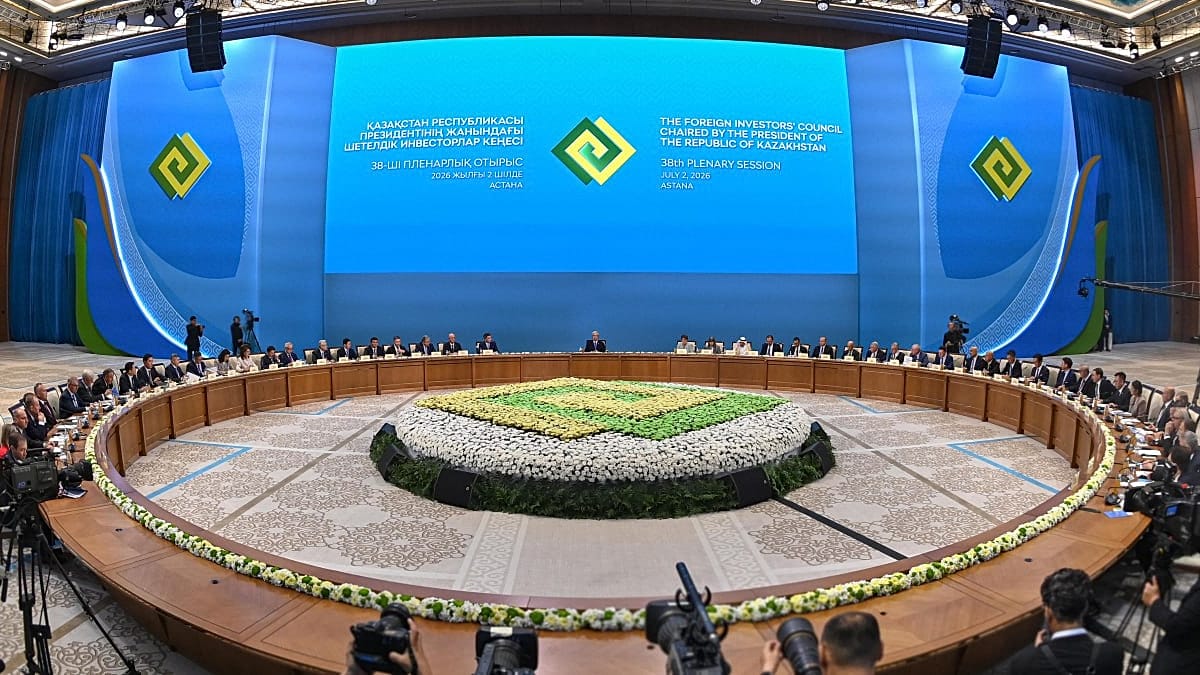
Kazakhstan is positioning itself as a regional hub for artificial intelligence and digital infrastructure, seeking to attract the next wave of foreign investment from global technology companies. Speaking at the 38th plenary session of the Foreign Investors' Council in Astana, President Kassym-Jomart Tokayev called on capital leaders to use the country as a secure, high-yield launching pad for AI development.
“We invite capital leaders to leverage our unique jurisdiction as your secure, high-yield launching pad,” Tokayev said.
The Central Asian nation has accumulated more than €130 billion in net foreign direct investment, accounting for nearly 70% of all FDI in the region, according to the president. The country aims to maintain its position as the leading investment destination while pursuing a fully digital economy by 2029.
Building AI Infrastructure
Developing large-scale digital infrastructure is central to Kazakhstan's AI strategy. The government is advancing plans for a one-gigawatt AI data centre campus and expanding international digital connectivity through a fibre-optic cable beneath the Caspian Sea. Officials are also promoting reforms to facilitate cloud computing, AI development, and digital investment.
Working groups at the Foreign Investors' Council presented recommendations to improve the investment environment, including proposals on cross-border data transfers and digital regulation. Investors say these measures are essential for accelerating AI adoption and attracting technology companies.
Kazakhstan recently signed memorandums with international partners, including Citi and Freedom Holding Corp, to explore financing models for a world-class AI cluster that could support government institutions, businesses, and researchers.
Critical Minerals as a Strategic Priority
Alongside AI, Tokayev identified critical minerals as a major opportunity for foreign investment. Kazakhstan is building a technology-driven ecosystem around the exploration, processing, and production of critical minerals, as global demand accelerates with the energy transition and AI industries.
The government has launched a Unified Subsoil Use Platform, digitising licensing procedures and automating 22 government services related to exploration and compliance. More than 4.7 million historical geological records have been digitised into a national database, and AI is now being used to convert legacy geological information into machine-readable datasets.
A Regional Research Centre for Rare Earth Metals is also being established to provide investors with higher-quality geological information and accelerate new discoveries. Tokayev said embedding AI throughout exploration, geological analysis, and mining operations would improve resource efficiency and unlock the next generation of critical mineral deposits.
“We invite global mining companies, technology leaders, financial institutions, and exploration partners to join us in unlocking the next generation of critical mineral resources,” he said.
Moving Up the Value Chain
The focus on critical minerals extends beyond extraction. On the sidelines of the forum, the European Bank for Reconstruction and Development announced a €255 million loan to support the construction of the Ertis pressure oxidation hydrometallurgical complex in the Pavlodar region. The facility, being developed by Solidcore Resources, will be capable of processing up to 278,500 tonnes of gold concentrate annually.
The project is expected to establish a new metallurgical segment within Kazakhstan's mining industry, supporting the country's broader strategy of moving beyond raw material exports towards higher-value processing and advanced industrial production.
Strengthening Investor Protections
Kazakhstan has introduced new legislation to strengthen investor protection. Under the reforms, state authorities can no longer inspect investors, suspend their operations, revoke licences, or impose certain administrative restrictions without approval from the prosecutor's office.
President Tokayev said the new law, which entered into force this week, provides investors with the country's strongest legal safeguards to date. “The new provisions provide the highest level of legal protection for investors,” he said.
The reforms come as Kazakhstan continues to improve its investment framework while seeking to reassure international businesses following several high-profile commercial disputes, including ongoing arbitration and litigation involving the Kashagan oilfield. The Prosecutor General now serves as Kazakhstan's Investment Ombudsman, and individual prosecutors have been assigned to oversee major investment projects and help resolve disputes.
Officials say Kazakhstan has signed nearly 50 international agreements on investment protection and is currently supporting more than 2,000 investors involved in over 250 projects. The government has also launched the National Digital Investment platform to streamline procedures.
For European investors, Kazakhstan's push into AI and critical minerals offers opportunities in a region that already accounts for the bulk of Central Asian FDI. The country's efforts to digitise its economy and strengthen legal protections align with broader trends in European investment strategies, particularly as the EU seeks to diversify supply chains for critical raw materials. However, ongoing geopolitical tensions, such as drone strikes on Black Sea oil tankers that disrupted CPC terminal operations, highlight the risks that remain for international partners.