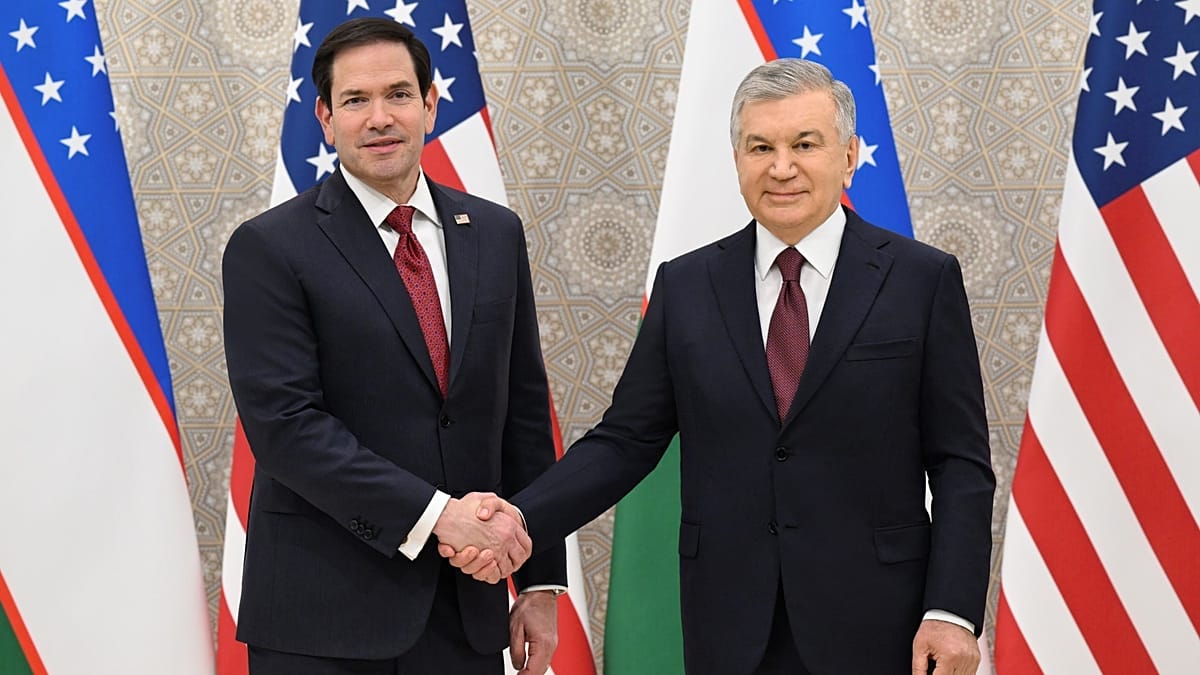
Uzbekistan has announced a sweeping economic package with American partners worth nearly $12bn (€10.7bn), following high-level talks in Samarkand attended by US Secretary of State Marco Rubio. The announcement came after Rubio met President Shavkat Mirziyoyev on Monday, where the two discussed trade, energy, critical minerals, aviation, and technology.
The two countries are seeking to deepen their strategic partnership through private investment and joint industrial projects. According to the Uzbek presidency, bilateral trade has grown by 35% since the start of the year, though the comparison period was not specified.
New priorities for US investment
Senior officials and American business representatives gathered for the second meeting of the American-Uzbek Business and Investment Council, where the economic agenda was developed. Mirziyoyev described the council as a unique mechanism for developing joint projects, emphasizing its distinctive role in Uzbekistan's international economic relations.
“We do not have this kind of format with any other country of the world,” he said during his meeting with Rubio.
The Uzbek president announced a package of 54 agreements and prospective initiatives valued at around $12bn and called for a comprehensive action plan to support their implementation. He also proposed a new approach to attracting investors, under which projects would be prepared with land, infrastructure, permits, and administrative requirements already addressed.
Uzbek companies would be encouraged to participate as partners, while a newly established direct investment fund could help finance eligible projects. Mirziyoyev identified critical minerals, renewable energy, electricity storage, data centres, and artificial intelligence as priority areas. He also proposed a joint trade, investment, and technology cooperation programme extending to 2035.
The council is co-chaired by Saida Mirziyoyeva, head of Uzbekistan's Presidential Administration, and US Special Envoy Sergio Gor. Mirziyoyeva encouraged US companies to bring investment proposals and practical problems directly to the council, positioning it as a mechanism for resolving obstacles rather than simply discussing future cooperation.
US investors praise growing activity
Business representatives interviewed by Euronews in Samarkand identified opportunities in mining, agriculture, and financial services. Dan Patterson, CEO of Silver Leaf International, pointed to the potential for Uzbek fruit exports to reach US consumers and for US companies to invest in mineral development.
“So there's also tremendous opportunity for minerals and mining advancements in almost every sector,” Patterson told Euronews.
Quinn Martin, president of Bluestone, said US investment activity had accelerated after several years of discussions. “Just my firm has been involved in three transactions in the last five months regarding US investors,” he told Euronews. According to Martin, the transactions involved Uzbekistan's national investment fund, banking, and hospitality. He expects US investment to increase further over the coming years.
Shokhrukh Gulyamov, Uzbekistan's Deputy Minister of Investment, Industry and Trade, also described discussions with US financial institutions. “Citigroup, one of the leading financial institutions in the United States, is in discussions with our banks about providing financing for various projects,” Gulyamov told Euronews. He also highlighted cooperation with Boeing, including aircraft deliveries and the supply of spare parts needed for maintenance.
Which companies are involved in the agreements?
According to Uzbekistan's Ministry of Investment, Industry and Trade, the agreements and proposed initiatives cover transport, energy, critical minerals, finance, digital technologies, agriculture, and healthcare. Railway manufacturer Wabtec is discussing locomotive supplies, maintenance services, and local component production.
Financial cooperation involving Franklin Templeton, Oppenheimer & Co, Citigroup, and BlackRock includes access to international capital markets, institutional investment, and infrastructure financing. In critical minerals, projects involving ReElement Technologies, Traxys, and Trafigura cover geological exploration, processing technologies, and mineral supplies.
The push comes as the US seeks a lasting economic foothold in Central Asia, a region where Rubio's visit underscores Washington's strategic interest. The broader context includes trans-Caspian trade and critical minerals as key themes in the region's engagement with the West.
For European observers, the developments in Uzbekistan are notable given the continent's own interest in diversifying supply chains for critical minerals and energy. The agreements could also have implications for European markets, as investors watch for shifts in global trade flows.
With the council set to continue its work, the coming months will reveal how quickly these agreements translate into tangible projects. For now, the momentum is clear: Uzbekistan is positioning itself as a serious partner for American capital, and the business community is responding.