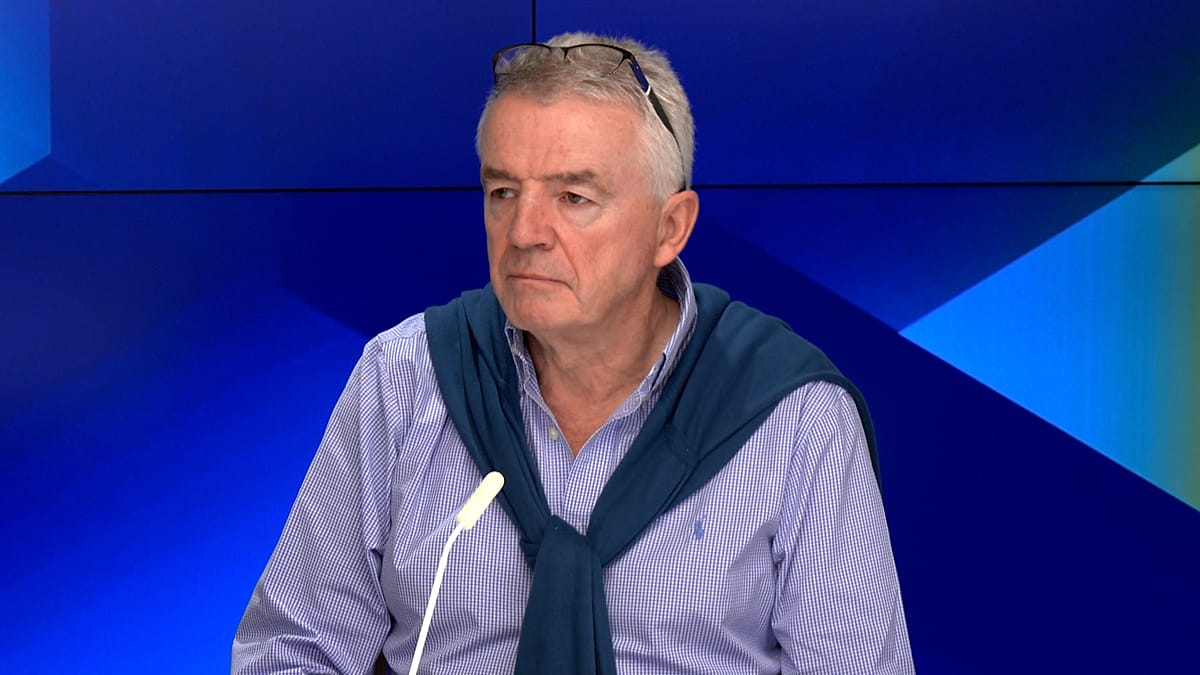
Ryanair chief executive Michael O'Leary has launched a blistering attack on European Commission President Ursula von der Leyen, calling her 'useless' and accusing her of burdening the aviation industry with green policies that add 'complexity and cost'. In a separate swipe, he described the European Parliament as a 'ship of fools' for passing environmental laws that he says are driving up the price of air travel.
O'Leary's comments come as the Irish low-cost carrier prepares to announce its winter schedule, which will see the airline cut one million seats across several European countries. Belgium and Germany are among the hardest hit, with O'Leary blaming increased air passenger taxes and what he calls Germany's 'hopelessly uncompetitive' business environment.
Green policies under fire
The Ryanair boss has long been a vocal critic of EU environmental regulations, arguing that measures such as emissions trading and sustainable fuel mandates disproportionately affect budget airlines and their passengers. 'Every time Brussels adds a green tax or a green rule, it's the ordinary traveller who pays,' O'Leary said in a statement. 'Von der Leyen's obsession with climate targets is making flying more expensive and less accessible for millions of Europeans.'
His remarks echo a broader industry pushback against the EU's Fit for 55 package, which aims to cut net greenhouse gas emissions by at least 55% by 2030. Airlines have warned that the bloc's proposed kerosene tax and blending mandates for sustainable aviation fuels could raise ticket prices significantly. The European Commission has defended its approach, insisting that the aviation sector must contribute to the continent's climate goals.
O'Leary's criticism of von der Leyen is not new. He has previously accused her of being out of touch with the realities of the aviation market and has called for a more pragmatic approach to decarbonisation. However, his latest comments, made ahead of the winter schedule announcement, are among his most direct personal attacks on the Commission president.
Capacity cuts and tax disputes
The decision to reduce capacity in Belgium and Germany reflects a growing frustration among carriers with national tax policies. Belgium introduced a new air passenger tax in 2022, which Ryanair has consistently opposed. Germany, meanwhile, has seen a steady increase in aviation taxes and fees, which O'Leary argues make the country's airports uncompetitive compared to hubs in neighbouring states.
'Germany has become a case study in how not to run an aviation market,' O'Leary said. 'High taxes, inefficient airports, and a government that seems determined to price out low-cost travel. It's hopelessly uncompetitive.' The airline's cuts will affect routes from Brussels and several German airports, though Ryanair has not yet specified which destinations will be dropped.
The news comes as other European carriers are also adjusting their networks in response to cost pressures. Earlier this year, Ryanair and easyJet announced 47 new routes for summer 2027, but that expansion is now being tempered by tax and regulatory headwinds in some markets.
Political fallout
O'Leary's comments are likely to reignite the debate over the EU's climate agenda and its impact on competitiveness. The European Parliament has been a key driver of ambitious green legislation, including the recent ban on short-haul flights where rail alternatives exist. Critics argue that such measures are symbolic and fail to address the real challenges of decarbonising aviation.
Von der Leyen has not responded directly to O'Leary's remarks, but her spokesperson reiterated the Commission's commitment to the European Green Deal, stating that 'the transition to a sustainable economy is both an environmental necessity and an economic opportunity.' The Commission has also pointed to the creation of the global climate fund as evidence of its leadership on the issue.
For now, Ryanair's winter schedule will go ahead with reduced capacity in Belgium and Germany, a move that O'Leary says is a direct response to 'punitive' taxes. He has hinted that further cuts could follow if governments do not reconsider their policies. 'We are not a charity,' he said. 'If a market becomes too expensive to serve, we will go where the costs are lower and the rules are saner.'
The airline's stance has drawn mixed reactions. Some industry analysts sympathise with O'Leary's cost concerns, while environmental groups argue that the aviation sector must pay its fair share for its carbon footprint. 'Ryanair's business model relies on externalising environmental costs,' said a spokesperson for a Brussels-based green NGO. 'It's no surprise that they oppose any regulation that forces them to internalise those costs.'
As the winter travel season approaches, the clash between low-cost carriers and EU regulators is likely to intensify. With geopolitical tensions and energy prices still volatile, the cost of flying remains a sensitive issue for European consumers. O'Leary's outspoken style ensures that the debate will not be quiet.