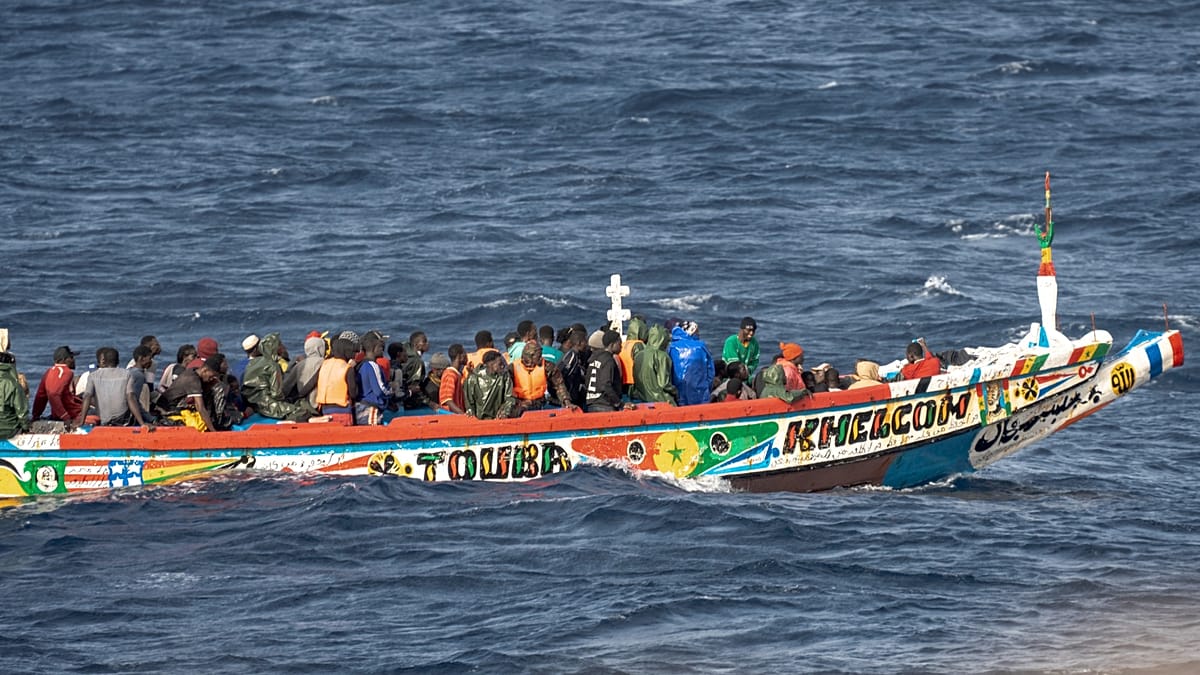
Mauritania's coastguard announced on Friday that it had rescued more than 300 migrants, among them 40 children, from an overloaded boat drifting off the country's Atlantic coast. The operation took place during the night from Wednesday to Thursday, near the fishing port of Nouadhibou, Mauritania's economic hub.
The wooden pirogue, which had departed from The Gambia, was carrying 315 people: 191 Senegalese nationals, 123 Gambians, and one Malian. The coastguard described the migrants as being "in a difficult humanitarian situation" when they were picked up, noting that the group included men, women, and minors, some of them infants.
A coastguard official, speaking to AFP on condition of anonymity, confirmed that the vessel had been drifting when it was located. The rescue comes just days after another operation in which 42 migrants, including women and children, were saved from a boat that had suffered engine trouble in the same waters.
A deadly route to Europe
For years, thousands of migrants have attempted the perilous Atlantic crossing from West Africa to Spain's Canary Islands, often aboard overloaded and poorly maintained fishing boats. The route, which stretches over 1,000 kilometres of open ocean, is one of the deadliest migration paths in the world. According to the International Organization for Migration, hundreds of people have died or gone missing in 2024 alone while trying to reach the Spanish archipelago.
Most of those attempting the journey come from Senegal, The Gambia, and Mali, fleeing poverty, political instability, and the impacts of climate change on agriculture and fishing. The boats, typically wooden pirogues designed for coastal fishing, are frequently not seaworthy for long voyages, and many capsize or break apart in rough seas.
Mauritania has become a key transit point and a staging ground for departures, with Nouadhibou and the capital Nouakchott serving as launch points. The country's coastguard has stepped up patrols in recent months, but the sheer volume of departures overwhelms rescue capacities. In July, the Mauritanian navy reported rescuing over 600 migrants in a single week.
The European Union has sought to cooperate with Mauritania and other West African nations to curb irregular migration, offering financial support and equipment in exchange for enhanced border controls. In February, the EU signed a €210 million agreement with Nouakchott aimed at boosting migration management and fighting smuggling networks. However, critics argue that such measures do little to address the root causes driving people to risk their lives at sea.
Spain's Canary Islands have seen record arrivals this year, with more than 30,000 migrants reaching the archipelago by the end of November, according to Spanish government figures. The islands' reception centres are stretched to breaking point, and local authorities have repeatedly called for more support from Madrid and Brussels.
The latest rescue off Nouadhibou highlights the ongoing humanitarian emergency on the Atlantic route. Survivors are typically taken to shore, where they receive medical attention and are processed by Mauritanian authorities. Many are eventually repatriated, but some attempt the journey again.
In a related development, Spain has begun relocating migrants from a makeshift beach camp in Ceuta to temporary shelters, as the Spanish enclave grapples with a surge in arrivals. The situation in Ceuta, along with the broader pressures on Spain's southern border, underscores the challenges facing European migration policy.
Meanwhile, the plight of unaccompanied minors in Ceuta has drawn criticism from human rights groups, who say that thousands of children are left without adequate protection. These issues are part of a wider European debate on how to manage migration humanely while respecting national sovereignty.
As the Atlantic route continues to claim lives, the need for a coordinated European response becomes ever more urgent. The EU's new Pact on Migration and Asylum, which entered into force in 2026, aims to create a more predictable and fair system, but its implementation remains uneven across member states.
For now, the coastguard in Mauritania remains on high alert, bracing for more departures as weather conditions improve in the coming months. Each rescue, like the one this week, is a reminder of the human cost of a crisis that shows no signs of abating.