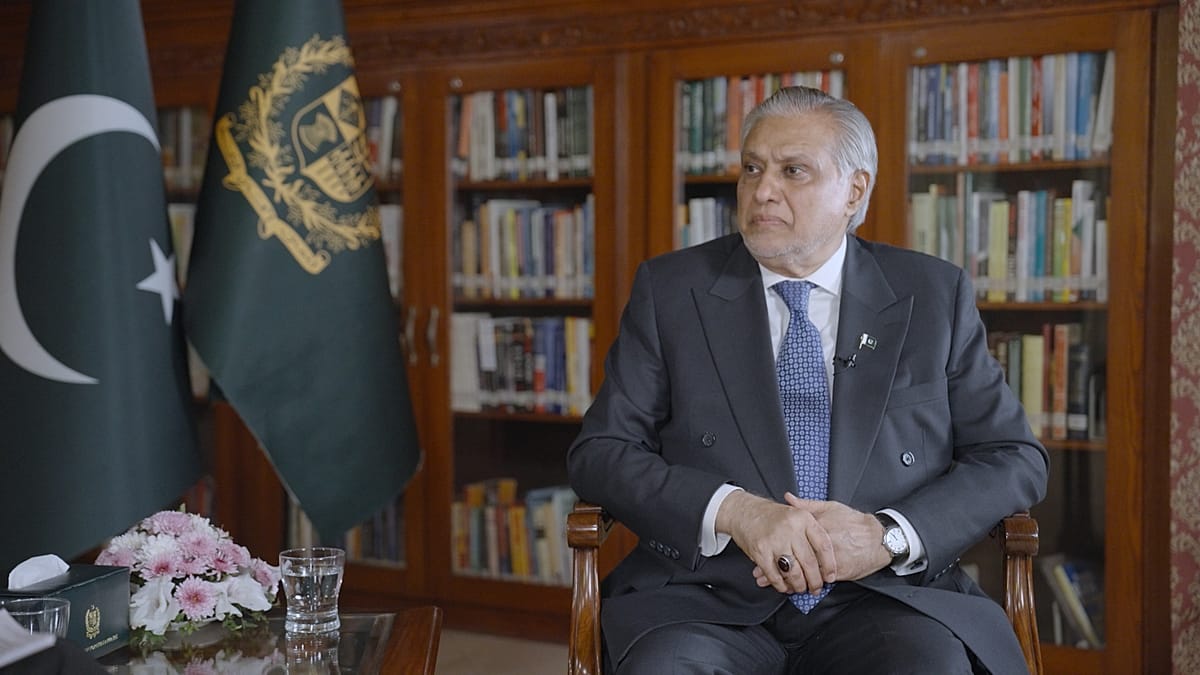
Pakistan's Deputy Prime Minister and Foreign Minister Mohammad Ishaq Dar has told Euronews that a new regional security architecture for the Middle East will not only stabilise the Gulf but also deliver tangible benefits to Europe and the wider global economy. In an exclusive interview in Islamabad for Euronews' World Conversation programme, Dar outlined the complex diplomatic efforts involving Pakistan, Turkey, Saudi Arabia and other regional players, with Europe as a key partner.
"We all have to see the new security architecture and the consequences on the global economy," Dar said, stressing that the framework would extend beyond the Gulf region. He described the mutual defence pact signed by Pakistan, Turkey and Saudi Arabia in August—often referred to as the Mecca Pact—as a potential "beginning of the regional security architecture." According to Dar, this pact is designed to ensure collective and individual security, and its benefits would ripple far beyond the immediate signatories.
European engagement and the Mecca Pact
Dar confirmed that the UK, France and Germany are already engaging with the new security structure, and that Italy has expressed interest in joining the dialogue. This European involvement, he suggested, reflects a shared recognition that stability in the Middle East is inseparable from European security and economic interests. The EU-UK security partnership could thus gain a new dimension through this regional initiative.
The Mecca Pact, signed in August, commits the three nations to mutual defence and cooperation. Dar framed it as a building block rather than a finished product, hinting that other countries in the region and beyond could eventually join. "It will help not only the region but countries beyond it too," he said, underscoring the global stakes.
Behind the scenes of the US-Iran agreement
In the interview, Dar revealed Pakistan's early role in mediating between the US and Iran, dating back to the first day of the war on 28 February. He described how he called his Iranian counterpart, Abbas Araghchi, at dawn to urge restraint. "Please exercise strength and don't react," Dar recalled, fearing that Iran might retaliate against Gulf states—which, he noted, unfortunately happened.
That phone call, Dar said, marked the beginning of an intensive diplomatic process. "The entire process began on that day," he explained. Pakistan's leadership then worked tirelessly to bring the parties to the negotiating table, culminating in a marathon 21-hour session with only brief consultative breaks. "After the fifth round, I was very sure that by the sixth round we had covered so much mileage that we reached a point of agreement," Dar said.
The result was the US-Iran Memorandum of Understanding signed on 18 June, which ended the war. Dar credited Pakistan's persistence: "We didn't give up." He also highlighted a core principle of the agreement that gained near-universal support: the free movement of shipping through the Strait of Hormuz, with no tolls, permits, fees or permissions. "The sea lanes must be seen as a free movement," he insisted, adding that Pakistan has not abandoned this goal and that all parties are still working hard to achieve it.
The European Union and the UK backed this diplomatic process, according to Dar. The agreement's emphasis on open sea lanes is particularly relevant for Europe, which relies heavily on Gulf energy supplies. The IEA has called the Middle East crisis the gravest energy security threat ever, underscoring the stakes for European consumers and businesses.
Dar's comments come as Europe grapples with its own security challenges, from the war in Ukraine to the need for greater strategic autonomy. The recent Berlin talks on Ukraine highlighted the limits of international declarations, while Norway's firm stance against Russian vetoes shows the continent's resolve. A stable Middle East, Dar argues, would ease pressure on Europe's security and economic fronts.
As the regional architecture takes shape, Pakistan is positioning itself as a key broker between the Gulf, Europe and the wider world. Whether the Mecca Pact evolves into a broader framework remains to be seen, but Dar's message is clear: Europe stands to gain from a more secure Middle East, and Pakistan is ready to help build it.