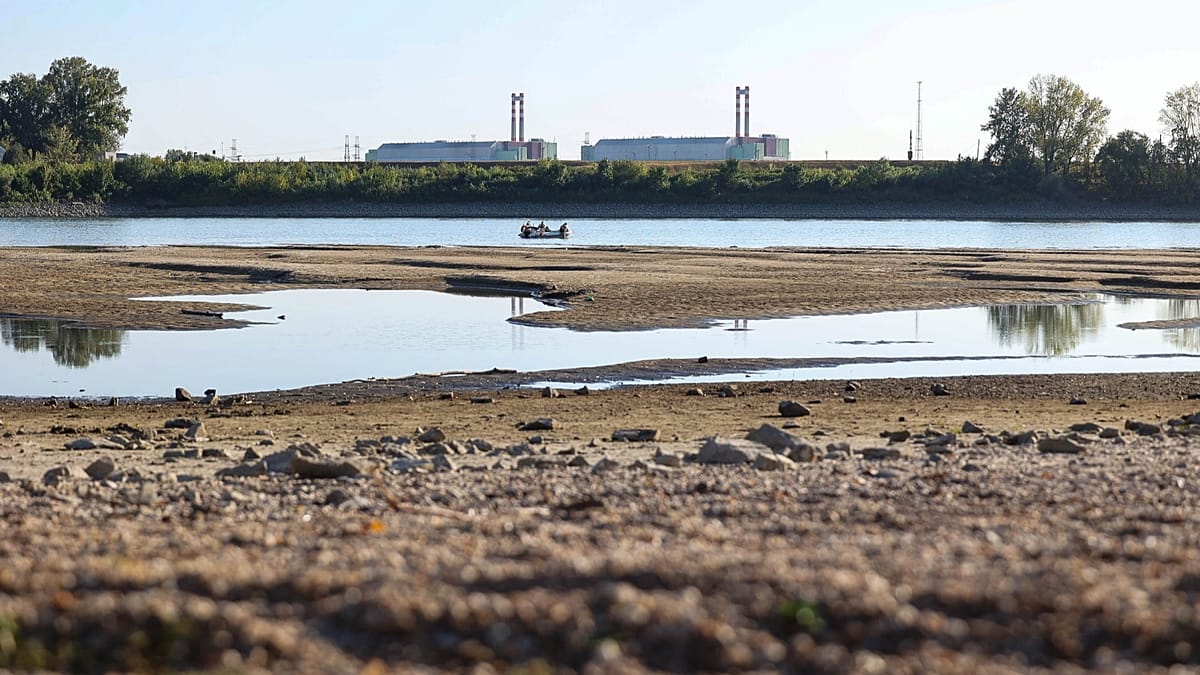
Budapest — Hungary's Prime Minister Péter Magyar has expressed cautious optimism that the Paks nuclear power station could resume operations in the near future, as water levels in the Danube continue their slow recovery from record lows. The plant, which relies on the river for cooling, was shut down on Sunday after the Danube dropped to unprecedented depths, a consequence of successive heatwaves that have gripped much of Europe since May.
In a post on X on Thursday, Magyar noted that the water level at Paks had climbed nine centimetres above Sunday's low, with further rainfall expected in the Austrian catchment areas. "The turbine at Paks is operating," he wrote, while urging Hungarians to voluntarily reduce electricity consumption during the scorching day ahead. The prime minister's comments came as Budapest recorded its highest-ever temperature on Wednesday, with 41.1°C measured in the Újpest district.
Stabilisation and gradual recovery
Magyar visited the plant on Tuesday to receive a briefing on the situation. He said conditions had stabilised once the Danube's water level stopped falling below the critical threshold and began to edge upward. By Tuesday evening, the level had risen five centimetres from the morning reading; by Wednesday morning it had gained another centimetre, reaching -134 centimetres at 8 AM. By Thursday morning, it stood at -131 centimetres.
At Budapest, the Danube is now 14 centimetres higher than last Sunday's low, according to the national water management authority. While the upward trend is encouraging, officials caution that the plant's full return to normal operation will require the water level to remain consistently above current readings. Restarting the units that were shut down will take time, and the last operating turbine can only be kept running if the river continues to cooperate.
The situation at Paks is part of a broader energy challenge across central Europe. Record-low river levels have forced emergency measures in several countries, affecting not only nuclear power but also hydropower generation and barge transport. The Danube's troubles mirror those of the Rhine, where drought has also pushed water levels to historic lows, disrupting shipping and industrial supply chains in Germany.
Hungary's reliance on the Danube for cooling makes Paks uniquely vulnerable to such climatic extremes. The plant, which supplies about half of the country's electricity, has been a cornerstone of the national grid since the Soviet era. Its prolonged shutdown would have forced Hungary to rely more heavily on imported power and fossil fuels, a prospect that Magyar's government has been keen to avoid.
The prime minister's upbeat assessment comes amid a broader political transition in Hungary. Magyar's rapid rise to power has reshaped the country's political landscape, and his handling of the energy crisis is being closely watched both at home and abroad. The Paks situation is also a test of his administration's ability to manage critical infrastructure under climate stress.
While the immediate crisis appears to be easing, the underlying issue remains: Europe's rivers are increasingly unreliable as a source of cooling water and hydropower. Hydropower output across the continent has hit record lows this year, forcing utilities to turn to natural gas and other fossil fuels to fill the gap. The drought has also raised questions about the long-term viability of river-dependent energy systems in a warming world.
For now, Hungarians can breathe a tentative sigh of relief. The Danube is rising, the turbine is spinning, and the worst may be over—at least for this summer. But the episode serves as a stark reminder that Europe's energy infrastructure must adapt to a climate that is no longer predictable. As Magyar put it, the coming days will still require "people to cut their consumption voluntarily," a plea that may become increasingly familiar across the continent.