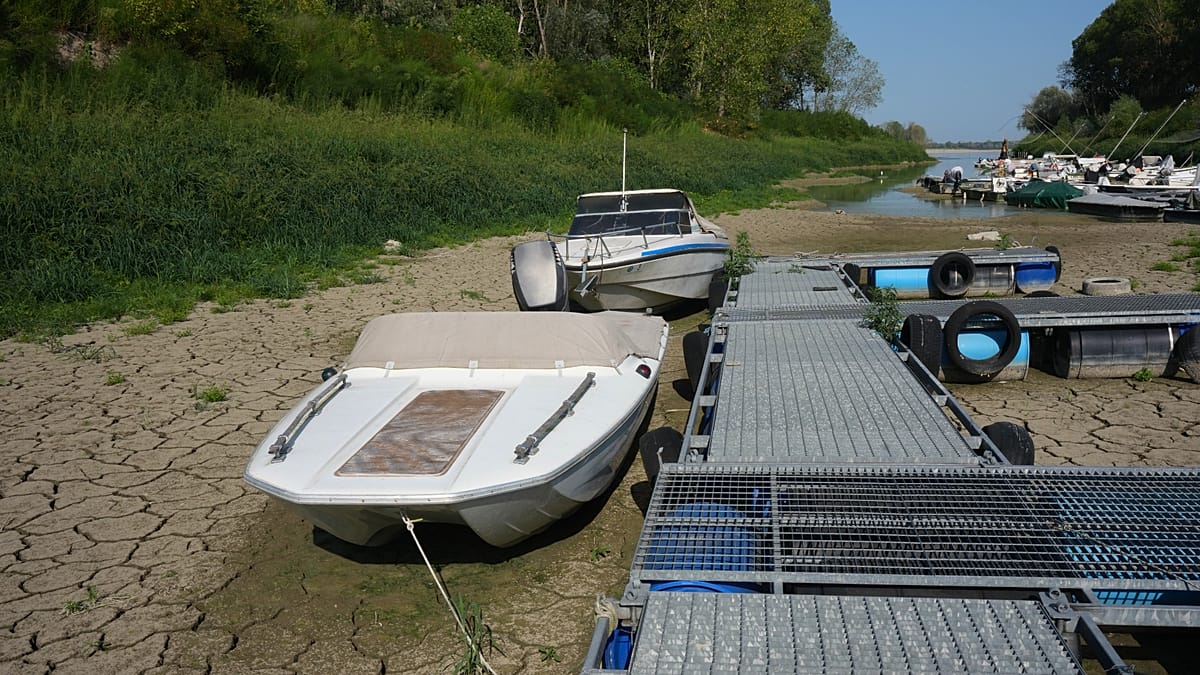
Italy's longest river, the Po, has dropped to levels not seen in decades, a stark symptom of a summer that will not relent. Near Pavia, in Lombardy, wide stretches of riverbed now lie exposed, baked by a fourth consecutive heatwave that has settled over the country. The sight has revived fears for water supplies and agriculture across the entire Po Valley, a region that produces roughly a third of Italy's food.
A lifeline under pressure
The Po runs from the Alps in Piedmont to the Adriatic, threading through some of the most productive farmland in Europe. Its waters irrigate rice paddies, cornfields, and orchards, and feed the industrial heartland around Turin, Milan, and Bologna. When the river runs low, the consequences ripple far beyond the riverbanks.
This summer's repeated heatwaves have accelerated evaporation and melted the Alpine snowpack earlier than usual, leaving the Po dependent on rainfall that has largely failed to arrive. The result is a river that, in places, resembles a stream winding through gravel and sand. Local authorities have already imposed water-use restrictions in several municipalities, and farmers are bracing for reduced harvests.
"We are seeing conditions that used to be exceptional become the new normal," said Marco Bussoni, a farmer who grows maize and wheat near Piacenza. "The soil is dry, the river is low, and we are forced to pump groundwater that is also becoming scarcer."
Regional and European implications
The crisis in the Po Valley is not isolated. Across southern Europe, from Spain to Greece, drought and heat are straining water systems and energy production. In France, heat and drought have already knocked out a fifth of nuclear capacity, as rivers used for cooling run too warm. The situation underscores how climate change is testing the continent's infrastructure and food security.
Italy's government has declared a state of emergency in several regions and is considering a national water strategy that would include new reservoirs and modernized irrigation networks. But such measures take years to implement, while the immediate need is urgent.
"We cannot rely on emergency responses alone," said environmental scientist Giulia Verdi of the University of Milan. "We need a long-term plan that treats water as a strategic resource, not an infinite one."
Looking ahead
Forecasters say the heatwave may ease in the coming days, but the damage to crops and water reserves may persist. The Po's low levels also allow saltwater to intrude from the Adriatic, contaminating freshwater aquifers and further threatening agriculture.
For the people of the Po Valley, the river is more than a waterway; it is a symbol of their livelihood and identity. As the riverbed widens and the water recedes, the question is whether this summer is an anomaly or a preview of a drier future. Western Europe's repeated heatwaves are already straining water, health, and the economy, and Italy is on the front line.
In the meantime, farmers like Bussoni are adapting, switching to less water-intensive crops and investing in drip irrigation. But they know that adaptation has limits. "We can change our methods, but we cannot change the weather," he said. "If the river keeps falling, no amount of technology will save us."