How would Velázquez's Las Meninas look if the sun suddenly dimmed? What shadows would creep across Goya's sun-drenched meadows? Madrid's Prado Museum has posed these questions in a new audiovisual project timed to the total solar eclipse that will sweep across Spain on 12 August 2026.
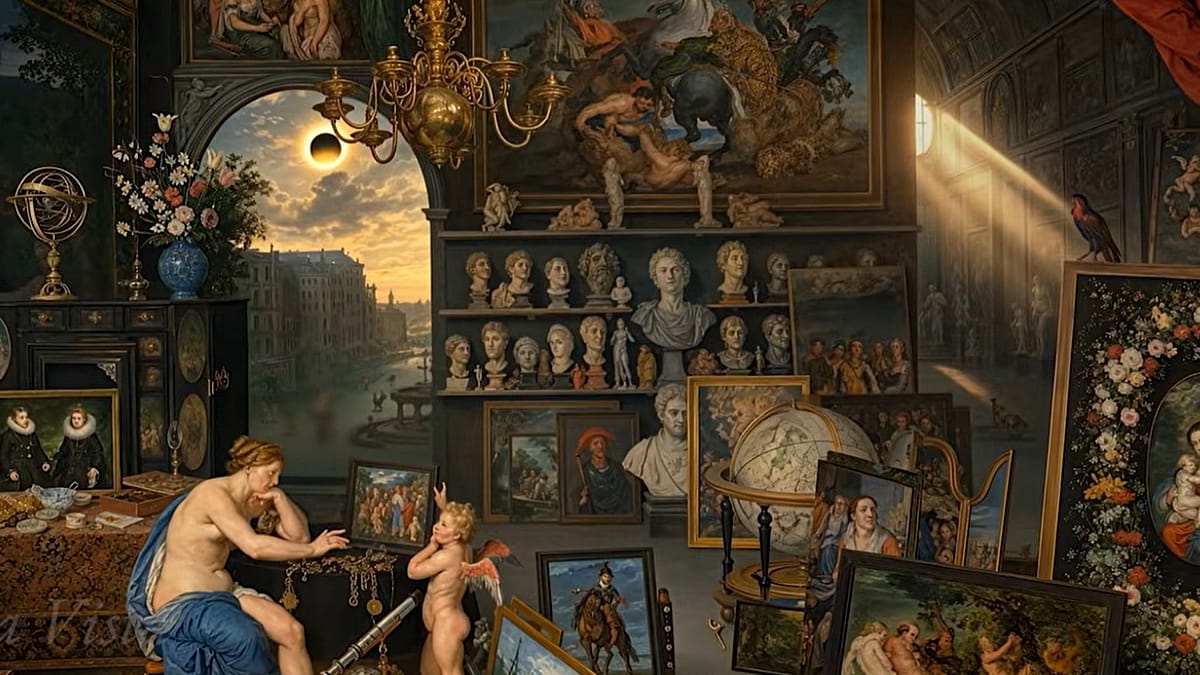
The video, titled El Prado a la luz del eclipse (The Prado in the Light of the Eclipse), uses artificial intelligence and digital art to simulate the progressive darkening of eleven iconic paintings from the museum's collection. As the virtual eclipse advances, colours shift, contrasts deepen, and familiar compositions take on an unfamiliar, almost theatrical atmosphere.
An eclipse through the eyes of the masters
The selected works span four centuries of European art, from Albrecht Dürer's Self-Portrait (1498) to Carlos de Haes's 19th-century landscape of the Picos de Europa. Alongside Velázquez's Las Meninas and The Forge of Vulcan, the video features Rubens and Brueghel the Elder's La Vista, Claude Lorrain's Embarkation of Saint Paula Romana, Goya's The Parasol and Meadow of San Isidro, José de Ribera's Jacob's Dream, Corrado Giaquinto's The Birth of the Sun and the Triumph of Bacchus, and José Casado del Alisal's The Surrender of Bailén.
Each painting reacts differently to the changing light. In landscapes, the eclipse casts long shadows and cools the palette; in portraits, it softens features and heightens contrasts. The effect is not merely aesthetic—it reveals details that are often lost in the bright, even lighting of museum galleries.
The production was developed by the Madrid-based studio AMB Piensa, which combined video-generation models with traditional graphic intervention. The AI was used to simulate depth, camera movement, and the precise progression of the eclipse's shadow across each scene. But the process was not fully automated: every sequence was reviewed and manually adjusted to preserve the composition, brushwork, and character of the original paintings.
“We wanted to show that technology can serve art, not distort it,” said a museum spokesperson. “Each frame was checked to ensure the eclipse enhanced the work without betraying its essence.”
Art meets astronomy
The project is part of a broader cultural outreach effort by the Prado, which hopes to attract audiences who might not normally visit a museum. By combining a spectacular astronomical event with digital innovation, the museum aims to make its collection accessible in a format that resonates with contemporary viewers.
Spain is bracing for a rare series of eclipses beginning in 2026, and the event has generated widespread excitement. The upcoming eclipse trio has also prompted practical preparations, from security measures in the Balearic Islands to advice on filming the eclipse safely. The Prado's video adds an artistic layer to the scientific and logistical discussions.
The underlying question is an old one: how much of what we see in a work of art depends on the light in which we view it? By simulating an eclipse, the museum invites viewers to reconsider the role of illumination in shaping our perception of colour, form, and mood.
For those unable to witness the eclipse in person, the video offers a way to experience its transformative power through the lens of Europe's artistic heritage. It also underscores the Prado's commitment to innovation, using new technologies to enrich the interpretation of its collection without sacrificing rigour or respect for the originals.
The video is available on the Prado's website and social media channels, and will be screened in the museum's auditorium on the day of the eclipse.