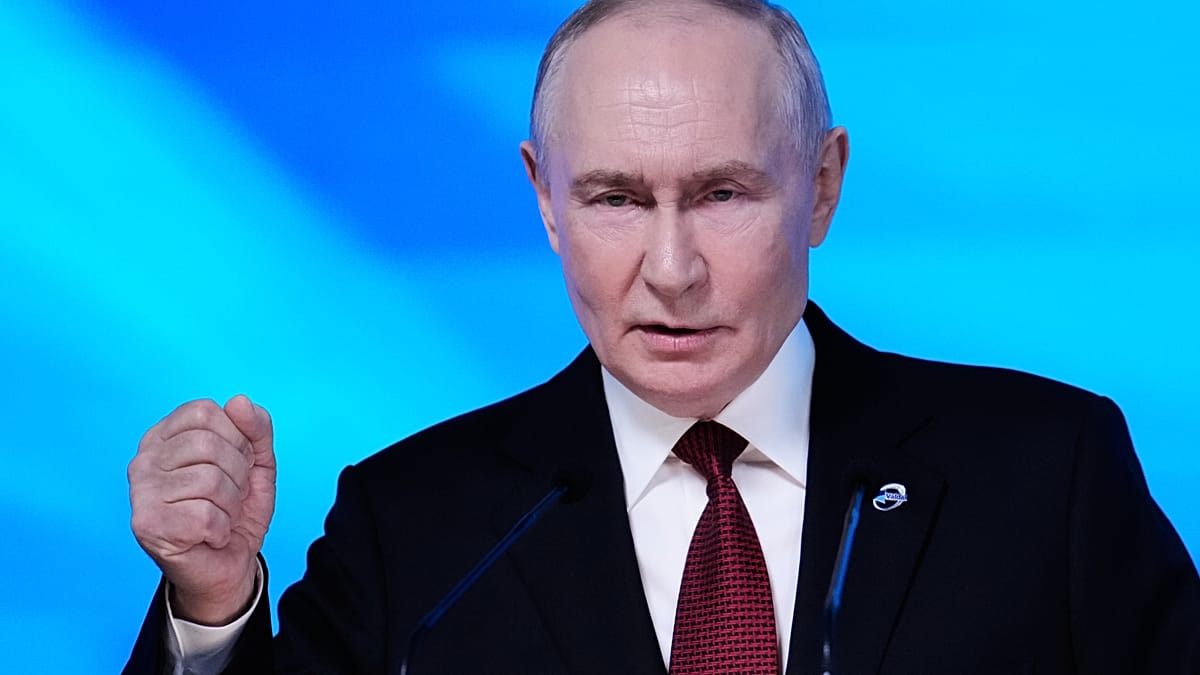
Russian President Vladimir Putin has warned that any direct attack on the exclave of Kaliningrad would prompt Moscow to deploy the full range of its military arsenal, including nuclear weapons. Speaking at the annual Valdai forum on Thursday, Putin said that if a strike were launched against Russian territory, the question of using all available weaponry would be on the agenda immediately.
Kaliningrad, a heavily militarised Russian territory sandwiched between Poland, Lithuania, and the Baltic Sea, has become a flashpoint in the broader confrontation between Moscow and NATO. The region hosts Russian nuclear-capable missiles and serves as a strategic outpost for the Baltic Fleet, making it a key focus of alliance planning.
Putin's remarks came amid a series of NATO military exercises along the exclave's borders in recent months. Moscow has repeatedly condemned these drills, describing them as provocative and destabilising. In a statement, the Russian Foreign Ministry accused NATO leadership and member states of engaging in actions that threaten regional security.
NATO, for its part, has dismissed Russian nuclear rhetoric as irresponsible and dangerous. Alliance officials have stressed that their exercises are defensive in nature and designed to reassure member states in the region, particularly the Baltic republics of Estonia, Latvia, and Lithuania.
Escalation fears in the Baltic region
Putin used his Valdai appearance to criticise what he called the "successive military exercises in the Baltic Sea" and alleged attempts to intercept Russian vessels. "All this constitutes an escalation," he said, while reiterating that Russia has no intention of attacking anyone, neither in 2029, 2030, nor 2050.
The Russian leader's comments are likely to heighten concerns among European allies, especially in Warsaw and Vilnius, which have long viewed Kaliningrad as a potential launchpad for Russian aggression. The exclave is separated from mainland Russia by hundreds of kilometres, and its defence would rely heavily on air and naval assets, as well as on the ability to deter NATO intervention.
Analysts note that Putin's threat of using "all types of weapons" is consistent with Russia's nuclear doctrine, which allows for the use of atomic arms in response to a conventional attack that threatens the state's existence. However, the ambiguity of what constitutes a direct attack on Kaliningrad adds to the uncertainty.
The situation has also drawn attention to the broader energy and security landscape in Europe. As winter approaches, Russian strikes on Ukraine's power grid have underscored the Kremlin's willingness to use military force beyond its borders, while EU naval missions in the Mediterranean have been expanded to counter Russian shadow fleet activities.
NATO's response to Putin's latest remarks has been measured. Earlier this year, NATO's chief dismissed Russian nuclear threats, stating that there is no immediate danger to the alliance. Yet the alliance continues to bolster its eastern flank, with enhanced forward presence battalions in Poland and the Baltics.
Some European leaders have urged a more diplomatic approach. Bulgaria's prime minister has called for EU dialogue with Russia to reduce nuclear risks, a stance that reflects the divisions within the bloc over how to handle Moscow.
Putin's comments at Valdai are part of a pattern of escalating rhetoric that has characterised his recent public appearances. They also come as Russia continues to face international isolation over its invasion of Ukraine, with the EU and the US imposing sweeping sanctions.
For the residents of Kaliningrad, the threat of being caught in a potential conflict is a daily reality. The exclave's economy is heavily dependent on transit through EU territory, and any military escalation would have immediate consequences for its 1 million inhabitants.
As the war in Ukraine grinds on, the risk of miscalculation in the Baltic region remains a central concern for European security. Putin's latest warning serves as a reminder that the continent's stability hinges on the delicate balance of deterrence and diplomacy.