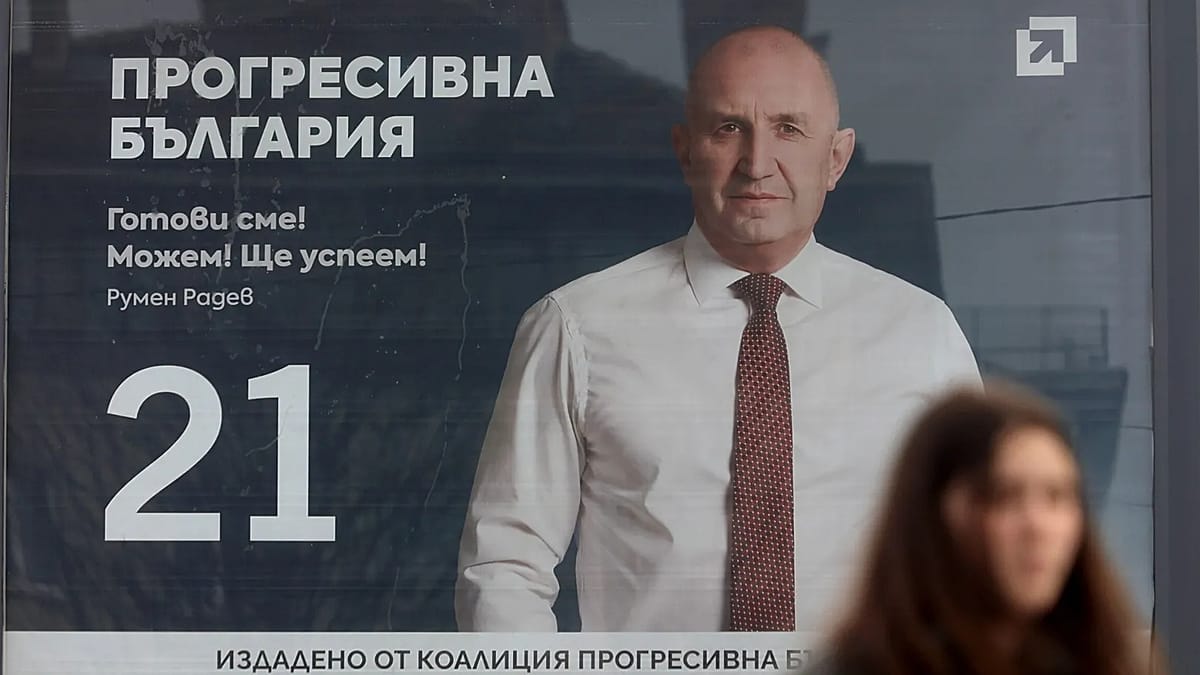
Bulgaria's prolonged political crisis appears to have reached a turning point with the victory of the Progressive Bulgaria coalition, led by former President Rumen Radev. The result of Sunday's election—the eighth parliamentary vote in five years—positions the 62-year-old former fighter pilot to become the country's next prime minister, potentially steering the EU's poorest member state toward a more Russia-friendly foreign policy while grappling with deep-seated corruption and social discontent.
A Pilot's Political Ascent
Radev, who served as Bulgaria's head of state from 2017 to 2026, has cultivated an image as an outsider capable of cleansing a political system widely seen as captured by oligarchs. A graduate of the elite US Air War College and former commander of the Bulgarian Air Force, he entered politics in 2016, winning the presidency largely on an anti-establishment platform. His re-election in 2021 with two-thirds of the vote demonstrated a durable appeal, which he has now parlayed into a parliamentary victory.
His political persona is defined by austerity and reserve, a contrast to the polished communicators who have dominated Bulgarian politics. "He sometimes gives the impression of reciting a memorised text," observers note, particularly when discussing policy proposals like using AI to regulate public tenders or reforming the judiciary. Yet, his modest lifestyle and intense patriotism have resonated with voters weary of scandal and perceived elite corruption.
The Russia Question and European Tensions
Radev's potential premiership introduces a significant geopolitical variable into European Union dynamics. Throughout his presidency and the recent campaign, he has consistently advocated for renewing dialogue with Moscow, even as Russia's full-scale invasion of Ukraine continues. "Bulgaria is in a unique position, because we are the only EU member state that is both Slavic and Eastern Orthodox," Radev argued recently. "That should be used ... and we really can be a very important link in this whole process, which I am sure will sooner or later begin, to restore relations with Russia."
This stance has put him at odds with the broader EU consensus on isolating Russia. As president, he criticized military aid to Ukraine and the bloc's efforts to reduce dependence on Russian energy. His call last year for a referendum on Bulgaria's adoption of the euro—which failed, with Sofia joining the eurozone on 1 January 2026—further highlighted his sceptical approach to deeper European integration. This comes as other European leaders, such as Estonia's president, urge a stronger EU defence posture in response to Russian aggression.
"Geographically, economically, in terms of resources and as a market, we need to rebuild those relations," Radev has insisted, framing the issue as one of pragmatic necessity for Bulgaria.
Sociologist Parvan Simeonov suggests Radev's positioning is emblematic of a regional pattern, where leaders "depending on the visiting delegation, choose whether or not to fly the Ukrainian flag in the background." This balancing act will be severely tested if Radev assumes executive power, forcing him to reconcile his pro-dialogue rhetoric with the EU's unified sanctions regime.
Domestic Promises: Stability and Social Justice
Domestically, Radev has presented himself as a defender of Bulgaria's lowest earners, campaigning on combating social inequalities and promoting budgetary discipline without radical change. His coalition brings together a disparate group of military officers, former socialist officials, athletes, and even the union leader of the country's main arms manufacturer—a sector that has ironically boomed from supplying Ukraine's army.
His appeal rests heavily on a promise to end the chronic instability that has seen no government survive a full term in five years, replaced by a cycle of caretaker administrations and fragile coalitions. Public trust has evaporated, and voter turnout has entered a state of chronic decline. The election itself was held under the shadow of a disinformation surge, prompting Bulgaria to activate the EU's Digital Shield for protection.
Radev's connection to popular protest movements has been a key element of his credibility. In 2020, he openly supported anti-corruption demonstrators, famously walking out of the presidential palace with his fist raised to join rallies that ultimately toppled the government of long-serving Prime Minister Boyko Borissov a year later. He backed protesters again late last year, and when the last government resigned in December, he stepped down from the presidency to run in this election.
The Path Ahead for Bulgaria and Europe
Radev's victory represents a search for stability in a nation fatigued by perpetual elections, but it also signals a potential shift in Bulgaria's European orientation. His coalition's success underscores the persistent societal and political divisions within Bulgaria exposed by the war in Ukraine—a fault line that continues to define the national conversation.
The incoming government will face immediate challenges: forming a stable coalition in a fragmented parliament, addressing economic grievances in a country with the EU's lowest GDP per capita, and navigating the conflicting pressures of EU unity and Radev's own calls for engagement with Moscow. His approach will be watched closely in Brussels and other European capitals, particularly those on NATO's eastern flank. It also presents a contrasting vision to other European leaders managing relations with adversarial states, much like the pragmatic course on Chinese investment charted by Hungary's Péter Magyar.
For now, Radev has hailed a "victory of hope." Whether he can translate that hope into durable governance and a coherent policy that satisfies both his domestic base and Bulgaria's European partners remains the critical, unanswered question facing Sofia and the continent.



