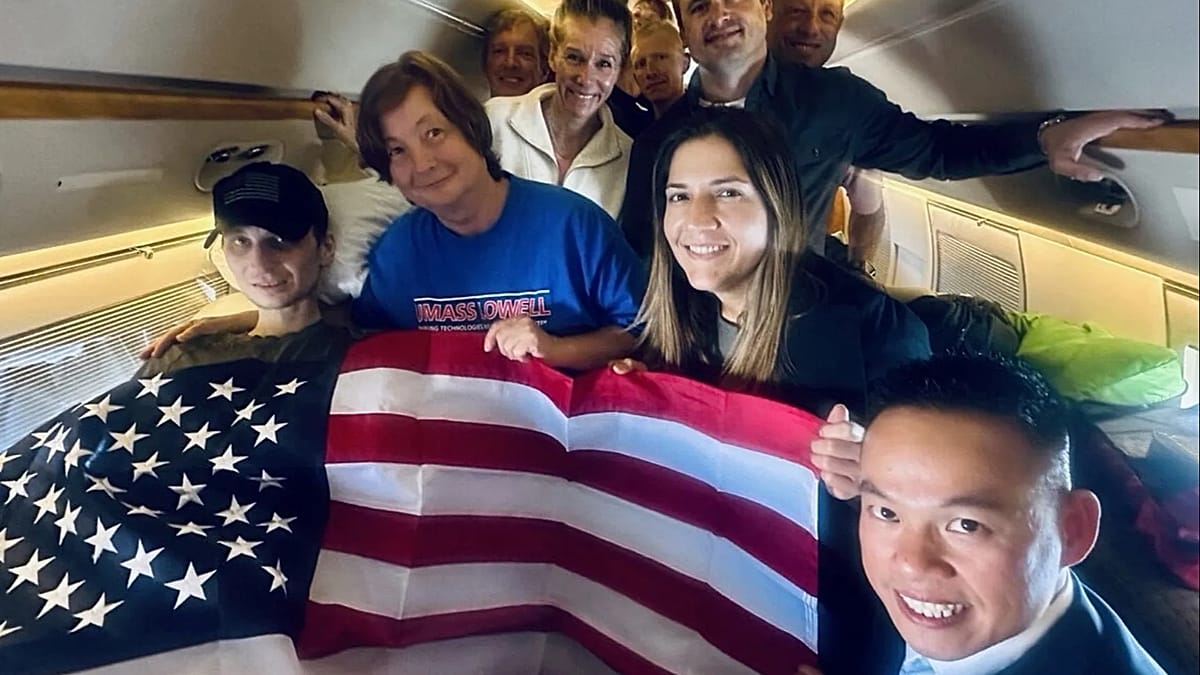
Robert Gilman, a former United States Marine, is on his way back to the United States after being released from prison in Russia, where he had been held since 2022. The release was confirmed by US President Donald Trump, who said his Russian counterpart, Vladimir Putin, had approved it on humanitarian grounds.
Gilman, who was reportedly in poor health and had been held in a psychiatric ward of a hospital, is expected to land at Andrews Air Force Base near Washington, D.C., on Tuesday evening. Trump said he had spoken with Gilman, who asked for a "GREAT cheeseburger" upon landing—a request the president said he would personally take care of.
Background of the case
Gilman was arrested in Russia in 2022 after an incident on a train in Voronezh, south of Moscow, where he was accused of assaulting a police officer. He was sentenced to four and a half years in prison, but his sentence was later extended to ten years after he was alleged to have attacked prison staff.
According to US Senator Ed Markey of Massachusetts, Gilman was diagnosed with a "dissociative stupor" about fifty days ago and became "non-responsive." Markey described him as "essentially catatonic" and noted that he had also suffered from a severe case of pneumonia.
The release comes amid a broader context of US-Russia prisoner exchanges, though Trump emphasized that Moscow did not request a swap in this instance. Secretary of State Marco Rubio thanked Russia for cooperating with special envoy Steve Witkoff to secure Gilman's release, which he said would allow Gilman "to receive the necessary medical treatment here in the United States."
Rubio also made clear that Washington remains committed to securing the return of other Americans detained in Russia. "The President will not stop until all unjustly detained Americans are home," he wrote on X.
This development follows a series of recent diplomatic tensions between Washington and Moscow, including new US sanctions on Russian energy revenues and ongoing concerns over Russian military strikes in Ukraine. The release of Gilman may be seen as a rare positive step in an otherwise strained relationship.
European observers will note that this case highlights the broader issue of foreign nationals detained in Russia, a concern that has resonated across the continent, particularly after the detention of several European citizens in recent years. The European Union has consistently called for the release of all individuals held on politically motivated charges.
Gilman's family, who have campaigned for his release, expressed relief and gratitude. His sister, Lexie Hudson, had previously shared photos of him in better times, and the family has been vocal about his deteriorating health.
As Gilman returns to the US, questions remain about the long-term impact of his detention on his physical and mental health. Medical experts will likely assess his condition upon arrival, and he is expected to receive comprehensive care.
The release also raises questions about the future of US-Russia relations, with some analysts suggesting that humanitarian gestures could pave the way for more substantive dialogue. However, given the ongoing conflict in Ukraine and the broader geopolitical tensions, any thaw in relations remains uncertain.