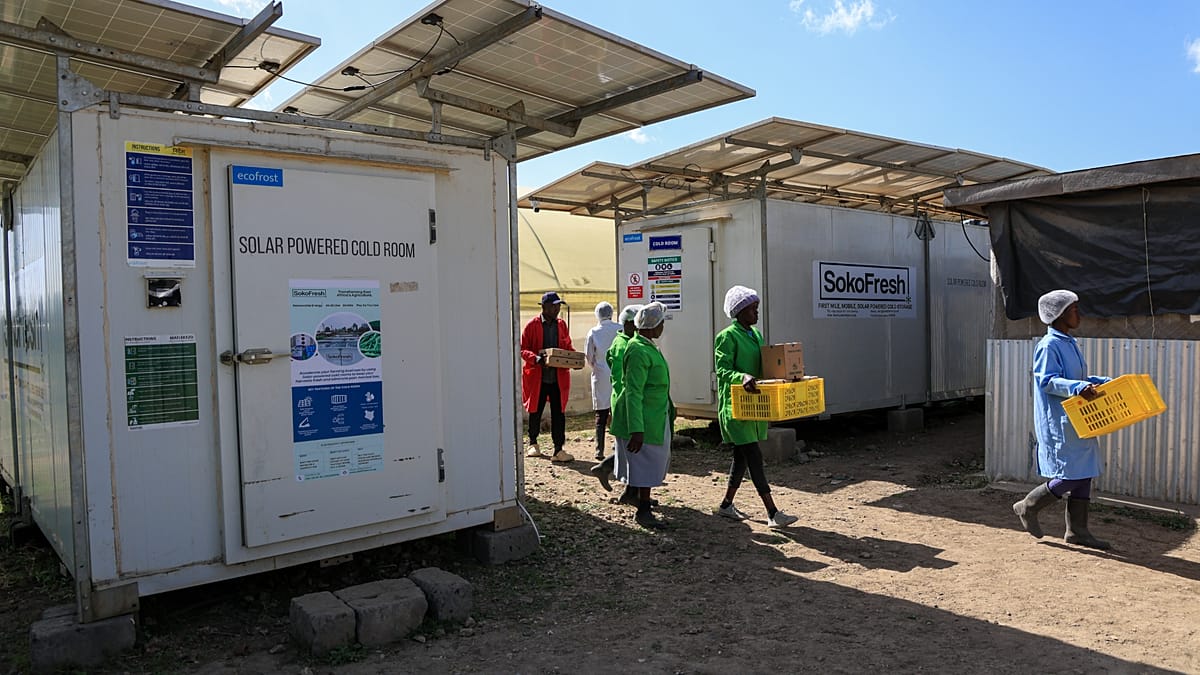
For European consumers accustomed to pristine vegetables from Kenya or Ethiopia, the journey from farm to table involves overcoming drought, extreme heat, and unreliable infrastructure. A quiet revolution in solar-powered cold storage is now helping smallholder farmers preserve their harvests, reduce waste, and boost incomes—a development with direct implications for Europe's food supply chains.
In Kitengela, Kenya, farmer Yvonne Anyonyi Mumiah walks between rows of rosemary and basil destined for European supermarkets. "You can do everything right on the farm, but if the produce is not stored properly, you lose both the product and income," she explains. Her solution: solar-powered cold storage units that keep her herbs fresh for weeks rather than days.
Pay-per-use model lowers barriers
The upfront cost of a solar-powered cold room—around $30,000 (€25,000)—is prohibitive for most smallholders. Companies like Soko Fresh and ColdHubs have introduced a pay-per-use model, charging farmers based on kilograms stored. This approach has cut spoilage rates from up to 50% to under 2%, while helping farmers earn up to 50% more per kilogram. The model is gaining traction across Kenya, Nigeria, Ethiopia, Rwanda, and South Africa.
"Cold storage remains one of the missing links in Africa's agricultural value chains," says Emmanuel Aziebor, regional director for Africa at CLASP, a nonprofit promoting energy-efficient appliances. "When farmers can store produce for longer, they gain access to better markets, reduce waste, and increase incomes."
The challenge is acute as climate change intensifies. Rising temperatures accelerate spoilage of vegetables, fruits, dairy, and fish, while unreliable electricity grids make conventional refrigeration expensive or impractical in rural areas. Solar-powered, off-grid cold rooms bypass these issues entirely.
Economic benefits outweigh environmental gains
While solar cooling reduces reliance on diesel generators—cutting fuel costs and emissions—experts argue the primary benefit is economic. For decades, development efforts focused on expanding electricity access across Africa, but less attention was paid to productive use. "We have neglected the conversation around how people can turn electricity into opportunity," Aziebor notes. "Unless people can use that power productively, the economic benefits never fully materialise."
This shift mirrors trends in Europe, where plug-in solar panels are empowering households to generate their own power. In Africa, solar-powered irrigation, milling machines, and processing equipment are enabling year-round farming and value addition closer to the source.
Funding remains a bottleneck. "The challenge today is not demonstrating that these systems work," says Carol Koech, vice president for Africa at the Global Energy Alliance for People and Planet. "It is building enough bankable projects that can attract larger pools of investment." Grants and low-interest loans help cover upfront costs, but commercial investors remain cautious due to fragmented markets dominated by small-scale producers.
Denis Karema, CEO of Soko Fresh, adds: "These investors see emerging technologies as high risk because we lack enough proven business models with reliable returns."
For European importers, the implications are clear. As climate pressures mount on global supply chains, innovations like solar-powered cold storage could become essential for ensuring consistent quality and reducing food loss. The technology is already proving its worth: in Nigeria, ColdHubs has installed walk-in cold rooms in major agricultural markets; in Rwanda, solar refrigeration supports dairy cooperatives; in Ethiopia, cold-chain investments are expanding horticultural exports.
The broader lesson, analysts say, is that renewable energy can do more than power homes—it can transform livelihoods. As Europe pushes for greater solar adoption, similar models could help bridge the gap between energy access and economic opportunity across the continent and beyond.