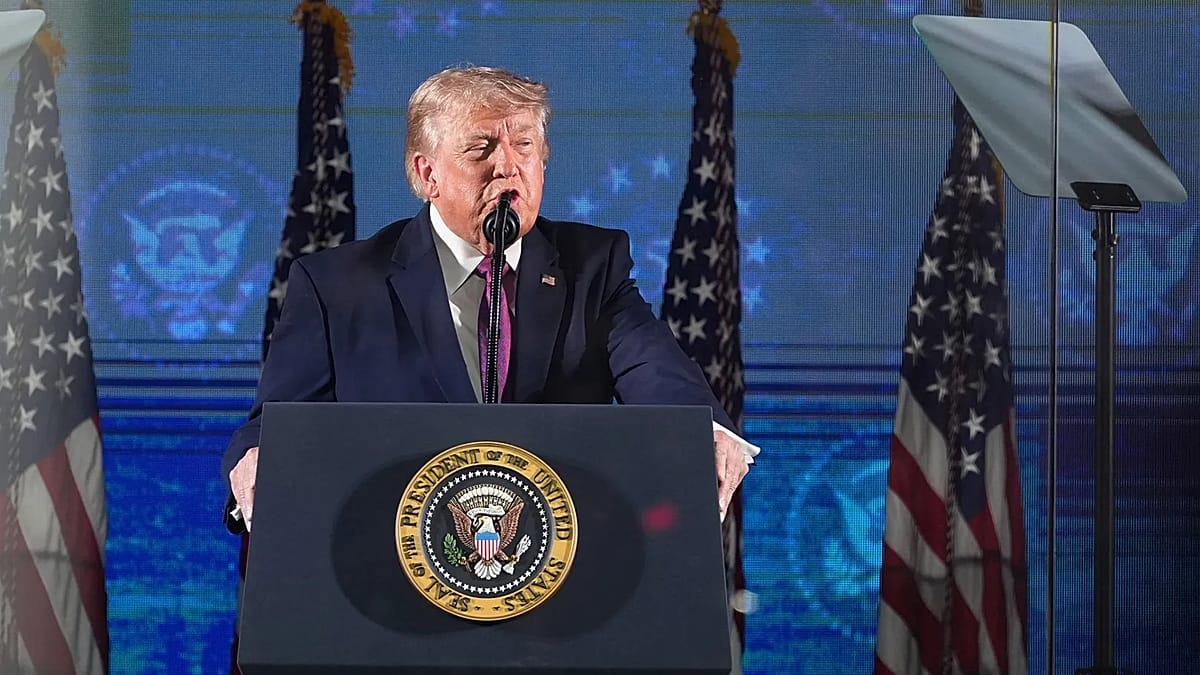
President Donald Trump delivered a defiant Fourth of July address from the National Mall in Washington, D.C., marking the 250th anniversary of American independence with a speech that blended historical triumphalism with sharp attacks on domestic political opponents. The event, which the White House had billed as the country's 'most important milestone,' featured a large fireworks display over a stormy capital.
'The American dream is back,' Trump told a cheering crowd, framing his presidency as a restoration of national greatness. 'No people have done more good, shown more courage, made more progress, righted more injustice, or achieved more greatness than you, the American people.' He added that for 250 years, the United States had been 'the hope, the promise, the light, and the glory among all of the nations of the world.'
Military Interventions and Domestic Rhetoric
Trump briefly referenced recent US military actions abroad, including the January seizure of former Venezuelan President Nicolás Maduro and what he described as having 'wiped out' Tehran's military during the Iran war. These remarks come amid ongoing tensions between Washington and European allies over the scope of US military engagement, particularly in the Middle East. The former US NATO envoy has described Trump's anger at allies as an 'exaggeration', but the president's rhetoric continues to unsettle European capitals.
The president also renewed his criticism of 'communists' — a term he frequently uses to describe his Democratic opponents and progressive activists. 'Our warriors did not fight communism on battlefields across the world only to have that menace rear its ugly head right back here in America,' he said. 'It's like a cancer. You got to cut it out.'
This language echoes themes Trump has used in previous speeches, including during his campaign rallies, and reflects a deepening polarization in US politics that European observers have watched with concern. The recent court ruling allowing Trump to remove climate and slavery signs from national parks has further highlighted the administration's cultural battles.
European Reactions
World leaders, politicians, and royals sent messages of congratulations to the US ahead of the celebrations. Ukrainian President Volodymyr Zelenskyy, European Commission President Ursula von der Leyen, and King Charles III all issued statements. Von der Leyen, who recently unveiled a major EU support package during a strategic visit to Armenia, emphasized the enduring partnership between Europe and the United States.
King Charles III delivered a particularly heartfelt message, calling the UK–US relationship 'one of extraordinary evolution' and 'one of the closest and most productive alliances the world has seen.' He noted that 'across defence and security, trade and investment, science, research, education, culture and the arts, the ties between the United Kingdom and the United States are unique and far-reaching.'
European diplomats in Brussels and national capitals have been closely monitoring Trump's second-term foreign policy, particularly his repeated criticism of NATO as 'ridiculous' ahead of the Ankara summit. The president's transactional approach to alliances continues to test the cohesion of the transatlantic relationship, even as European leaders publicly maintain a tone of cooperation.
The Fourth of July address, while focused on domestic themes, served as a reminder of the ideological and strategic distance that has grown between Washington and many European governments under Trump. For European Pulse readers, the speech underscores the need for Europe to strengthen its own strategic autonomy while navigating an increasingly unpredictable American partner.