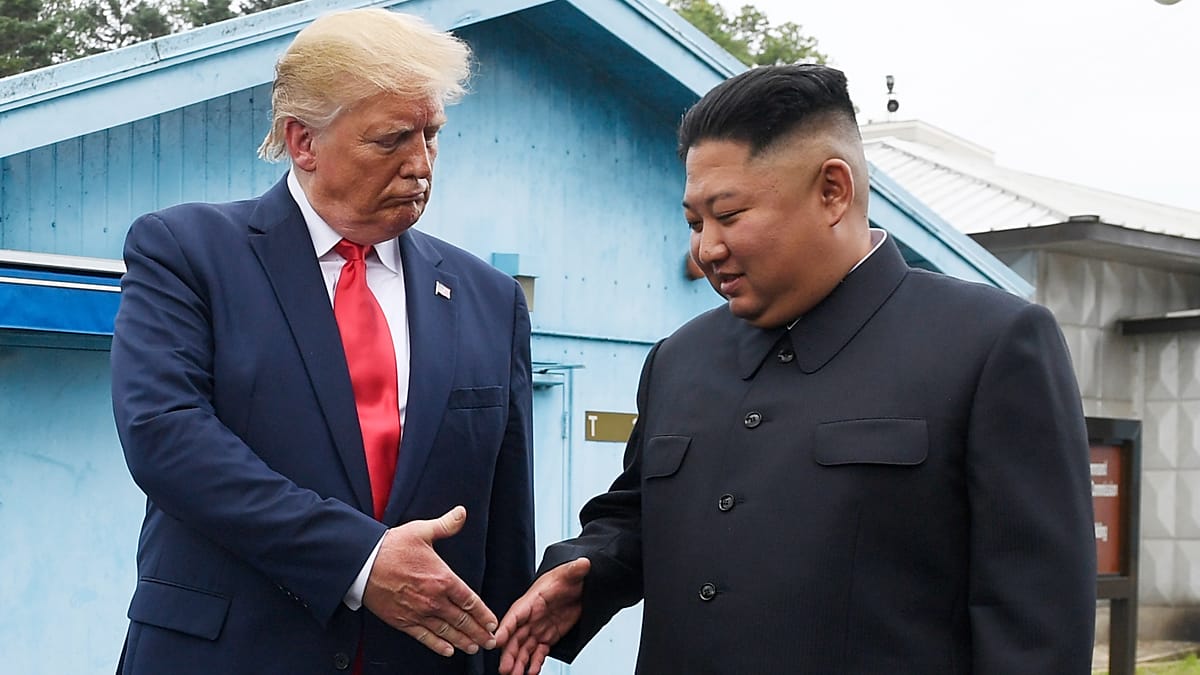
US President Donald Trump has suggested he could meet North Korean leader Kim Jong-un during his current trip to Asia, adding a new layer of uncertainty to an already packed diplomatic agenda. Speaking to reporters before leaving Washington on Monday, Trump said a meeting with Kim was possible while he is in China this week.
“We may meet with Kim Jong-un also,” Trump said. “So that would be good. We have the chance to accomplish a lot.”
The president is due to arrive in the Philippines early on Tuesday before travelling to Shenzhen, in southeastern China, where he is scheduled to hold trilateral talks with Russian President Vladimir Putin and Chinese President Xi Jinping. The meeting, on the sidelines of the Asia-Pacific Economic Cooperation (APEC) summit, is expected to focus heavily on nuclear disarmament.
“We're going to talk about denuclearisation. Tough subject because it's very hard for any of us say we'll get rid of our nukes,” Trump said. “Especially since you do have other countries.”
He added that the wars in Iran and Ukraine would also be on the agenda, as well as “economics and trade.” The inclusion of Ukraine is notable for European observers, given the continent's direct stake in the conflict and the ongoing discussions about security guarantees.
Nuclear diplomacy and European concerns
Trump's remarks come amid heightened European attention to nuclear non-proliferation. The debate in Tehran over its nuclear doctrine has raised questions about the stability of the global non-proliferation regime, and any US-Russia-China dialogue on the issue is likely to be watched closely in Brussels and other European capitals.
Trump has previously touted his personal rapport with Kim, saying in August that the two would meet at some point this year. “The fact that I get along with him, that's a good thing not a bad thing. He has 57 very powerful nuclear weapons. Should have never allowed it to happen,” he said at the time, adding: “If I were president, I wouldn't have allowed it. But he's got them.”
While the prospect of a Trump-Kim encounter has generated headlines, European diplomats are more focused on the substance of the trilateral talks. The Shenzhen meeting is seen as an opportunity to address not only nuclear issues but also trade tensions and regional security, including the ongoing frictions in the South China Sea.
For Europe, the outcome of these discussions could have significant implications. The EU has long advocated for a rules-based international order, and any shift in the balance of power among the US, Russia, and China would directly affect European interests. The EU's own strategic debates on technology and security reflect a broader concern about maintaining autonomy in a world of great-power rivalry.
Trump's comments also revive questions about the future of US-North Korea diplomacy, which has stalled in recent years. While a meeting in China would be symbolic, analysts caution that it is unlikely to yield concrete progress on denuclearisation without a clear framework.
As the president embarks on this diplomatic marathon, European leaders will be watching closely, aware that decisions made in Shenzhen could resonate far beyond the Asia-Pacific region.