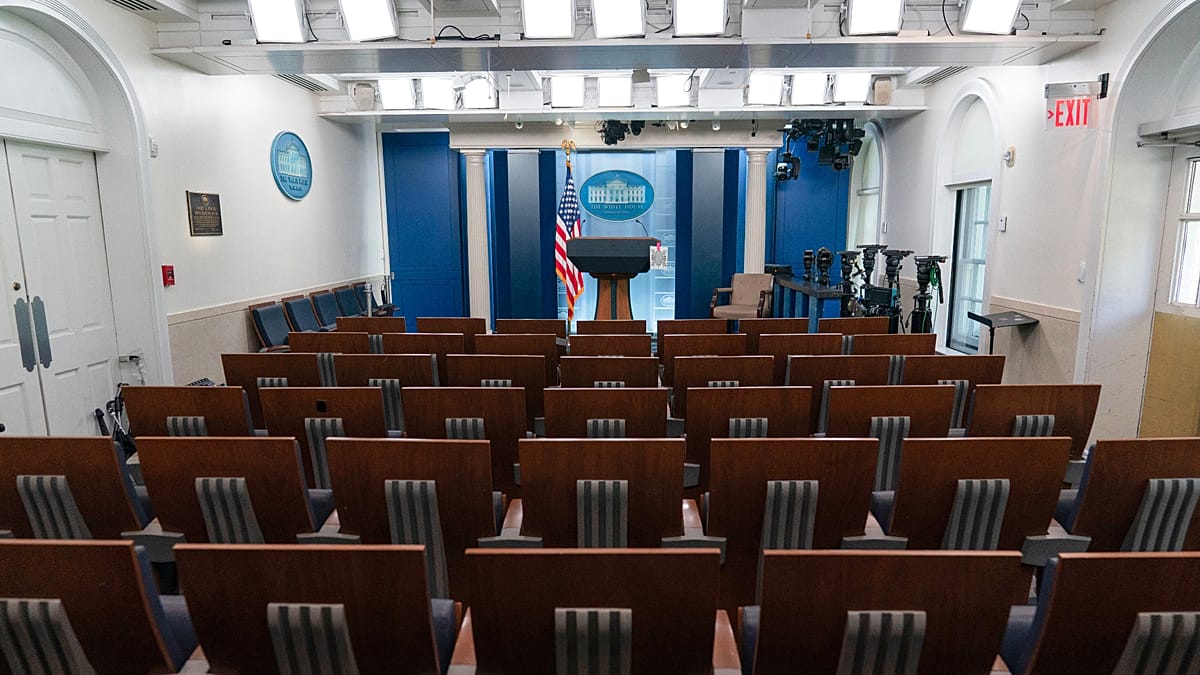
America's five principal television networks — ABC, CBS, CNN, Fox and NBC — took the rare step on Monday of suspending their shared "pool" coverage of the White House, the arrangement under which one broadcaster films presidential events on behalf of all of them. The decision followed the removal of CNN, MS NOW and Politico from the building, a move that has now escalated into a constitutional confrontation.
Journalists from the three outlets were denied entry to the White House grounds on Saturday and had their press passes confiscated. CNN was also stripped of its turn in the rotating pool, which it had been due to use to cover President Donald Trump's trip to New York for the United Nations General Assembly.
In a message to pool members, Fox's Washington bureau chief, Bryan Boughton, who currently chairs the group, said there would be no substitute coverage: "Effective today, the TV pool will not be covering events designated as pool coverage of the President. This follows the White House's position preventing CNN from fulfilling its assigned pool duties." The suspension is open-ended.
A coordinated response across US newsrooms
The five networks issued a joint statement framing the dispute as a matter of public interest rather than corporate grievance. "The public has a vital interest in receiving accurate, independent information about its government. No administration should restrict a news organisation because it objects to its reporting," they said.
Other publishers joined the protest. The Associated Press, Agence France-Presse, The Washington Post and The New York Times were among the organisations that declined to publish photographs of presidential events on Monday. The practical effect was immediate: Trump's ribbon-cutting for a new granite helipad on the South Lawn was carried only on the White House website, and his remarks were inaudible because no pool microphones were present. His UN General Assembly appearance likewise went without live television coverage.
By Monday evening the White House had launched its own streaming channel, "Trump TV," promising "top videos, major remarks, and must-see highlights streaming 24/7 and updated in real time." When it went live, it was showing archived footage of a Trump speech delivered on 3 July at Mount Rushmore.
Vance defends the ban as the outlets go to court
Vice President JD Vance rejected the broadcasters' position, telling reporters the outlets were disseminating "effectively far-left propaganda." He added: "They can still report. They still have the access to free speech. They're just not going to get an office in the White House anymore."
The affected organisations confirmed on Monday that they would sue the administration. "This ban could not be a more direct assault on the First Amendment nor a more blatant violation of our most fundamental constitutional principles," they said in a court filing. The litigation follows the earlier decision to bar the three outlets from White House premises, and builds on the lawsuit over revoked press credentials that the outlets had already signalled.
The standoff is the sharpest test yet of how far an American administration can go in penalising coverage it dislikes. The pool system exists precisely because no single newsroom can be everywhere at once; suspending it does not merely punish three outlets, it degrades the flow of information to every broadcaster and, by extension, to the public.
Why this matters in Europe
For European capitals, the episode is not a distant curiosity. The United States is the EU's principal security guarantor and its largest single trading partner, and the health of its public information ecosystem shapes how European governments read Washington's intentions. Officials in Brussels, Berlin and Paris have spent the past decade building defences against disinformation and political interference in media markets, and the sight of a White House restricting access on the basis of editorial content cuts against assumptions long embedded in transatlantic relations.
There is also a practical dimension. European broadcasters rely on pooled American footage for coverage of the UN General Assembly, G7 and NATO summits, and presidential statements that move markets and foreign policy. When that pipeline narrows, European newsrooms must either accept the White House's own feed or report with less. That is a familiar dilemma for journalists in countries where state control of information is the norm — and one that Western democracies had assumed they would not have to confront at the heart of the alliance.
Whether the courts restore access, or whether the White House's streaming channel becomes the default source for presidential imagery, will be watched closely well beyond Washington. The precedent being set concerns not only American press freedom but the terms on which Europe's closest ally communicates with the world.