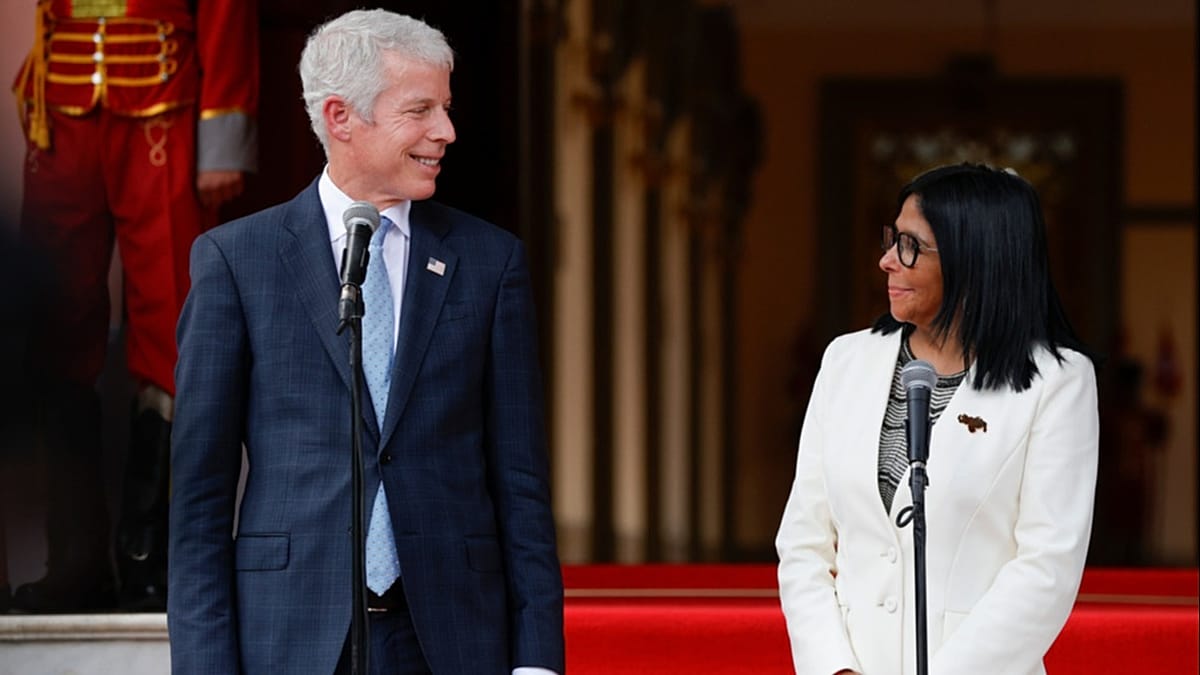
US energy companies signed a series of multibillion-dollar agreements with Venezuela on Wednesday, just days after Caracas agreed to hand Washington control of roughly one-fifth of its vast oil reserves. The deals, overseen by US Energy Secretary Chris Wright in Caracas, involve investments worth "tens of billions of dollars" and are seen as a quid pro quo for the US gaining majority control of 65 billion barrels of Venezuelan crude.
Wright, who travelled to the Venezuelan capital to witness the signing, described the agreements with Chevron, GE Vernova, and Italy's ENI as "critical in starting this ball rolling of peace, opportunity, and prosperity" in the country. US President Donald Trump has touted the arrangement as the "biggest oil deal in world history."
The timing is politically charged. With US Republicans facing potential losses in November midterm elections amid soaring fuel costs linked to the war with Iran and a broader affordability crisis, the deal offers a potential economic boost. However, it has also sparked fierce debate over Venezuela's sovereignty.
Critics question legitimacy
Critics in both the US and Venezuela accuse the Trump administration of holding the country to ransom, pointing to the ousting of former president Nicolás Maduro in a raid and warnings that interim President Delcy Rodríguez could face a similar fate if she does not comply with Washington's demands. Wright rejected such claims, insisting the US is not "stealing Venezuelan oil."
"All we're doing is taking an idle, underground asset that isn't doing anything for Venezuelan people and bringing the money, the technology to develop it," he said.
Rodríguez, for her part, defended the agreements as necessary to attract investment. "More oil translates into more jobs, higher wages, better public services, hospitals, schools and food," she said, estimating that Venezuela would earn $209 billion (€180 billion) in profits over 25 years.
Chevron, the only US oil major with a significant presence in Venezuela, confirmed it will expand operations in the Orinoco Belt, where it already has active fields. The company plans to invest more than $7 billion (€6 billion) over the next five years, aiming to more than double production to about 600,000 barrels per day. CEO Mike Wirth said in a statement: "Chevron's history in Venezuela spans more than a century, and our expanded position reflects our confidence in the country's deep resource potential."
Venezuela holds the world's largest proven oil reserves, exceeding 303 billion barrels, according to OPEC's 2025 Annual Statistical Bulletin, with Saudi Arabia a distant second at 267 billion barrels. Yet energy experts remain sceptical about the speed of any revival, noting that Venezuela's oil industry has suffered from years of neglect and mismanagement.
Legal and political questions also loom. Ian Vásquez, vice president for international studies at the Cato Institute, noted that Venezuela's constitution requires legislative approval for such arrangements, which has not occurred. "The deal lacks legitimacy since it was agreed to with a dictatorship that has clung to power for decades through violence and by committing what was probably the largest electoral fraud in Latin American history in 2024," he wrote. He added that any future Venezuelan democracy would likely question the deal, undermining its long-term stability.
The agreement grants North American Blue Energy Partners (NABEP) 100-year rights over 17 oil fields, a concession that may be difficult to reverse. As the details of the deal remain unclear, European observers are watching closely, given the potential impact on global energy markets and the continent's own supply diversification efforts. The surge in energy costs has already put pressure on European economies, and any shift in Venezuelan output could have ripple effects.
For now, the deals mark a significant expansion of US corporate presence in Venezuela, but their durability depends on political and legal challenges that are far from resolved. As Venezuela insists on its sovereignty, the coming months will test whether this arrangement brings the promised prosperity or becomes another chapter in the country's troubled oil history.