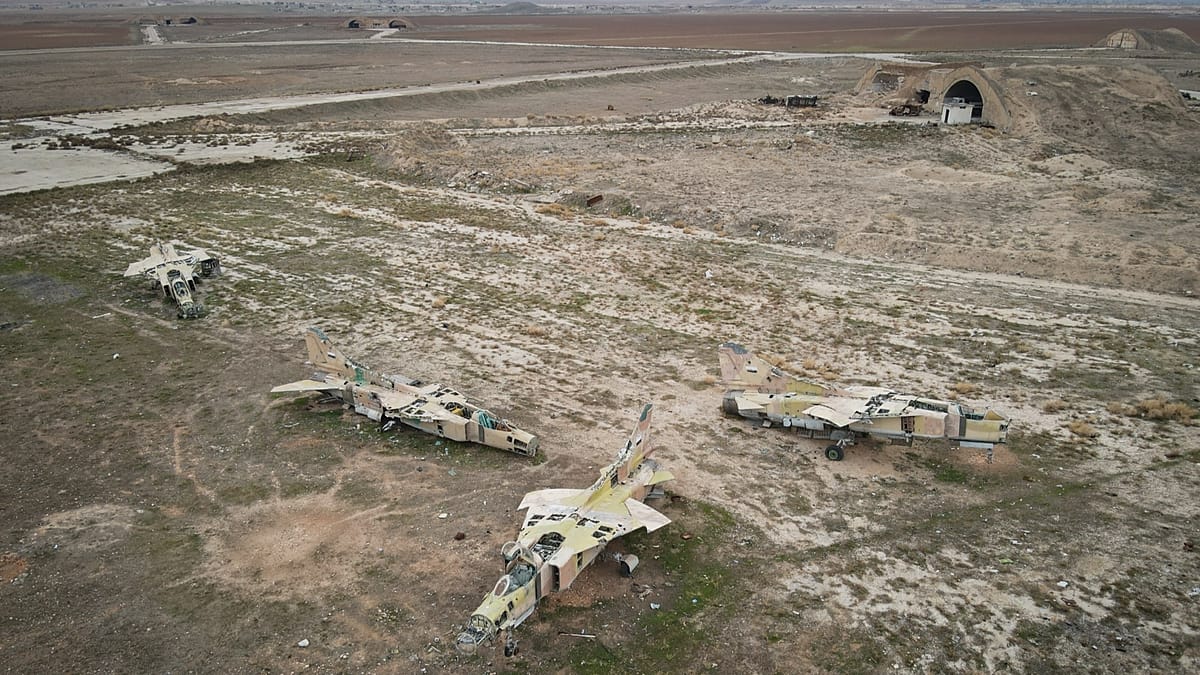
The United States has sharply criticised Israel for launching airstrikes on a Syrian military airbase close to the Turkish frontier, calling the attack an “unnecessary escalation” that undermines regional stability. The strike, which targeted the Abu Duhur airbase in Idlib province on Tuesday, has further inflamed tensions between Israel and Turkey, two key actors in the post-Assad landscape.
Syrian state television reported that eight separate strikes hit the runway and storage facilities at the base, located roughly 70 kilometres from the Turkish border. No casualties were reported, but the attack has drawn swift diplomatic condemnation from Damascus, Ankara, and several Arab capitals.
Tom Barrack, the US special envoy for Syria and Iraq who also serves as ambassador to Turkey, voiced Washington's displeasure in a post on X. “We are deeply concerned that the confirmed Israeli airstrikes on Abu al-Duhur Airbase constitute an unnecessary escalation that does not advance regional stability,” he wrote. The statement marks a rare public rebuke of Israel by the Trump administration, which has generally backed Israeli military actions in the region.
Israel defended the operation, with Prime Minister Benjamin Netanyahu's office claiming that Syria had been “on the verge of breaching” an agreed-upon “status quo in security matters” by allowing Turkish troops to deploy at the base. “Israel repeatedly warned Syria that such a deployment would pose a threat to Israel's security. Syria chose to ignore these warnings,” the statement said.
Turkey rejected that rationale outright. The Communications Directorate in Ankara dismissed the Israeli claims as “frivolous allegations” designed to legitimise unlawful strikes against Syria's sovereignty and territorial integrity, according to state-run news agency Anadolu. Turkish officials did not confirm whether any of their forces had been stationed at Abu Duhur.
Syria's foreign ministry condemned the attack as “an unjustified act of aggression” that threatened regional security and stability. Qatar, Egypt, and Saudi Arabia also issued statements denouncing the strikes, reflecting broad Arab unease over Israel's expanding military footprint in Syria.
Rising Israel-Turkey friction
The incident underscores the deepening rivalry between Israel and Turkey since the fall of Bashar al-Assad's regime in December 2024, when insurgent forces seized Damascus. Israel has since conducted hundreds of strikes across Syria, targeting former Syrian military assets to prevent them from falling into the hands of the country's new authorities. Israeli troops have also occupied a UN-patrolled buffer zone in southern Syria, where they remain deployed despite international criticism.
Turkey, for its part, has backed some of the groups that now control parts of Syria and has its own security concerns along the border. The two countries have traded accusations over Syria, with Israel viewing Turkish military presence as a direct threat and Turkey accusing Israel of exploiting the post-Assad chaos to expand its influence.
Syria's new authorities, led by former Islamist insurgents, have said they do not seek conflict with Israel. Yet Israel remains deeply wary of the government in Damascus, and the latest strikes suggest that wariness extends to any Turkish military entrenchment near its borders.
The US criticism adds a new layer of complexity. Washington has historically shielded Israel from international censure, but the Barrack statement signals frustration with actions that could destabilise a region already in flux. The strike also comes amid broader regional turbulence, including deadly Israeli strikes in Lebanon and ongoing long-range campaigns in Ukraine that continue to shape European security concerns.
For European observers, the episode highlights the fragile security architecture along the eastern Mediterranean. The EU has repeatedly called for restraint and for respect of Syria's sovereignty, but has struggled to exert influence as both Israel and Turkey pursue their own agendas. The symbolic sentencing of Assad by a Syrian court earlier this year did little to alter the ground realities.
As the region braces for further escalation, the question remains whether Washington's rebuke will temper Israeli actions or simply underscore the limits of US influence over its closest ally in the Middle East.