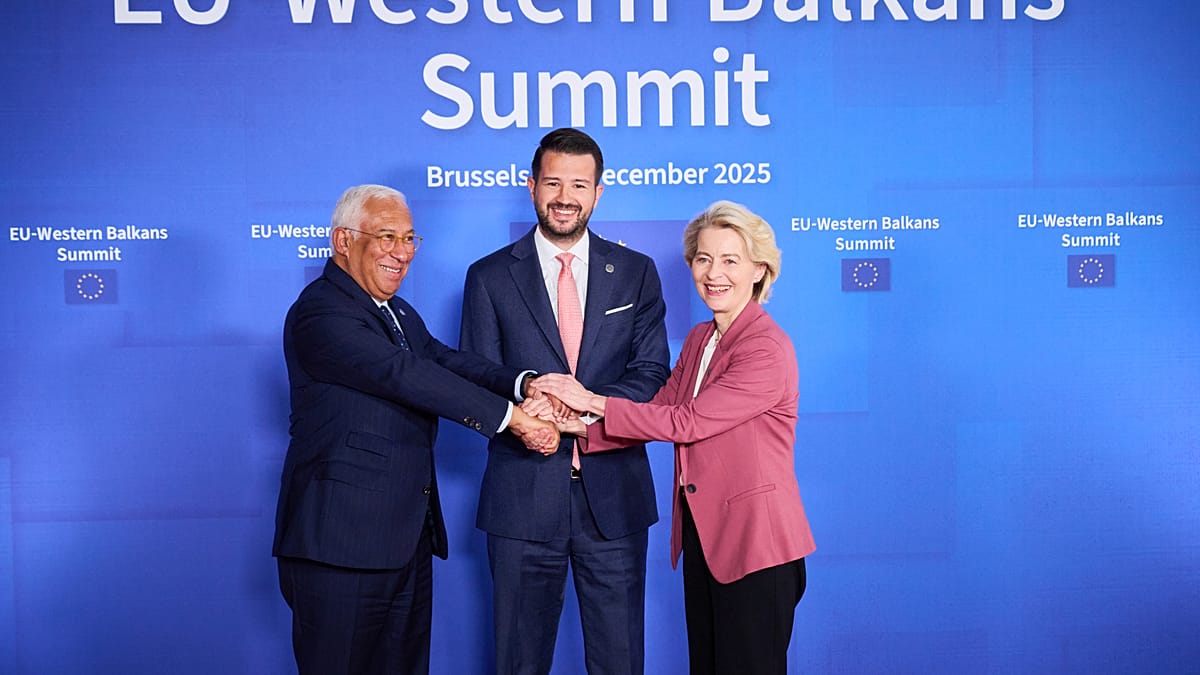
Brussels is hosting a double-header of summits this week, but the first act—the EU-Western Balkans gathering—has already been overshadowed by a conspicuous empty chair. Serbia, the region's largest country, is absent, its newly elected leadership still finding its feet after the student-led protests that toppled Aleksandar Vučić's government. The acting president and parliamentary speaker, Aleksandar Čupić, cited pressing parliamentary business, but the real reasons are more strategic: Belgrade is unwilling to endorse a declaration that would require aligning with EU foreign policy on Russia and normalising relations with Kosovo.
The Kosovo issue remains a raw nerve, as demonstrated last week when a Serbian nationalist song was played at the European Commission's enlargement conference, causing a diplomatic stir. Former Kosovo President Vjosa Osmani is set to discuss this on Europe Today, and the episode underscores how fragile the dialogue remains.
Montenegro's moment of truth
At the other end of the spectrum, Montenegro is tantalisingly close to finishing its accession negotiations. Brussels aims to have the treaty ready for signature by June, but two obstacles loom large. First, Croatia, the EU's newest member, is pressing Montenegro to resolve a longstanding border dispute, a move that Italy has criticised as holding enlargement hostage to bilateral grievances. Second, the proposed ten-year probation period for new members—with potential suspension of voting rights for rule-of-law breaches—has Podgorica worried about becoming a second-class member. The EU wants to avoid another Viktor Orbán situation, but Montenegro's President Jakov Milatović, also a guest on Europe Today, wants assurances that his country will be treated as an equal.
Beyond the accession politics, the summit will focus on economic integration and security cooperation. The EU's €6 billion Growth Plan for the Western Balkans is expected to disburse funds to Albania, Montenegro, and North Macedonia soon, and plans to extend the EU's roaming-free mobile regime to the region are advancing. As our own enlargement summit earlier this month showed, the prospect of a bigger EU is more tangible than it has been in years. But with French presidential elections looming next spring, the political window for enlargement may not stay open indefinitely.
Danish dilemma for Europe's Socialists
Meanwhile, a different kind of storm is brewing within the European left. Danish Prime Minister Mette Frederiksen's hardline migration stance has put her at odds with her own political family. In a recent podcast, she spoke of opposing a "great replacement of the population" and referred to Denmark's "original tribe, which is ethnically Danish"—language that critics say echoes far-right conspiracy theories. "This podcast was a disaster," one S&D MEP told our reporter. At a group meeting in Strasbourg, Portuguese and German MEPs voiced their objections, prompting S&D chief Iratxe García Pérez to promise a formal debate.
Frederiksen has long been an awkward fit for the centre-left, with her restrictive policies coinciding with the electoral decline of Denmark's far right. But her latest initiative—teaming up with Austria, Germany, Greece, and the Netherlands to establish a migrant return hub in Rwanda—directly contradicts the S&D's opposition to such facilities. "For now, no one is taking her side," a senior Socialist lawmaker said. No disciplinary action is expected, but the showdown exposes a deeper dilemma: how far can Social Democrats accommodate demands for tougher migration policies without compromising their principles?
Other news from the continent
In Strasbourg, the European Parliament's centrist chiefs—Manfred Weber, Iratxe García Pérez, and Valérie Hayer—met to hammer out a coalition agreement for the second half of the parliamentary term. The deal is not expected to prevent Weber's EPP from voting with the far right, a major bone of contention. Renew Europe is making the agreement a condition for backing Roberta Metsola's re-election as Parliament president.
EU Energy Commissioner Dan Jørgensen told On the Record that Europe will never return to Russian energy, regardless of any peace deal between Washington and Moscow. Even if sanctions are lifted, the EU's gas import ban will remain. He also warned consumers to brace for a difficult winter.
Brussels is drawing up plans to overhaul UN climate summits after the COP31 fiasco in Antalya. The Commission wants more transparency, streamlined negotiations, and an end to the veto power of a single country. Smaller coalitions of willing countries could drive the fossil fuel transition.
The European Court of Human Rights ruled on Tuesday that Poland and Latvia exposed individuals to inhuman or degrading treatment when they tried to enter their territory from Belarus in 2021. The ruling could set a precedent for similar cases, such as the mass arrival of irregular migrants in Ceuta from Morocco last July.
NATO chief Mark Rutte has vowed to defend allies against threats in space, a reminder that the alliance's remit extends beyond traditional domains. And as Brussels braces for worker protests over Belgian austerity plans, the city is once again the stage for Europe's political and social tensions.