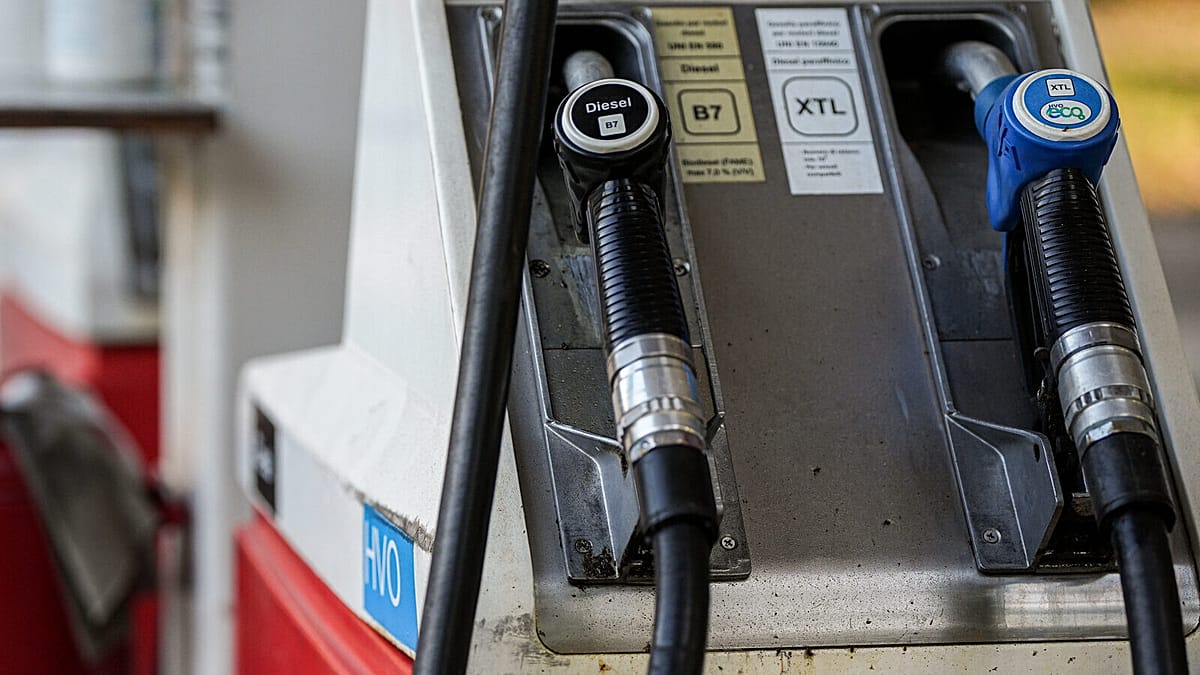
The European Union is leaving the door open to a coordinated release of strategic oil reserves, as the United States intensifies pressure on its allies to make additional diesel stocks available or face a possible export ban. EU Energy Commissioner Dan Jørgensen told Europe Today that such a move "is a possibility", while stressing that the timing remains under discussion with all members of the International Energy Agency, not only Washington.
"We are discussing with all members of the International Energy Agency, not only the United States, when the right time is to release, because this is one of the opportunities that we have. We've used it before, and we'll likely use it again," Jørgensen said. The Paris-based IEA coordinates emergency stock releases among its members, which include most EU states plus the UK, Norway and Switzerland.
Washington's push meets European caution
US Treasury Secretary Scott Bessent has urged Europe to make new stocks available "immediately" to ease costs, arguing that American "farmers, truckers, and businesses should not be left carrying the burden". The appeal reflects mounting political pressure in Washington, where diesel prices have climbed to around $7 a gallon and Brent crude has traded between $97 and $102 a barrel since late September — roughly $25 to $30 above pre-war levels. The issue has become a priority for President Trump ahead of pivotal midterm elections.
The underlying squeeze stems from the war in Iran and reduced global refining capacity, which have combined to drive up costs for European companies and households alike. Any decision to tap reserves ultimately lies with national capitals rather than the European Commission, and Jørgensen confirmed that EU governments are discussing a coordinated release through the IEA "as we speak". An EU source said the Commission held a call on Thursday with several countries, including the UK, to assess different scenarios. The discussions echo earlier deliberations over a coordinated oil reserve release as diesel prices surged.
For European governments, the calculus is delicate. Releasing stocks could offer short-term relief at the pump, but it also depletes buffers that might be needed if the supply shock worsens. Several member states have also pressed Brussels for fiscal room to cushion the energy shock, with Greece pressing for fiscal leeway as the crisis deepens.
Ukraine's 2026 gap declared closed
In a separate development, the European Commission has abruptly closed the debate over Ukraine's $27 billion deficit, announcing that Kyiv's financial and military needs for this year are fully covered. "Through coordinated joint efforts, we have identified the means to cover Ukraine's budget and defence needs for 2026," the Commission said in a statement posted on Thursday by President Ursula von der Leyen.
The funding gap, flagged by Kyiv's Ministry of Defence in late August, had prompted intense technical talks between the two sides. Brussels consistently kept its distance from the headline figure, which EU officials regarded as unexpected and unexplained, instead urging Ukraine to focus on passing the reforms needed to unlock a €90 billion support loan. The loan is barely a year old, and reforms remain stalled in the Verkhovna Rada, making talk of fresh money premature.
Attention now shifts to 2027, which looks considerably grimmer. Ukraine has identified a $78 billion hole for next year — $32.6 billion for the budget and $45 billion for the military — a figure that Russia's escalation threatens to inflate further. Brussels and Kyiv will continue discussions on those needs, with the International Monetary Fund also involved but not yet ready to publish an updated estimate. "Beyond 2026," IMF communications director Julie Kozack said on Thursday, "the specific financing gap is going to depend on, of course, very importantly, the evolution of the war, the implementation of reforms by the authorities, economic developments and continued support from Ukraine's international partners."
Von der Leyen's message to Podgorica
Commission President Ursula von der Leyen used her annual tour of the Western Balkans to deliver three messages to Montenegro. First, she pressed Podgorica to resolve its bilateral disputes with Croatia, describing them as "of utmost importance". Zagreb has raised a series of issues that risk derailing Montenegro's ambition to become the EU's 28th member by 2028, with the Commission currently mediating.
Second, she stressed that cross-party support is essential to maintaining that timeline, after Montenegrin politics was rocked by controversy when Parliament Speaker Andrija Mandić sent public condolences following the death of Ratko Mladić in August. The episode has fuelled scrutiny of the country's political direction, with the EPP under pressure over Mladić funeral honours in neighbouring Serbia.
Third, von der Leyen underlined that the EU itself must prepare for enlargement, teasing next week's pre-enlargement policy reviews. "We will look at our institutions, our policies, our budget, what has to be done to be ready to welcome a new member state and to make sure that our union is ready to become larger," she said.
Athens seeks asylum suspension mechanism
Greece has proposed suspending the right to apply for asylum in the EU during mass influxes of irregular migrants, with Migration and Asylum Minister Thanos Plevris making the case to counterparts at a ministerial meeting in Luxembourg. The measure would mark a significant shift in the bloc's migration policy, allowing returns without individual assessment of asylum claims — a practice that could amount to "collective pushbacks", which are prohibited under current EU law.
Athens wants the proposal folded into the "European Emergency Response Framework", a new law the Commission is due to present in the coming months to address irregular arrivals and the instrumentalisation of migration at the EU's external borders. The mechanism, dubbed the "Special Derogation Regime", would be triggered only in exceptional circumstances, with criteria including a rapid increase in arrivals, pressure on local infrastructure and evidence that migratory flows are being orchestrated by third states.