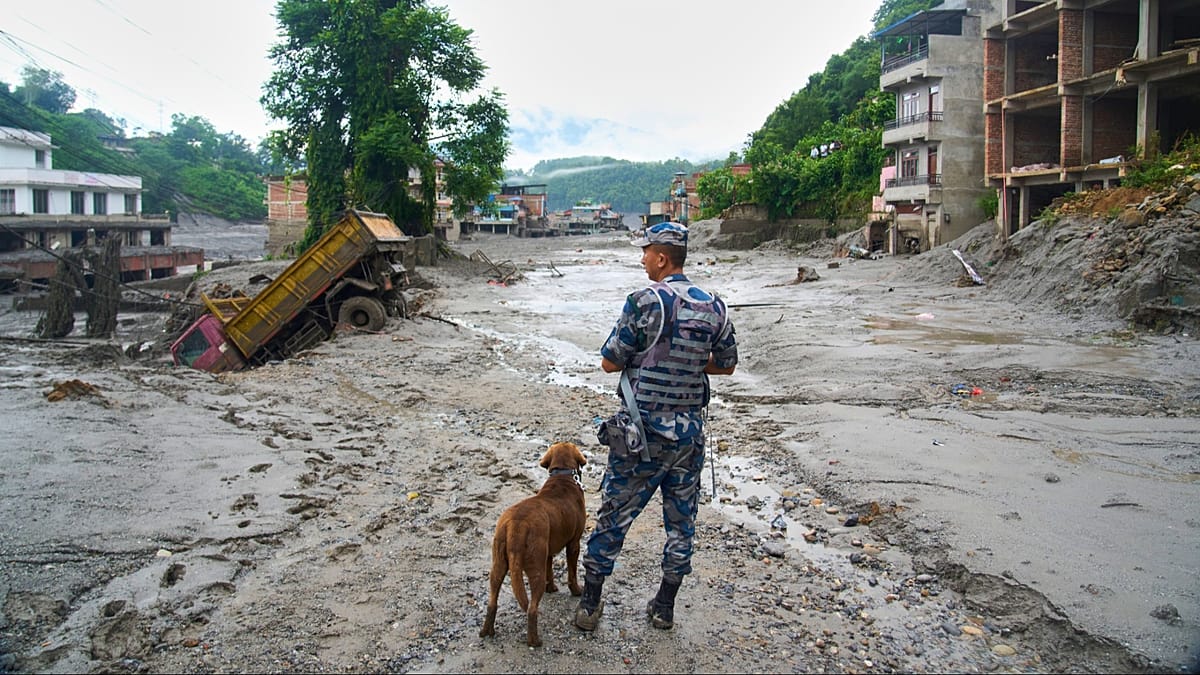
Nepali army helicopters were scrambling on Friday to reach more than 100 workers still trapped inside a hydropower tunnel after catastrophic floods devastated the country's northern border region. The army has already pulled 350 workers and local residents to safety from the tunnel at the Upper Trishuli hydropower project in Rasuwa district, according to the prime minister's office.
Army spokesman Raja Ram Basnet said two helicopters had been dispatched, but rescuers were battling difficult conditions, including trouble locating the tunnel's entrances. "Our focus is in search and rescue of people," Basnet told AFP, adding that relief supplies were also being provided to survivors.
The operation comes two days after a glacial collapse unleashed a massive flow of ice, rock, and debris through river valleys near Nepal's border with China's Tibet region. The US Geological Survey said the debris flow and flooding travelled nearly 100 kilometres along the Trishuli and Bhote Koshi rivers, destroying buildings and infrastructure and cutting a vital highway linking Nepal and China.
The scale of the destruction was still emerging on Friday, with roads, bridges, and several hydropower projects damaged or destroyed. Survivors described floodwaters sweeping through worksites with extraordinary speed. "There were at least 400 workers at the site," Dev Shrestha, who was airlifted from another hydropower project, told AFP. "More people died than were rescued."
Worker Buddha Tamang said he survived because he was inside a tunnel when the flood struck. "The senior officers working on the other side, they were all swept away," he said.
China halts Tibet rescue amid renewed flood risk
Across the border in Tibet, Chinese authorities paused rescue operations on Friday because of fears of further flooding, with hundreds of people still missing after Wednesday's disaster. State broadcaster CCTV said a lake formed by huge piles of mud and debris near the border hub of Gyirong had begun overflowing towards areas where rescuers were operating. Teams were ordered to stand by, while those already in the affected area were told to withdraw one kilometre.
Continued rainfall is expected to raise the lake's water level over the coming days, increasing the risk of a breach and further flooding downstream. Nepal issued a warning to move to higher ground after reports that a dam upstream in Tibet had burst. "Information has been received that a water dam has burst again on the Tibetan side," police said in a statement. "All security personnel, rescue workers, and the general public deployed in rescue and relief operations are requested to remain alert and immediately move to a safe location/report the incident."
Scientists have warned that rising temperatures are increasing the risks posed by unstable glaciers across the Himalayas. The glacial collapse likely triggered the Nepal-Tibet flood, according to researchers, and the death toll is nearing 400 with 1,400 still missing. For European travellers in the region, essential guidance has been issued, while the mudslide engulfing Gyirong has compounded the crisis.
The disaster underscores the broader climate risks facing mountain communities across Asia, a concern that resonates with European scientists and policymakers who are closely monitoring glacial melt in the Alps and the Andes. As the EU steps up its climate diplomacy, the fate of Himalayan communities serves as a stark reminder of the urgent need for global action.