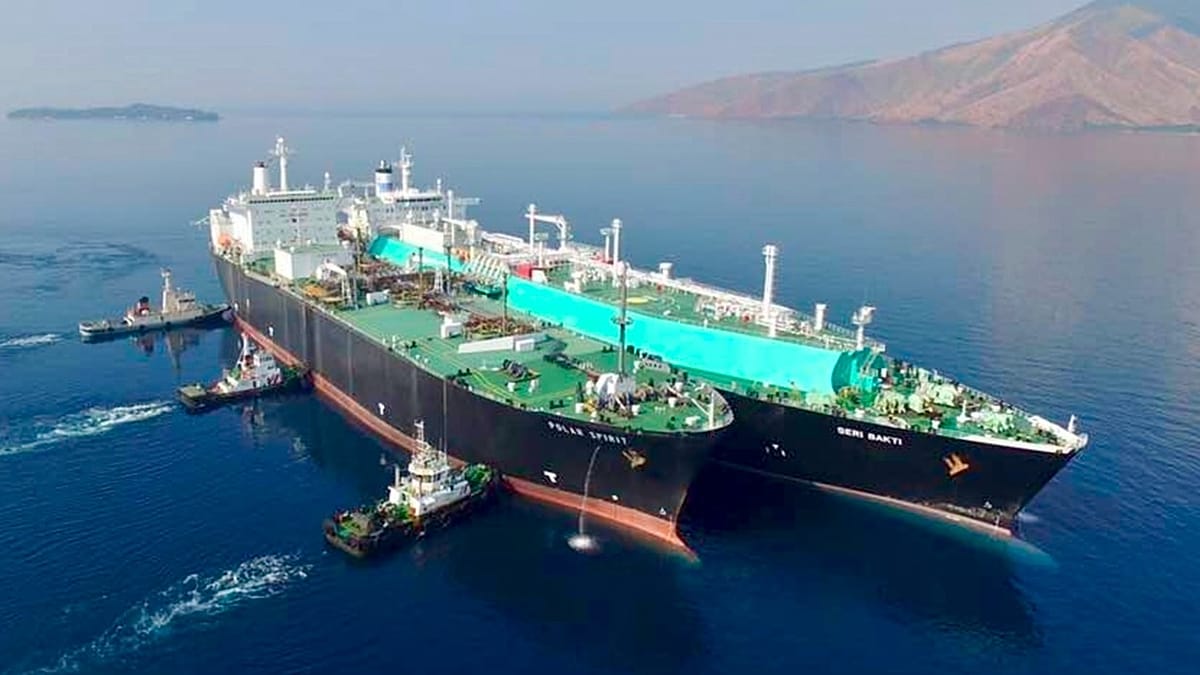
Six months into the blockade of the Strait of Hormuz, Qatar and the United Arab Emirates are resorting to emergency ship-to-ship (STS) transfers to keep liquefied natural gas moving to international buyers. The operations, which took place off the coasts of Oman and the UAE in August, add more than $1 million (€860,600) per transfer and up to 35 hours of extra sailing time, according to shipping data from Kpler and Vortexa.
Three LNG cargoes loaded in Qatar and the UAE were transferred between vessels before continuing to destinations in Asia. Two of the three transfers involved ships that had previously been damaged or involved in incidents. The Qatari tanker Al Rekayyat, struck by a projectile near Hormuz in July, transferred its cargo to the Tembek off the UAE coast; the Tembek later delivered the LNG to India. The GasLog Shanghai, which had an incident while leaving the strait in late July, passed its cargo to the GasLog Savannah off Oman. A third operation involved the ADNOC-controlled Mraweh, which transferred LNG loaded at Das Island to the LNG Enugu off Oman, with the cargo then heading toward Japan.
A costly workaround
Ship-to-ship transfers are technically complex and rarely used in the LNG trade. Unlike crude oil, which can be moved between vessels relatively quickly, LNG must be kept at minus 162 degrees Celsius to remain liquid. The process requires specialist cryogenic equipment, fenders, tugboats, and trained personnel on both ships. As a result, STS transfers are standard in the crude oil industry but remain exceptional in LNG, typically reserved for emergencies.
Bogdan Ratiu, commercial and shipping director at LNG Synergy, told Euronews that most recent operations were emergency transfers rather than routine commercial ones. “This is a constraint, they have no choice in certain situations,” he said. Ratiu estimated that an LNG STS transfer takes around 30 to 35 hours and requires specialist equipment and personnel. “It will easily add over $1 million if STS is involved,” he added.
Once LNG is loaded at Ras Laffan, the world's largest LNG export complex, vessels are normally sent to customers as quickly as possible. Keeping LNG on board for extended periods ties up ships and leads to losses through boil-off, when some of the gas naturally evaporates. Newer vessels can reliquefy some of that gas, but older ships have fewer options. Ratiu noted that QatarEnergy has traditionally tried to minimise the time LNG remains on board, and Ras Laffan was designed for rapid turnaround. “Desperate times require desperate solutions,” he said.
Before the war, Ras Laffan loaded between 140 and 150 LNG cargoes per month, making it the single most important origin point for global LNG supply. All of its output must transit the Strait of Hormuz to reach international markets; no pipeline or alternative route exists.
Gulf LNG shortfall remains severe
Between March and June, LNG loadings from Qatar and the UAE fell by 35 billion cubic metres compared with the same period a year earlier, according to the International Energy Agency (IEA). Qatar exported just 18 LNG cargoes in the first six months of the Iran war, compared with 509 in the same period a year earlier—a decline of around 96%. Qatar is estimated to have lost around $24 billion (€20.7 billion) in gas sales over the period, and QatarEnergy remains under force majeure on some deliveries, with cancellations extending into early November.
Much of the missing Gulf supply has been replaced elsewhere. The IEA said non-Gulf LNG production rose by almost 18%, or around 27 bcm, between March and June, offsetting about three-quarters of the fall in Qatar and UAE deliveries. Overall global LNG production fell by around 4% during the period. North America and Africa were among the regions adding supply, supported by new projects and improved gas availability for existing plants. Despite this, gas prices remain well above pre-war levels.
Hormuz remains the main problem
The UAE can bypass Hormuz for some oil exports through a pipeline to Fujairah, but no similar large-scale route exists for LNG. Diplomatic efforts are under way to restore some shipping through the strait. Qatar and Iran discussed a proposed temporary shipping corridor through Hormuz and a joint project to clear mines from the waterway during talks in Tehran in late August. Qatar has said the proposal is part of wider efforts to restore freedom of navigation.
Fitch Ratings removed Qatar from Rating Watch Negative on Friday and affirmed its AA sovereign rating, saying the immediate risks to the country's LNG facilities had eased. The force majeure extension remains a key concern for European buyers, who have been seeking relief from high energy prices. The blockade has also reignited fears of broader supply disruptions, while US strikes on IRGC targets have added to regional tensions.
For now, STS transfers offer a lifeline, but they are not a long-term solution. The complexity and cost mean they are unlikely to replace normal shipping routes once the strait reopens. Until then, Qatar and the UAE will continue to rely on these emergency measures to meet their contractual obligations and keep global LNG markets supplied.