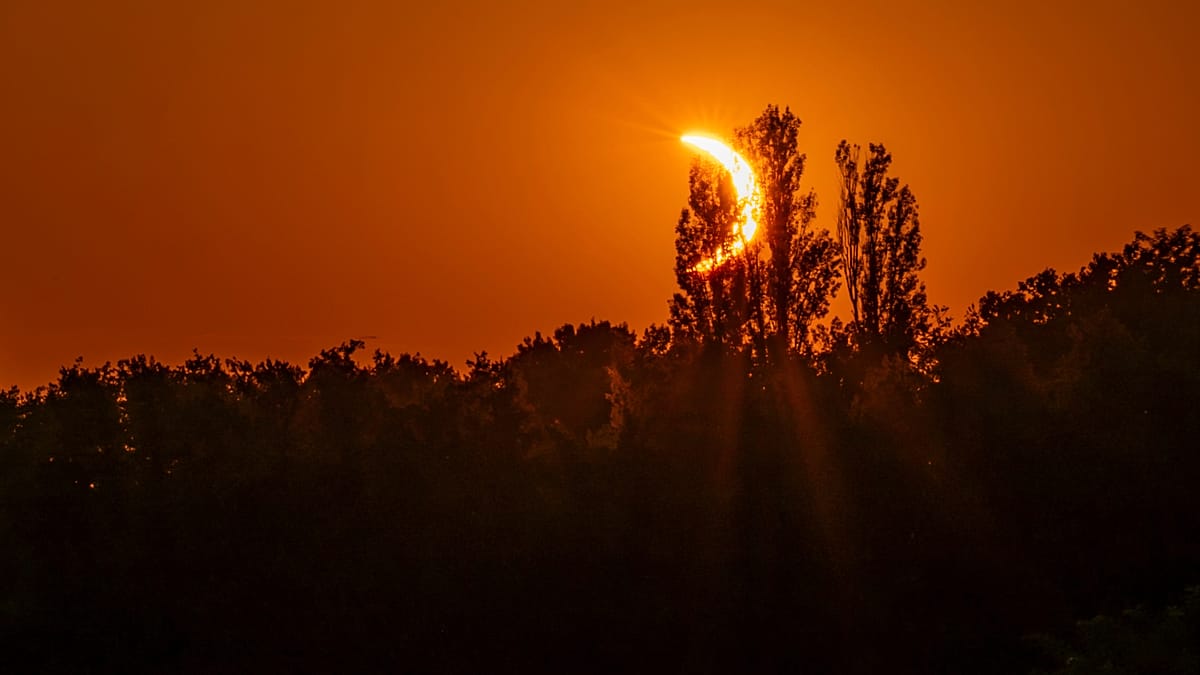
At an altitude of nearly 2,900 metres, the Pic du Midi observatory in the French Pyrenees became a front-row seat for one of nature's most striking spectacles. On Saturday morning, a partial solar eclipse transformed the sky above the mountain range into a deep crimson, drawing hikers and astronomers to the summit for a rare communal moment.
The eclipse, which was visible across parts of Europe, reached its peak over the Pyrenees just before midday. Although a layer of clouds intermittently veiled the sun, the effect was no less dramatic. The light dimmed, the temperature dropped, and the surrounding peaks took on an eerie red tint that lingered for several minutes.
Among those gathered was Marie Lefèvre, a hiker from Toulouse who had made the early ascent with a group of friends. “We came for the hike, but the eclipse turned it into something else entirely,” she said. “The sky turned red, and for a moment it felt like the mountains were on fire. It was peaceful, poetic, and honestly, magical.”
Astronomers from the Pic du Midi observatory, which has been studying the skies since the late 19th century, set up telescopes and solar filters on the terrace. Despite the clouds, they managed to capture images of the partial phase, when the moon covered roughly 70% of the sun's disc at this location.
“The clouds added a layer of unpredictability,” said Dr. Étienne Roussel, an astrophysicist at the observatory. “But they also created a beautiful diffusion of light. The red hue was caused by the scattering of sunlight through the atmosphere, which becomes more pronounced when the sun is low and partially obscured.”
The event drew visitors from across the region, including families with children, amateur photographers, and seasoned eclipse chasers. Many had planned their trips weeks in advance, while others stumbled upon the spectacle during a routine weekend hike.
For those who missed it, the next major solar eclipse visible from Europe will occur in 2027, when a total eclipse will sweep across parts of Spain and North Africa. That event promises to be even more dramatic, with totality lasting over six minutes in some areas.
The partial eclipse was also observed elsewhere on the continent, from Spain to St. Petersburg, though the Pyrenees offered one of the most memorable settings. In Britain, a timelapse from Greenwich captured the event from the capital, where the moon covered a smaller portion of the sun.
While the spectacle was purely visual, it also served as a reminder of the sun's power. Recent research has highlighted the risks posed by solar activity, including radiation exposure for airline passengers during solar storms. For the hikers at Pic du Midi, however, the eclipse was a moment of wonder rather than worry.
A shared experience in the mountains
The atmosphere at the summit was one of collective awe. Strangers exchanged telescopes and solar glasses, pointing out details in the sky that might otherwise have gone unnoticed. Children gasped as the light changed, and a quiet hush fell over the crowd as the red glow deepened.
“You can watch an eclipse on a screen, but it's not the same,” said Javier Moreno, a photographer from Zaragoza who drove four hours to reach the Pyrenees. “Being here, feeling the cold wind and seeing the mountains change colour, that's what makes it unforgettable.”
The Pic du Midi observatory, which is also a popular tourist destination, plans to host similar viewing events for future eclipses. Its high altitude and clear skies make it one of the best locations in Europe for astronomical observation.
As the eclipse receded and the sky returned to its usual blue, the hikers began their descent, carrying with them images of a red sky and a shared memory that will last far longer than the event itself.