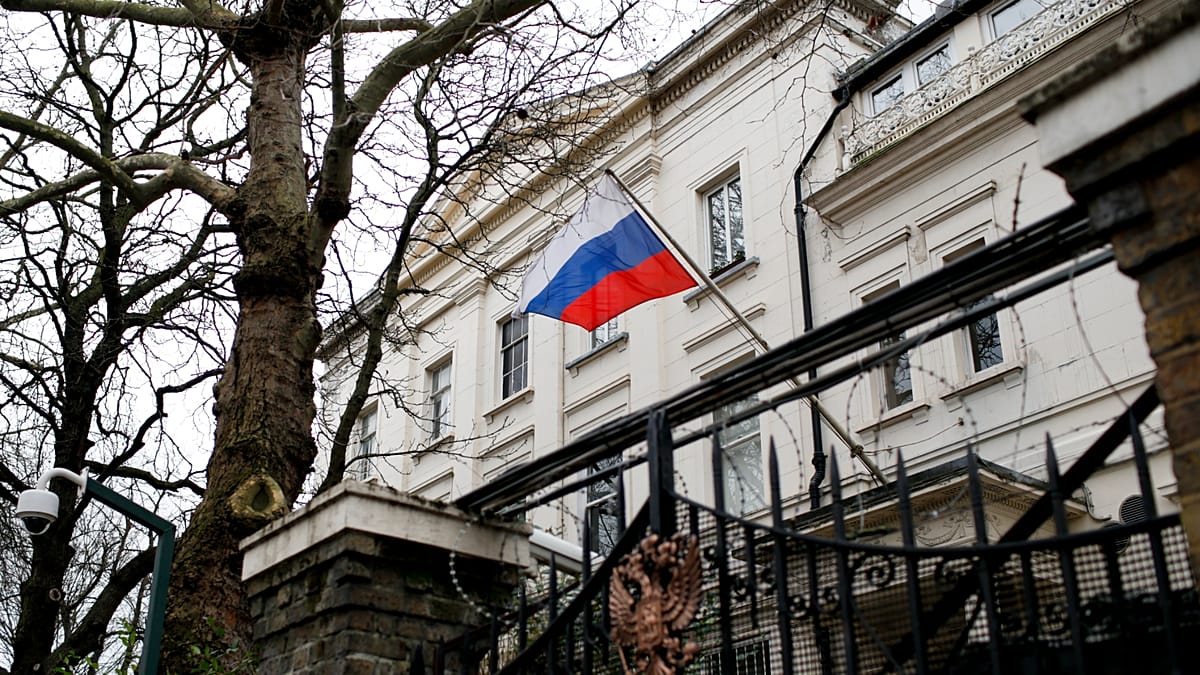
Britain's Foreign Office summoned Russia's most senior diplomat in the country on Thursday to condemn what it called an "egregious and reckless attack" involving a drone at Leipzig airport last month. The move follows a wave of European condemnation and signals a coordinated diplomatic response to what officials describe as a growing pattern of Russian sabotage.
"Today we summoned the Russian charge d'affaires to condemn the attack in the strongest terms," a Foreign Office spokesperson said in a statement. The incident, which involved an explosive-laden drone, was described as "the latest in a clear pattern of attempts by the Russian state to undermine our collective security."
The Leipzig/Halle Airport incident occurred on the night of 4–5 August, when police used a robot to defuse a device found near a Ukrainian cargo plane. The discovery came after months of suspicious drone sightings over German military and industrial sites had already put Berlin on alert. A second drone, also carrying traces of an explosive substance, was reportedly found near the airport weeks later.
Germany points to Russian hybrid operations
Germany's government has blamed Russia for the incident. Interior Minister Nancy Faeser said it "fits the known pattern of Russian hybrid operations in Europe." Berlin has since moved to close Russia's consulate in Bonn and its cultural centre in the capital, a significant diplomatic step.
Russia has dismissed the allegations as "absurd." Its embassy in Germany rejected the accusations as "unsubstantiated" and warned of "consequences" over the German response. The Kremlin has consistently denied involvement in sabotage and hybrid attacks across Europe.
The UK's action follows similar moves by other European capitals and institutions. EU foreign policy chief Kaja Kallas, speaking at a meeting of the bloc's foreign ministers in Ireland, said: "It is clear that it has all the hallmarks of state-sponsored terrorism." She added: "The question is, what do we do about this?" Kallas confirmed that the EU had summoned the Russian envoy, with member states doing the same.
European Commission President Ursula von der Leyen called the Leipzig incident "a new escalation" in Europe. "This was an attack using military-grade material carried out by Russian operatives on European Union soil," she said after talks with NATO Secretary General Mark Rutte. "We will not tolerate it." Von der Leyen warned that such incidents had become a "new normal" for Europe as Russia steps up destabilising activities. Her remarks echo her earlier warning about Russian drone sabotage.
Poland's foreign minister, Radoslaw Sikorski, struck a similarly stark tone: "We do not seek conflict with Russia, but Russia seems to be at hybrid war with us." His comments reflect a broader shift in European capitals toward a more assertive response to Moscow's covert operations.
The incident has intensified debates across the continent about how to counter Russian hybrid threats. European governments are weighing tougher measures, including expanded sanctions and increased surveillance of critical infrastructure. Some member states, such as Lithuania, have already vowed to respond immediately to any Russian attack, while Finland has conducted its largest civil defence drill since World War II to prepare for potential threats.
Diplomatic tensions are also rising in other areas. Norway recently seized a Russian ship in Svalbard over Ukraine's Crimea claim, and Kyiv has formally warned ICAO that Russian airspace is unsafe for airlines. These developments underscore the widening scope of the confrontation between Russia and the West.
The Leipzig drone attack has become a symbol of the new threats facing Europe. As EU leaders gather to discuss their response, the message from Brussels and national capitals is clear: the era of patience with Russian hybrid warfare is over. Whether that translates into concrete action remains to be seen, but the diplomatic language has sharpened considerably.