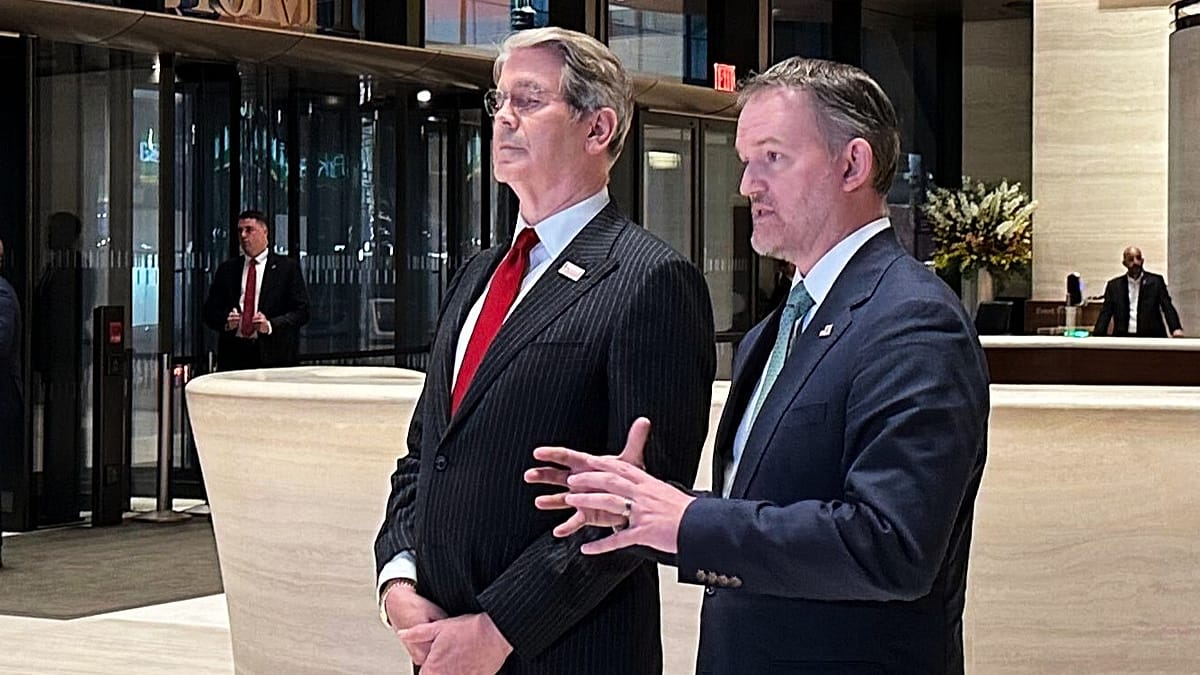
Washington and Beijing have agreed to establish a formal communication channel on artificial intelligence, a rare step toward cooperation between the world's two leading AI powers. The announcement came after talks on Sunday between US Treasury Secretary Scott Bessent and Chinese Vice Premier He Lifeng in New York, setting the stage for a summit between President Donald Trump and President Xi Jinping later this week.
Bessent described the proposed mechanism as a 'US-China AI dialogue' aimed at fostering transparency and managing shared risks. 'We want a shared vision of common goals and common threats,' he told reporters. 'We think that just like any cross-border activity, that moving from opaque to more transparency between the No. 1 and the No. 2 AI powers in the world is very important.'
The US has proposed a notification system for potential incidents—situations 'that rise up to a national security level from AI,' Bessent said. Both sides have agreed to meet again to flesh out the details.
A prelude to a high-stakes summit
The talks are a prelude to a planned White House meeting on Thursday between Trump and Xi. The two leaders last met in Beijing in May, where they discussed creating a new 'Board of Trade' to manage economic tensions. Sunday's discussions confirmed that both sides would operationalise that board, according to a US readout.
The move comes amid growing global concern about the potential dangers of advanced AI systems, including existential risks. Despite an intensifying technological rivalry, the shared fear of catastrophic outcomes has provided an incentive for dialogue. Trump has resisted calls to slow AI development, arguing that doing so would allow China to catch up with US companies.
Chinese state media described the meetings as 'candid, in-depth, and constructive.' The official Xinhua news agency said the two sides engaged in discussions on key economic and trade issues, including implementing previous agreements and promoting bilateral trade and investment.
For Europe, the US-China AI dialogue carries significant implications. Brussels has been developing its own AI regulations under the EU AI Act, and has sought to position itself as a rule-setter in the field. The prospect of Washington and Beijing setting norms for AI safety could sideline European voices, a concern echoed by von der Leyen's recent address in Strasbourg, where she called for a coordinated European approach to AI and China.
Meanwhile, the EU is grappling with its own trade tensions with China, particularly over electric vehicles. Germany has pressed Brussels for tougher tariffs as Chinese car sales approach one million in Europe, highlighting the delicate balance between cooperation and competition.
The AI dialogue is also likely to intersect with broader security concerns. The US has recently passed sweeping sanctions on Russia, with tariff threats for China and India, adding another layer to the bilateral relationship. Those measures could complicate the trade discussions ahead of the summit.
Analysts note that the AI dialogue is a modest but meaningful step. 'It's a recognition that even rivals need guardrails,' said a European diplomat familiar with the talks. 'The question is whether it will lead to concrete agreements or remain a talking shop.'
For now, both sides appear committed to keeping the channel open. Bessent said the notification mechanism would cover potential incidents that could escalate to national security concerns, a category that includes cyberattacks, autonomous weapons, or other AI-related threats. The details of how such notifications would work remain unclear, but the agreement signals a willingness to manage risks collaboratively.
As the world's two largest economies prepare to meet, the AI dialogue offers a rare point of convergence. Whether it can survive the broader trade and security tensions will be a key test for the relationship.