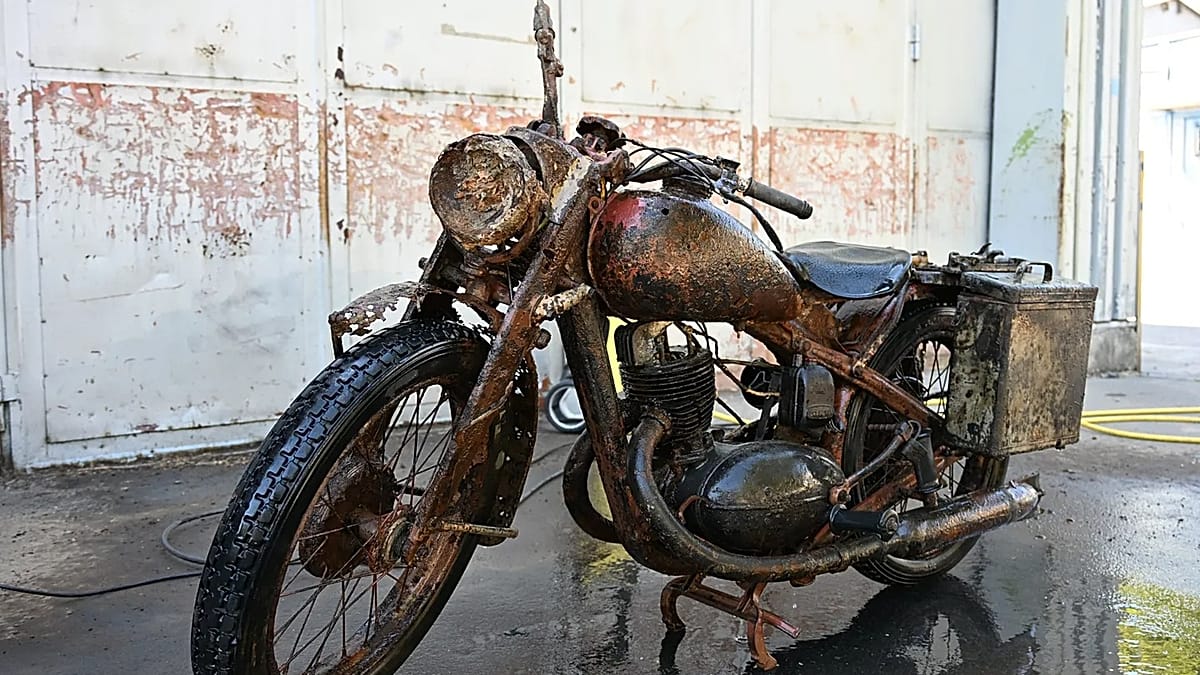
Photographs of a wartime motorcycle lifted from the receding waters of the Danube in Budapest have circled the globe, from Indian and Vietnamese news sites to British tabloids and American automotive platforms. The machine, a DKW NZ 350-1, was recovered on 2 August near Batthyány Square, directly opposite the Hungarian parliament, and is in remarkably good condition given its decades underwater.
The Hungarian Institute and Museum of Military History, which is overseeing the recovery, confirmed the model. The NZ 350-1 was a variant of the robust NZ 250 and NZ 350 series, which were prized by motorcyclists for their reliability. In 1944, DKW introduced the NZ 350-1 specifically for military use, and production continued until 1945, with just under 12,000 units built.
A machine shaped by war
The motorcycle's design reflects the exigencies of the Eastern Front. A small fin on the rear frame acted as a mud and snow scraper, preventing debris from clogging the chain drive—a lesson learned during the brutal Russian winters. The engine block was cast in grey iron, a material chosen partly because of wartime aluminium shortages. This particular example, saturated with water and mud when it was raised, weighed over 200 kilogrammes; it is now being cleaned and preserved in the museum's hangar in Budapest.
The find has also yielded personal effects: a petrol can, a Y-strap (a leather harness used to carry ammunition pouches and other gear), and a bayonet frog. Beneath the motorcycle lay the skeletal remains of two German soldiers, their identity tags intact. For the first time in more than eight decades, there is a real chance to establish who they were and what led to their deaths. A Kuban sleeve shield, awarded in 1943 to troops who fought in the Kuban bridgehead, was also discovered nearby.
From Zschopau to the Danube
The DKW brand traces its origins to Danish engineer Jørgen Skafte Rasmussen, who founded a mechanical engineering firm in Zschopau, Saxony, in 1907. The name DKW initially stood for Dampfkraftwagen (steam-powered vehicle), but by 1922 the company was producing two-stroke engines. It grew into one of Germany's leading motorcycle manufacturers, and in 1932 merged with Audi, Horch, and Wanderer to form Auto Union AG, with Zschopau remaining the centre of motorcycle production.
As the Nazis rearmed, DKW was drawn into military production. The NZ 350 was built in large numbers for the Wehrmacht, and the Zschopau plant's output was staggering: the 350,000th motorcycle rolled off the line in 1934, and the 500,000th in 1939. With the outbreak of war, civilian production was curtailed in favour of military needs. The motorcycle now recovered from the Danube dates from this late phase of the conflict.
After the war, the Zschopau plant was dismantled by Soviet occupation forces, with machinery shipped to the USSR. DKW engineers were taken to Izhevsk, where they helped establish motorcycle production. The NZ 350's legacy lived on in the Soviet IZh-350, a near-copy that was manufactured from 1946, with more than 127,000 units built by 1951.
The recovery is part of a broader phenomenon this summer: record-low water levels in the Danube have exposed wrecks, sandbanks, and other relics across the region. In Budapest, the riverbed has even become an unlikely venue for parties, while further downstream in Serbia, boats have been stranded and sandbanks exposed. The drought has also had practical consequences, such as the temporary shutdown of Hungary's Paks nuclear plant, which relies on river water for cooling; operations have since resumed as water levels recovered.
The motorcycle's near-pristine condition—its leather saddle, speedometer, and even the paintwork largely intact—has astonished observers. As the museum's conservators work to stabilise the machine, the hope is that the identity tags will provide answers about the two soldiers, closing a chapter that has remained open since the final months of the Second World War.