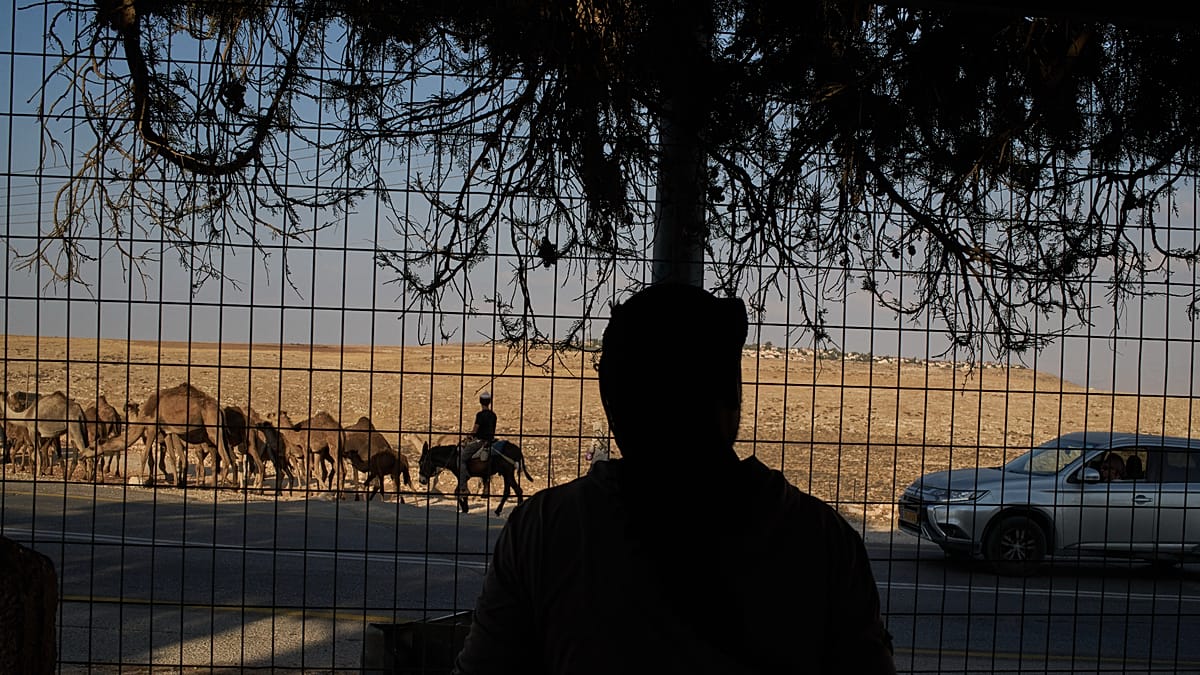
Israeli settlers are increasingly diverting natural springs across the occupied West Bank, cutting off water that Palestinian villages depend on for irrigation and income. In one case documented over the summer, a spring feeding the village of Fasayil, in the Jordan Valley, was siphoned into an ancient pool nearby that has been rebranded as a tourist attraction named after Herod, the Roman-appointed king of Judea.
Saad Nemer, a farmer from Fasayil, said the loss of the water had ruined his fields. COGAT, the Israeli military body responsible for civil affairs in the West Bank, has acknowledged that the diversion took place "without authorisation" and said it would investigate. The date of the pool's construction remains unclear; other ruins in the area have been dated by the archaeology unit of Israel's Civil Administration to the first century BCE, during Herod's reign.
A wider campaign around heritage sites
According to the Israeli rights group B'Tselem, the seizure of springs and archaeological sites forms part of a broader strategy to "elevate the historical, cultural, and religious ties of the State of Israel and the Jewish people to the West Bank." The pattern is not confined to water: settlers have damaged, destroyed or taken over roughly 160 Palestinian water and sanitation structures in 2026, according to a recent report from the United Nations Office for the Coordination of Humanitarian Affairs. The same report found that attackers are increasingly targeting shared infrastructure, disrupting supply to entire communities or large parts of them.
Amihai Eliyahu, Israel's far-right Heritage Minister, told the Associated Press that the pool would be drained in early October so that administration archaeologists could carry out a full survey. He praised those who diverted the water and said around $1 million could be allocated to rehabilitate the site. "We'll turn this place into the Garden of Eden," he said during a visit.
Twelve capitals move on settlement trade
Earlier this month, twelve countries announced new trade sanctions on Israeli settlements in the occupied West Bank, citing what they described as a "rapidly deteriorating" situation marked by mounting settler attacks on Palestinians. Canada, Denmark, Finland, Iceland, Ireland, Norway, Poland, Portugal, Spain and Sweden joined the United Kingdom and France in confirming plans to restrict trade with settlement enterprises, according to a joint statement from the countries' foreign ministers.
"The Government of Israel's actions in the West Bank are undermining the possibility of a two-State solution," the statement reads, pointing to "unprecedented levels of settler violence and settlement expansion."
The ministers added: "Together, we are resolute: the two-state solution must be protected, and we will take action in pursuit of a just and lasting peace." The coordinated move marks one of the broadest European-led economic responses to settlement activity to date, drawing in Nordic, central European and Mediterranean states alongside London and Paris.
Violence in the West Bank has surged since the war in Gaza began, following the Hamas attacks on Israel on 7 October 2023. According to the Office of the United Nations High Commissioner for Human Rights, there were around 737,000 Israeli settlers in the West Bank, including East Jerusalem, as of October 2024. The humanitarian fallout has been compounded by military operations elsewhere in the Palestinian territories, with repeated strikes on Gaza camps displacing civilians and destroying shelters.
For European governments, the spring seizures sharpen a dilemma that has divided the EU since 2023: how to press Israel over settlement expansion without fracturing a common foreign policy. The joint sanctions statement stops short of EU-wide measures, relying instead on a coalition of the willing that includes several member states and two non-EU partners. Whether that coalition can translate declarations into enforceable trade restrictions — and whether Washington follows — will determine how much pressure Israeli authorities feel over the coming months.
Water access in the West Bank has been restricted since Israel took control in 1967, and Palestinian communities have long faced shortages. The diversion of springs such as Fasayil's adds a new layer to an old dispute, one in which archaeology, tourism and agriculture are increasingly intertwined with the politics of land. As the pool near Fasayil awaits its survey, the farmers downstream are left to reckon with fields that no longer receive water.