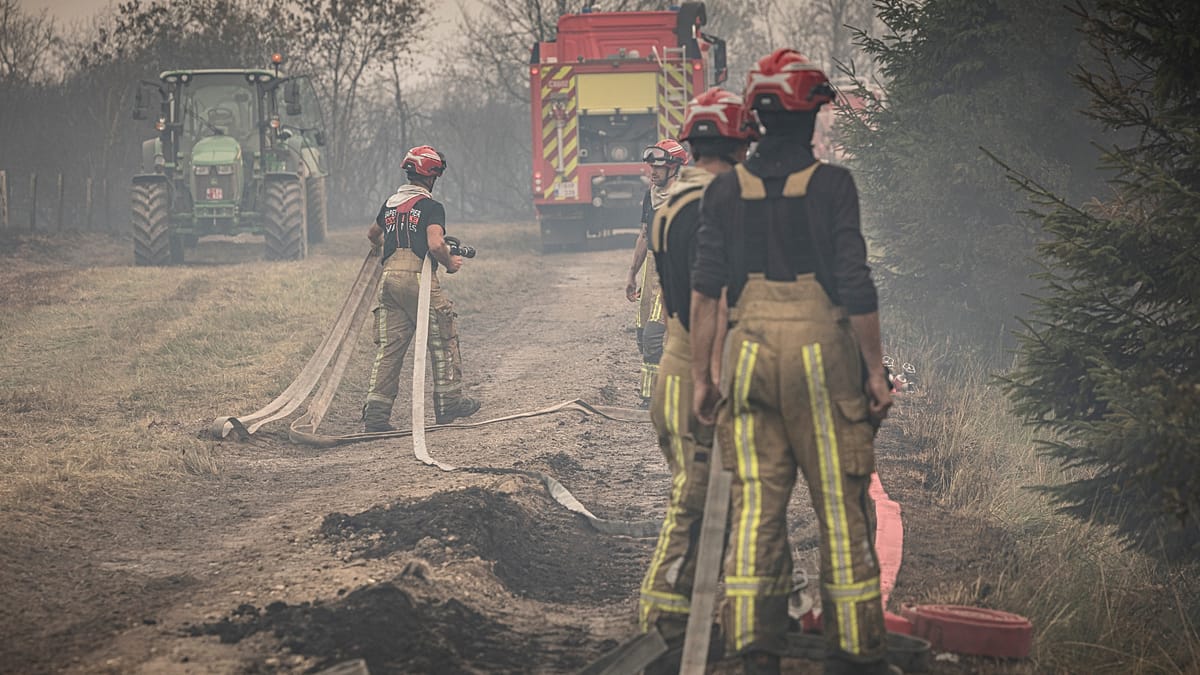
Firefighting crews in eastern Belgium are locked in a race against time as a large wildfire, fanned by dry conditions and shifting winds, pushes toward the German border. The blaze, which broke out in the heavily forested region near the High Fens plateau, has already consumed hundreds of hectares and forced the closure of several roads and hiking trails.
Local authorities in the province of Liège have requested reinforcements from neighbouring regions, including Walloon Brabant and Flanders, as well as support from the Belgian military. Helicopters have been deployed to drop water on the most inaccessible fronts, but thick smoke has at times grounded aerial operations, leaving ground crews to battle the flames in treacherous terrain.
Difficult terrain and shifting winds
The High Fens, a peat-rich moorland straddling the border between Belgium and Germany, is notoriously difficult to fight fires in. The spongy ground can hide smouldering roots, and the region's steep valleys can funnel winds in unpredictable directions, causing flames to jump firebreaks. "The terrain is extremely challenging," said a spokesperson for the Walloon fire service. "We are dealing with a fire that can change direction in minutes."
Residents in several small villages on both sides of the border have been advised to keep windows closed and avoid outdoor activity as smoke drifts across the area. In Germany, the state of North Rhine-Westphalia has been monitoring the situation closely, with fire crews on standby in case the fire crosses the frontier.
The blaze is the latest in a series of wildfires that have battered Europe this summer, as a prolonged heatwave and drought have left vegetation tinder-dry across much of the continent. Scientists point to climate change as a key driver of these extreme conditions, which are making wildfires more frequent and more intense even in regions traditionally considered too wet to burn.
Belgium has seen a number of significant wildfires in recent years, including a major blaze in the High Fens in 2020 that was described as the country's largest in a century. That fire, which also threatened to spread into Germany, was eventually contained after several days of intense effort. The current fire is being compared to that event, though officials caution that conditions are different this time.
"We are better prepared than we were a few years ago," said a spokesperson for the Belgian Crisis Centre. "But the scale of this fire is a reminder that we need to invest more in prevention and in firefighting capacity." Indeed, a recent analysis of EU firefighter numbers has highlighted stark gaps in the continent's ability to respond to large-scale blazes, with some countries relying heavily on volunteer crews.
The European Union has activated its Civil Protection Mechanism, which can coordinate the deployment of firefighting aircraft and teams from other member states. However, with several countries in southern Europe also battling major fires, resources are stretched thin. "We are monitoring the situation and are ready to assist if needed," said a spokesperson for the European Commission.
For now, the immediate priority is to protect the small communities scattered across the region. In the village of Mont Rigi, just a few kilometres from the fire front, residents have been preparing evacuation plans. "We are used to the fog and the rain here, not to this," said one local shopkeeper. "It feels like the climate is changing right before our eyes."
Firefighters are also concerned about the risk of unexploded ordnance from the two world wars, which has been exposed by wildfires across Europe in recent years. The High Fens saw heavy fighting during the Battle of the Bulge, and munitions are occasionally found in the area. Crews have been advised to be cautious when digging firebreaks.
As night falls, the fire continues to burn, visible as an orange glow on the horizon. Officials say the coming days will be critical, with weather forecasts predicting little rain and continued high temperatures. "We are doing everything we can," said the Walloon fire service spokesperson. "But this fire is a stark reminder that no country in Europe is immune to the growing threat of wildfires."