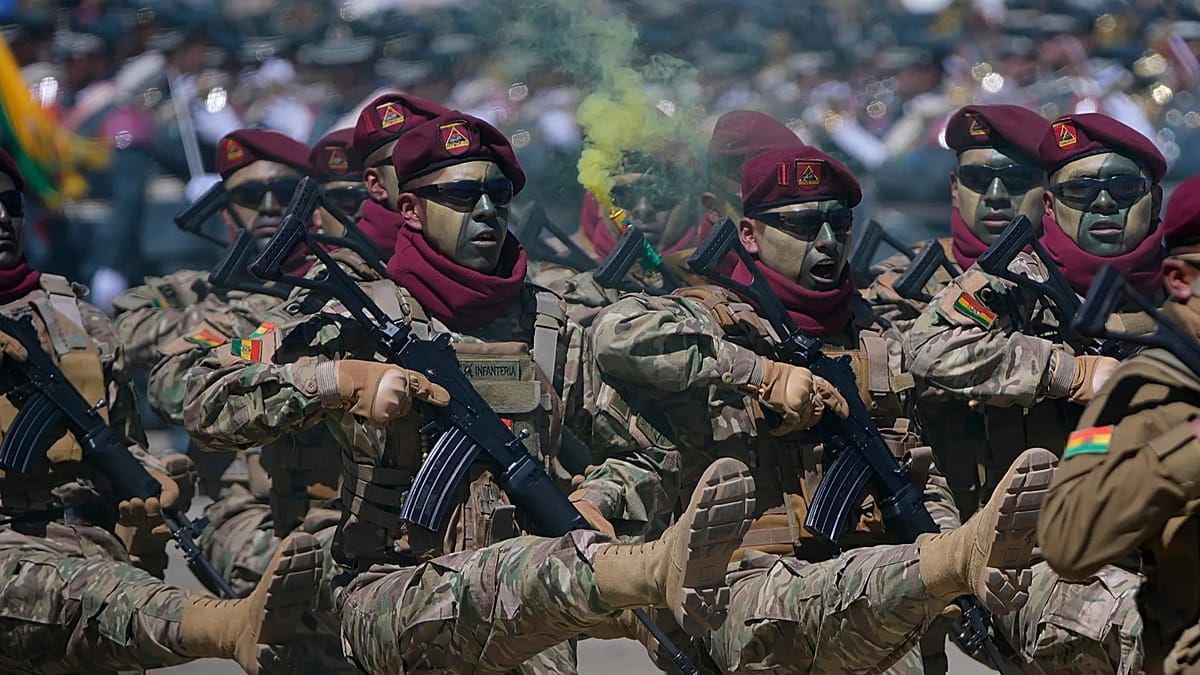
At least two people have died and 81 others were injured after two explosions ripped through an army base in Bolivia on Friday, according to authorities. The blasts occurred at the RAM-2 “Bolívar” General Maintenance Center in Viacha, a town southwest of the administrative capital La Paz.
Bolivia’s Defence Minister, Ernesto Justiniano, told reporters that the site was used to store pyrotechnic material. He stressed that “no weaponry of any kind was detonated” during the incident. The first explosion, he said, “involved black powder from pyrotechnic material stored at the site,” while the second, “much larger” blast was still being investigated.
Justiniano said the priority was to protect people and care for the wounded. “The most important thing tonight is to protect people, attend to the injured, continue the search for those who have not yet been located, and ensure that families can return to their homes only when conditions are safe,” he told reporters. He added that seven people remained missing.
Video footage circulating on social media, which appears to capture one of the blasts, shows a massive explosion and a thick plume of smoke rising into the air. The scale of the second blast has raised concerns about the potential for further casualties as search efforts continue.
President orders investigation
Bolivia’s President, Rodrigo Paz, expressed his “deepest sympathy” with the families of the victims and those injured in a post on X. He also announced that he had ordered a thorough and transparent investigation. “We must establish with absolute clarity the causes of this incident, verify compliance with safety protocols, and determine who is responsible,” he wrote.
The incident comes as Bolivia, like many countries in Latin America, grapples with questions about military infrastructure and safety standards. While the immediate focus is on the victims and their families, the investigation will likely scrutinise how pyrotechnic materials were stored and whether proper protocols were followed.
For European readers, the tragedy is a reminder of the risks inherent in military logistics and the importance of stringent safety regulations, a topic that has also resonated in Europe following incidents such as the explosion at Augsburg station that injured at least two people. In Germany, authorities have been investigating a range of security threats, including arson attacks on defence firms, as seen in Munich, where police arrested two suspects.
While Bolivia is not part of the European Union, the country maintains diplomatic and economic ties with Europe, and the safety of military installations is a universal concern. The European Union has also been focusing on defence and security, with recent discussions on air defence packages for Ukraine and civil defence drills in Finland highlighting the importance of preparedness.
As the investigation unfolds, Bolivian authorities are expected to provide more details on the cause of the explosions and the condition of the injured. The international community, including European nations, will be watching closely, given the broader implications for military safety standards worldwide.