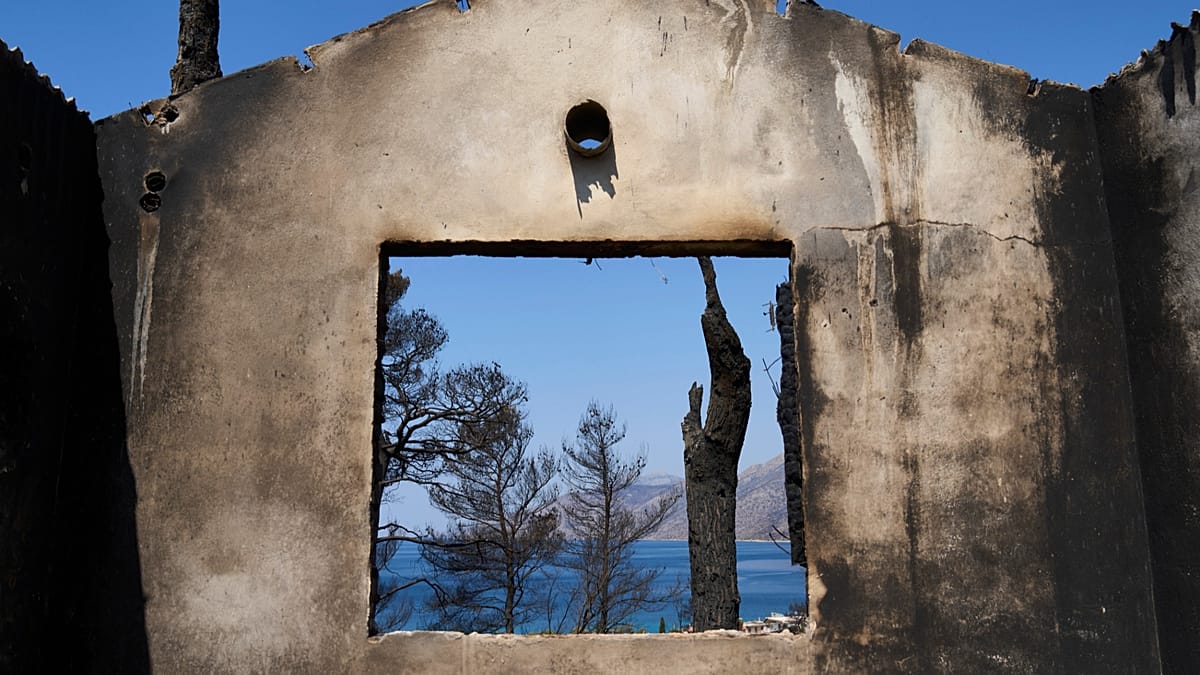
Greek authorities and residents in the region west of Athens are beginning to tally the destruction left by a wildfire that has scorched more than 14,000 hectares since Friday. The blaze, which reached the outskirts of Megara and the seaside resort of Porto Germeno, has destroyed dozens of homes and vast stretches of farmland and forest.
Prime Minister Kyriakos Mitsotakis is expected to chair a cabinet meeting later on Wednesday to discuss compensation for those affected, according to his office. Teams from the Environment and Civil Protection ministries have been dispatched to assess communities roughly 50 kilometres northwest of the capital, where residents are returning after preventive evacuations, public broadcaster Ertnews reported.
Fire service spokesman Vassilis Vathrakoyannis told AFP on Wednesday that “the situation in the region is much better,” though firefighters remain on maximum alert to deal with areas where smoke is still rising. The smell of smoke still hung over Porto Germeno, where a large part of the formerly forested hillsides has been reduced to ash, and AFP reporters observed that dozens of houses had been gutted by the flames.
The fire, fanned by wind gusts of up to 130 kilometres per hour, spread rapidly towards the southern slopes of Mount Kithairon and reached Megara, an industrial and agricultural town about 40 kilometres from Athens. The blaze started on Friday with a spark on power cables managed by a private company in Agios Vasileios, a seaside village at the foot of a mountain 85 kilometres northwest of Athens, according to an initial investigation by the fire service.
Arrests for negligence and suspected arson
Greek authorities have been battling dozens of fires across the country since late July, following devastating blazes in Spain and France. The fires have claimed five lives, including three firefighters and the two crew members of a helicopter that crashed while fighting the flames. The helicopter crash underscored the dangers faced by crews operating in extreme conditions.
Officials say 33 people were arrested between 29 June and 2 August for starting fires, 30 through negligence and three on suspicion of arson. Most of the negligence cases involved farm work carried out despite local bans, including welding. Restrictions and park closures are imposed locally according to fire-risk levels, but enforcement remains a challenge.
On Tuesday, crews were working against the clock, as winds typically pick up in the afternoon—a coastal phenomenon common across the Mediterranean in summer, when land heats faster than the sea and draws in stronger breezes. The army deployed tracked earth movers to carve fire breaks across the scorched hillsides, while specialist units pushed into forest areas on foot to extinguish smouldering embers before they could reignite.
The evacuations from around Porto Germeno and other areas west of the capital included more than 250 people rescued by boats from beaches, as flames cut off some escape routes. The easing of winds earlier in the week allowed crews to gain some control, but the forecast for stronger gusts has put everyone on edge.
Greece is no stranger to summer wildfires, but the intensity and scale of this year's blazes have raised concerns about the impact of climate change on the Mediterranean region. The heatwave that has gripped southern Europe has created tinderbox conditions, and experts warn that such events are likely to become more frequent and severe.
As the immediate threat recedes, the focus shifts to recovery and rebuilding. For residents like those in Porto Germeno, the loss is personal. “We have nothing left,” one local told reporters, standing amid the charred remains of what was once a home. The government has promised swift compensation, but for many, the road to recovery will be long.
The fire has also reignited debates about land management and prevention. Some experts point to regenerative farming practices as a potential shield against future blazes, while others call for better maintenance of power infrastructure and stricter enforcement of fire-safety regulations. For now, though, the immediate priority is to ensure that the flames do not flare up again.