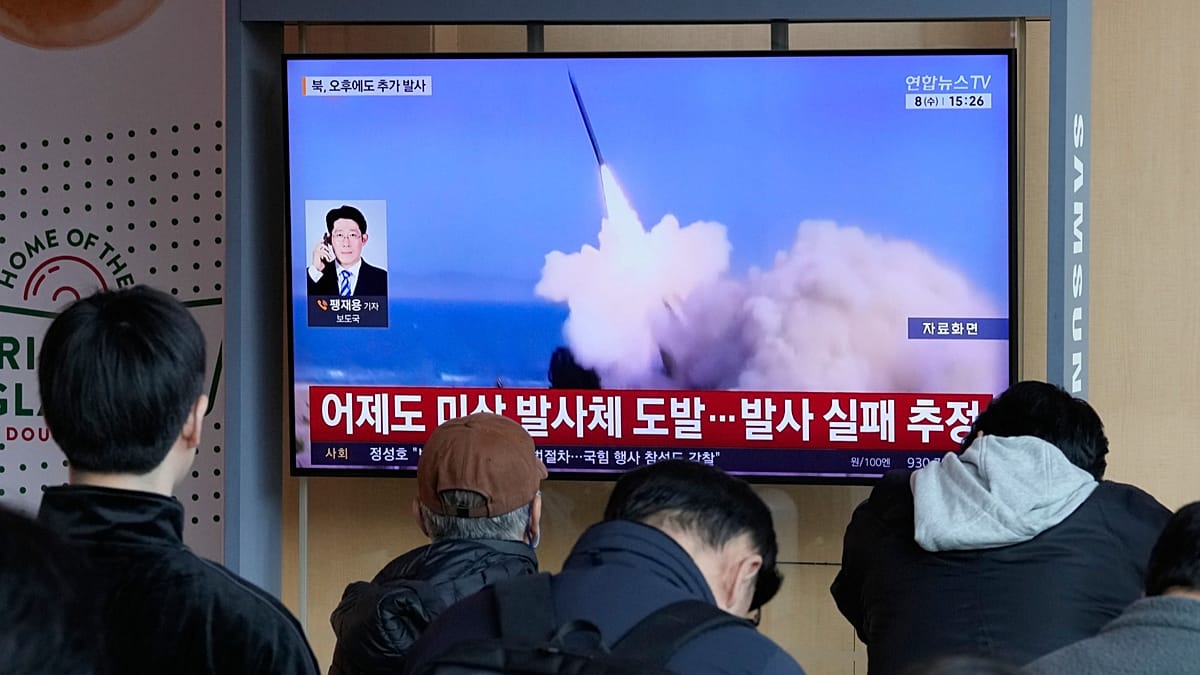
North Korea fired at least one short-range ballistic missile into the Sea of Japan on Thursday, according to South Korea's Joint Chiefs of Staff (JCS). The launch, detected from the Wonsan area at around 5:00 pm local time, was reported in a message to news organizations. The JCS said the missile was directed toward the East Sea, the Korean name for the body of water also known as the Sea of Japan.
Japan's defense ministry confirmed the launch, posting on X that "something that may be a ballistic missile has been launched from North Korea." A subsequent post noted that "there is no longer any impact on the areas around Japan." The JCS said Seoul has strengthened surveillance and maintained readiness for possible additional launches, while sharing information with its security allies, the United States and Japan.
Regional tensions escalate
The launch comes days after North Korean officials lambasted Japan for its military expansion. Tokyo's Defense Minister Shinjiro Koizumi said earlier this week that Japan's military needs to be boosted with a "sense of urgency and crisis," following a government assessment warning of growing threats from China, Russia, and North Korea. In a statement carried by North Korean state media on Wednesday, Kim Yo-jong, the powerful sister of leader Kim Jong-un, said Pyongyang's "leadership will set up additional military options which are obviously due to Japan's transformation."
Japan's defense ministry declined to comment directly on Kim Yo-jong's remarks but said the country's defense capabilities "remain bare minimum" and "are not meant to threaten other countries." In a statement, the ministry emphasized: "Ours isn't the defence meant to wage wars, but to prevent new wars, strictly kept to self-defence and within the scope of our (pacifist) Constitution and international laws."
Tokyo raised its military expenditure by 9.7% to $62.2 billion (€53.8 billion) in 2025, equivalent to 1.4% of GDP, its highest share since 1958. China, a key ally of North Korea, has also expressed alarm at what it sees as "new militarism" by Japan.
Nuclear ambitions and diplomatic stalemate
North Korea has repeatedly declared itself an "irreversible" nuclear state since leader Kim Jong-un's 2019 summit with US President Donald Trump collapsed over the scope of denuclearisation and sanctions relief. The regime has also deepened economic and military ties with Russia, supplying troops and munitions for Moscow's war in Ukraine in exchange for financial support, food, energy, and military technology, according to analysts. This cooperation has raised concerns in European capitals, particularly as Ukraine faces relentless missile attacks and deadly strikes on Kyiv.
South Korea's dovish President Lee Jae Myung, who took office in June 2025, has reversed the stance of his hawkish predecessor by offering nuclear-armed Pyongyang talks without preconditions. The hermetic leadership of North Korea has yet to respond to his repeated offers. The two Koreas remain technically at war because their 1950-53 conflict ended with an armistice rather than a peace treaty.
North Korea has also repeatedly branded Seoul, a security ally of Washington, its "most hostile" enemy. The latest missile launch underscores the fragility of peace on the Korean Peninsula and the broader security implications for Europe, where NATO allies monitor North Korean weapons transfers to Russia. As Kim Yo-jong's warnings suggest, further provocations may be imminent, keeping regional and global observers on edge.