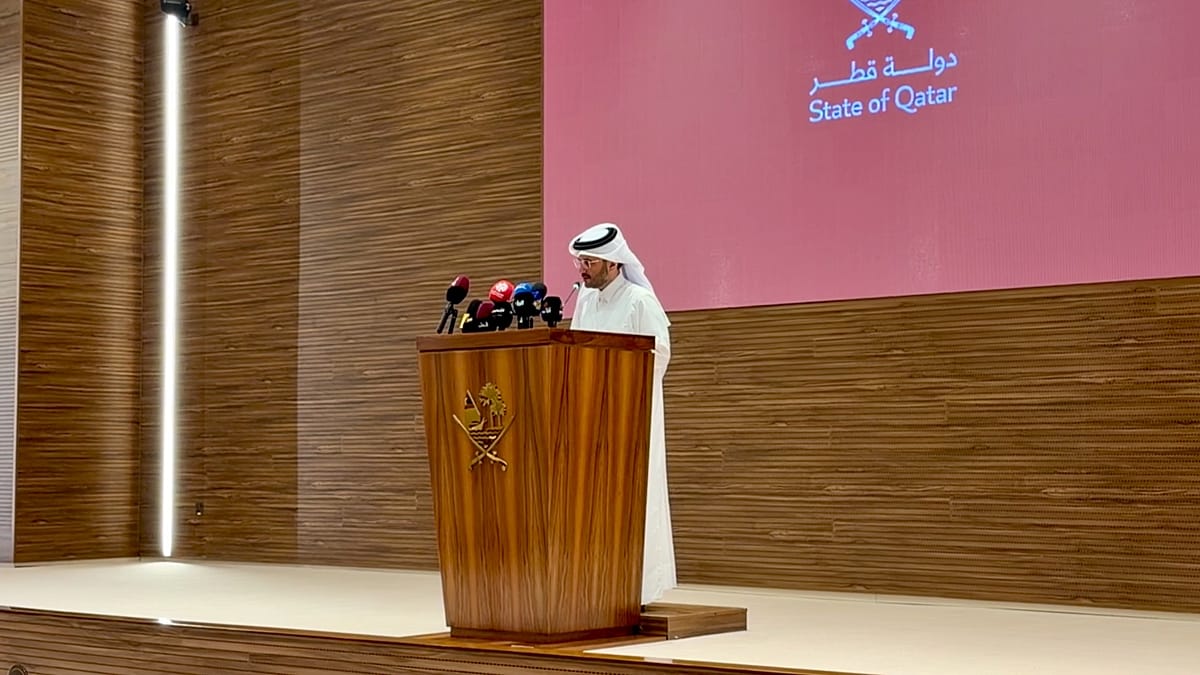
Qatar's foreign ministry said on Tuesday that regional efforts to broker a short-term agreement between the United States and Iran are at an advanced stage, with draft language being exchanged through mediators. The goal is to prevent further escalation and restart direct negotiations, though no face-to-face talks are currently planned.
Speaking to reporters in Doha, ministry spokesman Dr Majed Al Ansari said Qatar is working closely with Oman and Pakistan to shuttle ideas and proposals between Washington and Tehran. "The whole region is now working together," he said, adding that the immediate focus is on avoiding escalation, reopening the Strait of Hormuz, and "reopening the door for diplomacy."
Al Ansari's comments come amid conflicting statements from the two capitals. US President Donald Trump claimed on Monday that talks were ongoing and described the diplomatic push as Iran's "last chance" to reach an agreement before further military action. Tehran, for its part, has denied negotiating directly with Washington, though it acknowledges discussions with Oman over navigation through the strait.
Al Ansari confirmed that no direct US-Iran talks are scheduled, but said mediators continue to pass proposals between the sides. "We remain hopeful that if we can get a resumption of the talks any time soon, we would be able to push forward towards a major deal that would help us walk back into a situation of peace in our region," he said.
Oman has taken on a more prominent role in the mediation over the past two weeks, with Doha coordinating closely with Muscat. "The mediators, Qatar, Pakistan and now Oman, are all working together on that issue," Al Ansari said. He declined to confirm whether a complete draft agreement exists, but noted that "language has been drafted on a possible agreement and is being circulated between the parties."
Focus on free navigation in Hormuz
The immediate priority is securing a short-term arrangement that would allow the Strait of Hormuz to reopen to commercial shipping. Shipping traffic has been severely disrupted by restrictions and attacks on vessels, including a cargo ship that reported being struck by an unknown projectile off Oman early Tuesday, according to the UK Maritime Trade Operations agency.
Al Ansari stressed that Qatar cannot accept any change to the status quo in the strait. "We are looking towards a diplomatic resolution that would allow all to use the Strait of Hormuz the way they have always used it," he said. He added that any future management system, including possible financial arrangements, must comply with international law and be agreed across the region. "It has to be in coordination with all the regional countries, not one or two or any section of them."
The waterway, he said, must never again be used as "a tool of political extortion or diplomatic extortion, or as leverage against any regional or international players." Qatar would support a new management arrangement if all regional countries agreed to it.
The stakes are high for European energy security, as a significant share of LNG and oil shipments from the Gulf pass through Hormuz. Recent incidents, including a second Qatari LNG tanker hit in the strait, have raised concerns in Brussels and national capitals about supply disruptions.
Qatar urges pressure on Israel over Gaza roadmap
In a separate development, Al Ansari called on the international community to press Israel to fully implement the Gaza roadmap, saying Hamas and the Palestinian side have complied with what was agreed. "On Hamas's side and the Palestinian side, we have seen adherence to everything that was agreed on the roadmap," he said. "The expectation is that Israel would do the same."
He urged the international community to "put the right pressure on Israel to implement the plan," and called for Israel to withdraw from Gaza and other occupied territory. "This occupation cannot be justified by any current or past security situations," Al Ansari said.
The Qatari comments come as regional diplomacy intensifies, with European governments watching closely. The EU has been involved in efforts to stabilise the region, including talks on Hezbollah disarmament and broader security arrangements. Meanwhile, the situation in the Red Sea remains tense, with Houthi threats of full escalation adding to the volatility.
For now, Qatar's message is one of cautious optimism. "Our focus right now is on avoiding escalation, reopening the strait and reopening the door for diplomacy between the parties," Al Ansari said. "What we don't want to see right now is a major escalation in our region and the events are leading in the opposite direction."